Looking for classes? Ksquare Career Institute, Bengaluru →

Physics
Motion in a Plane
56 questions from 29 papers, each with its answer.
- 56 questions
- 29 papers
- 3.17% of Physics
Addition of vectors
-
Six vectors, $\vec{a}$ through $\vec{f}$ have the magnitudes and directions indicated in the figure. Which of the following statements is true?
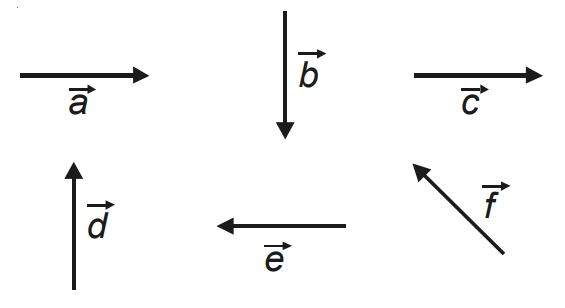 By the triangle law, if two vectors are drawn head to tail, their sum is the vector drawn from the tail of the first to the head of the second.
Using the magnitudes and directions shown in the figure, place the tail of $\vec{e}$ at the head of $\vec{d}$.
The vector from the tail of $\vec{d}$ to the head of $\vec{e}$ then has the same magnitude and direction as $\vec{f}$.
The other combinations ($\vec{b} + \vec{e}$, $\vec{b} + \vec{c}$, $\vec{d} + \vec{c}$) give resultants that do not coincide with $\vec{f}$ in direction.
Hence $\vec{d} + \vec{e} = \vec{f}$.
Motion in a plane with constant acceleration
-
A particle has initial velocity $(3\hat{i} + 4\hat{j})$ and has acceleration $(0.4\hat{i} + 0.3\hat{j})$. Its speed after 10 s is$\vec{v} = \vec{u} + \vec{a}t$
$\vec{v} = (3\hat{i} + 4\hat{j}) + (0.4\hat{i} + 0.3\hat{j})\times10$
$\vec{v} = (3 + 4)\hat{i} + (4 + 3)\hat{j} = 7\hat{i} + 7\hat{j}$
Speed $= |\vec{v}| = \sqrt{7^2 + 7^2} = \sqrt{98}$
$= 7\sqrt{2}$ units
That is every question in Motion in a Plane for this filter.
Want a score?
Answers here are not saved. Practise as a test to be marked and see your progress.
Practise as a test