Looking for classes? Ksquare Career Institute, Bengaluru →

Relative velocity
Concepts tested here
- Condition for collision
- Minimum distance between moving bodies
All Questions
2015 AIPMT-I 1 question
-
A ship A is moving westwards with a speed of 10 km $h^{-1}$ and a ship B 100 km south of A is moving northwards with a speed of 10 km $h^{-1}$. The time after which the distance between them becomes shortest is$\vec v_A = 10(-\hat i)$ km/h and $\vec v_B = 10\hat j$ km/h.
Velocity of B relative to A: $\vec v_{BA} = 10\hat j + 10\hat i$, so $|\vec v_{BA}| = \sqrt{10^2 + 10^2} = 10\sqrt{2}$ km/h, directed at $45^\circ$.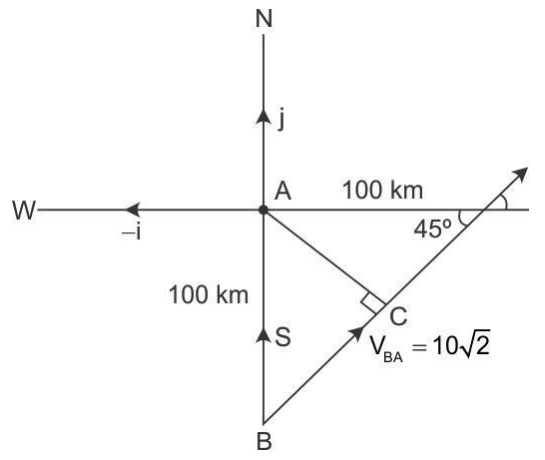
Relative to A, B moves along BC; the distance is least when B reaches the foot C of the perpendicular from A.
$BC = 100\cos 45^\circ = 50\sqrt{2}$ km
$t = \frac{50\sqrt{2}}{10\sqrt{2}} = 5$ h
2015 AIPMT-II 1 question
-
Two particles A and B, move with constant velocities $\vec u_1$ and $\vec u_2$. At the initial moment their position vectors are $\vec r_1$ and $\vec r_2$ respectively. The condition for particles A and B for their collision is:For collision, the velocity of B relative to A must point along the position of A relative to B.
Direction of relative position of A w.r.t. B: $\frac{\vec r_1 - \vec r_2}{|\vec r_1 - \vec r_2|}$
Direction of velocity of B w.r.t. A: $\frac{\vec u_2 - \vec u_1}{|\vec u_2 - \vec u_1|}$
Condition: $\frac{\vec r_1 - \vec r_2}{|\vec r_1 - \vec r_2|} = \frac{\vec u_2 - \vec u_1}{|\vec u_2 - \vec u_1|}$