Looking for classes? Ksquare Career Institute, Bengaluru →

Uniform circular motion – vector analysis
Concepts tested here
- circular-motion-velocity-acceleration-vectors
All Questions
2016 1 question
-
A particle moves so that its position vector is given by $\vec{r} = \cos\omega t\,\hat{x} + \sin\omega t\,\hat{y}$, where $\omega$ is a constant. Which of the following is true?
$\vec{a} = -\omega^2\vec{r}$ and $\vec{v}\cdot\vec{r} = 0$.
$\vec{v} = \frac{d\vec{r}}{dt} = \omega(-\sin\omega t\,\hat{x} + \cos\omega t\,\hat{y})$ ...(ii)
$\vec{a} = \frac{d\vec{v}}{dt} = -\omega^2(\cos\omega t\,\hat{x} + \sin\omega t\,\hat{y}) = -\omega^2\vec{r}$ ...(iii)
So the acceleration is antiparallel to r, i.e. directed towards the origin.
$\vec{v}\cdot\vec{r} = \omega(-\sin\omega t\cos\omega t + \sin\omega t\cos\omega t) = 0$, so the velocity is perpendicular to r.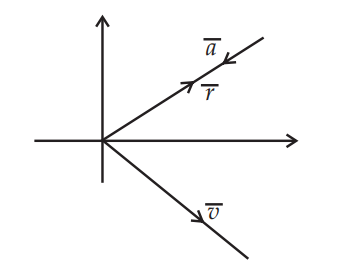
Hence the velocity is perpendicular to r and the acceleration is directed towards the origin.