Looking for classes? Ksquare Career Institute, Bengaluru →

Motion in a Plane
Projectile Motion
12 questions from 12 papers, each with its answer.
- questions
- 12
- papers
- 12
- years asked, 2017–2026
- 3 of 10
- of Motion in a Plane
- 21.43%
Appears in
Concepts tested
- angle of projection from maximum height
- Change in momentum of a projectile
- Identical trajectories
- KE at highest point
- Maximum height and range
- maximum height of a projectile
- Maximum range
- Range equal to maximum height
- Range for complementary angles
- speed at highest point
- Velocity at the highest point
- Velocity at the point of landing
All Questions
2023 1 question
-
A bullet is fired from a gun at the speed of $280\ m/s$ in the direction $30^\circ$ above the horizontal. The maximum height attained by the bullet is ($g=9.8\ ms^{-2}$, $\sin30^\circ=0.5$)
$h_{max}=\frac{u^2\sin^2\theta}{2g}=1000\ m$.
$h_{max}=\frac{u^2\sin^2\theta}{2g}=\frac{280\times280}{2\times9.8}\times\frac{1}{4}=1000\ m$
2022 1 question
-
A ball is projected with a velocity, $10\ ms^{-1}$, at an angle of $60^\circ$ with the vertical direction. Its speed at the highest point of its trajectory will be :At the highest point, only the horizontal component of velocity remains. Angle with the horizontal $\theta = 90^\circ - 60^\circ = 30^\circ$ $u_x = u\cos\theta = 10\cos 30^\circ = 5\sqrt{3}\ ms^{-1}$
2021 1 question
-
A particle moving in a circle of radius $R$ with a uniform speed takes a time $T$ to complete one revolution. If this particle were projected with the same speed at an angle $\theta$ to the horizontal, the maximum height attained by it equals $4R$. The angle of projection, $\theta$, is then given by:Speed in circular motion: $T = \frac{2\pi R}{v} \Rightarrow v = \frac{2\pi R}{T}$ $H_{max} = \frac{v^2\sin^2\theta}{2g} = \frac{4\pi^2R^2\sin^2\theta}{2gT^2} = \frac{2\pi^2R^2\sin^2\theta}{gT^2} = 4R$ $\sin\theta = \left(\frac{2gT^2}{\pi^2R}\right)^{1/2}$ $\theta = \sin^{-1}\left(\frac{2gT^2}{\pi^2R}\right)^{1/2}$
2014 AIPMT 1 question
-
A projectile is fired from the surface of the earth with a velocity of 5 $ms^{-1}$ and angle $\theta$ with the horizontal. Another projectile fired from another planet with a velocity of 3 $ms^{-1}$ at the same angle follows a trajectory which is identical with the trajectory of the projectile fired from the earth. The value of the acceleration due to gravity on the planet is (in $ms^{-2}$) (given g = 9.8 $ms^{-2}$)Range $= \frac{u^2\sin2\theta}{g}$; for identical trajectories at the same angle, $g \propto u^2$.
$g_{planet} = \left(\frac{3}{5}\right)^2\times 9.8 = 3.5$ $ms^{-2}$
2013 NEET 1 question
-
The velocity of a projectile at the initial point A is $(2\hat i + 3\hat j)$ m/s. Its velocity (in m/s) at point B is:
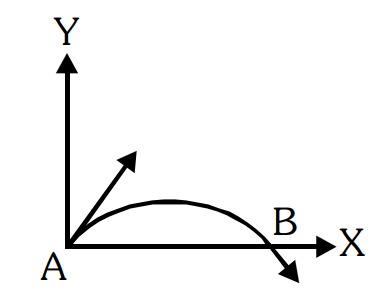 B is at the same level as A. The horizontal component of velocity stays the same and the vertical component is reversed.
So the velocity at B is $2\hat i - 3\hat j$ m/s.
2012 AIPMT-PRE 1 question
-
The horizontal range and the maximum height of a projectile are equal. The angle of projection of the projectile isMaximum height $H = \frac{u^2\sin^2\theta}{2g}$; range $R = \frac{2u^2\sin\theta\cos\theta}{g}$
H = R: $\frac{u^2\sin^2\theta}{2g} = \frac{2u^2\sin\theta\cos\theta}{g}$
$\sin\theta = 4\cos\theta \Rightarrow \tan\theta = 4$
$\theta = \tan^{-1}(4)$
2011 AIPMT-MAINS 1 question
-
A projectile is fired at an angle of $45^\circ$ with the horizontal. Elevation angle of the projectile at its highest point as seen from the point of projection isAt the highest point the projectile is at height H and at horizontal distance $\frac{R}{2}$ from the point of projection.
$H = \frac{u^2\sin^2\theta}{2g}$ and $R = \frac{2u^2\sin\theta\cos\theta}{g}$
Elevation angle $\phi$: $\tan\phi = \frac{H}{R/2} = \frac{u^2\sin^2\theta/2g}{u^2\sin\theta\cos\theta/g}$
$\tan\phi = \frac{\tan\theta}{2}$
With $\theta = 45^\circ$: $\tan\phi = \frac{\tan45^\circ}{2} = \frac{1}{2}$
$\phi = \tan^{-1}\frac{1}{2}$
2011 AIPMT-PRE 1 question
-
A missile is fired for maximum range with an initial velocity of 20 m/s. If g = 10 m/$s^2$, the range of the missile isRange of a projectile: $R = \frac{u^2\sin2\theta}{g}$
The range is maximum when $\sin2\theta = 1$, i.e., $\theta = 45^\circ$.
$R_{max} = \frac{u^2}{g}$
$R_{max} = \frac{(20)^2}{10} = \frac{400}{10}$
$R_{max} = 40$ m
2010 AIPMT-MAINS 1 question
-
The speed of a projectile at its maximum height is half of its initial speed. The angle of projection isLet the initial speed be $v_0$ and the angle of projection be $\theta$.
At the maximum height the vertical component of velocity is zero; only the horizontal component remains: $v = v_0\cos\theta$
Given $v = \frac{v_0}{2}$: $\frac{v_0}{2} = v_0\cos\theta$
$\cos\theta = \frac{1}{2}$
$\theta = 60^\circ$
2008 AIPMT 1 question
-
A particle of mass $m$ is projected with velocity $v$ making an angle of $45^\circ$ with the horizontal from level ground. When the particle lands on the level ground, the magnitude of the change in its momentum will be -Only the vertical component of velocity changes during projectile motion, so the change in momentum is in the vertical direction only.
Horizontal component of velocity: $v_x = v\cos 45^\circ$. It stays constant throughout the flight, so $\Delta p_x = 0$.
Vertical component at the time of projection: $v_{iy} = +v\sin 45^\circ$ (upward).
Vertical component when the particle lands on the same level: $v_{fy} = -v\sin 45^\circ$ (downward).
Initial vertical momentum: $p_{iy} = mv\sin 45^\circ$.
Final vertical momentum: $p_{fy} = -mv\sin 45^\circ$.
Change in momentum: $\Delta \vec{p} = (p_{fy} - p_{iy})\,\hat{j} = (-mv\sin 45^\circ - mv\sin 45^\circ)\,\hat{j} = -2mv\sin 45^\circ\,\hat{j}$
$|\Delta \vec{p}| = 2mv \times \dfrac{1}{\sqrt{2}} = \sqrt{2}\,mv$
The negative sign only shows that the change in momentum is directed vertically downward (along $-y$).
So the magnitude of the change in momentum is $\sqrt{2}\,mv$.
2006 AIPMT-PRE 1 question
-
For angles of projection of a projectile at angles $(45^\circ - \theta)$ and $(45^\circ + \theta)$, the horizontal ranges described by the projectile are in the ratio of :Horizontal range: $R = \dfrac{u^2\sin 2\alpha}{g}$
$R_1 = \dfrac{u^2\sin 2(45^\circ - \theta)}{g} = \dfrac{u^2\sin(90^\circ - 2\theta)}{g} = \dfrac{u^2\cos 2\theta}{g}$
$R_2 = \dfrac{u^2\sin 2(45^\circ + \theta)}{g} = \dfrac{u^2\sin(90^\circ + 2\theta)}{g} = \dfrac{u^2\cos 2\theta}{g}$
$\dfrac{R_1}{R_2} = \dfrac{\cos 2\theta}{\cos 2\theta} = 1$
In other words, $(45^\circ - \theta)$ and $(45^\circ + \theta)$ are complementary angles (their sum is $90^\circ$), and for complementary angles of projection the range is the same.
So the ranges are in the ratio 1 : 1.
2001 AIPMT 1 question
-
A particle is projected making angle $45^\circ$ with horizontal having kinetic energy K. The kinetic energy at highest point will be : -At the highest point, the vertical component of velocity is zero and only the horizontal component $u\cos\theta$ remains.
$K' = \dfrac{1}{2}m(u\cos\theta)^2 = K\cos^2\theta$
$K' = K\cos^2 45^\circ = K\left(\dfrac{1}{\sqrt{2}}\right)^2 = \dfrac{K}{2}$