Looking for classes? Ksquare Career Institute, Bengaluru →

Simple harmonic motion
Appears in
Concepts tested here
- Condition for SHM 2
- Displacement-time graph of SHM
- Phase difference
All Questions
2011 AIPMT-MAINS 1 question
-
Two particles are oscillating along two close parallel straight lines side by side, with the same frequency and amplitudes. They pass each other, moving in opposite directions when their displacement is half of the amplitude. The mean positions of the two particles lie on a straight line perpendicular to the paths of the two particles. The phase difference isLet the displacement of each particle be $x = A\sin\theta$, where $\theta$ is its phase.
When they cross, $x = \frac{A}{2}$ for both: $\frac{A}{2} = A\sin\theta$, so $\sin\theta = \frac{1}{2}$
$\theta = 30^\circ$ or $150^\circ$
Velocity is $v = A\omega\cos\theta$: at $\theta = 30^\circ$ the velocity is positive and at $\theta = 150^\circ$ it is negative.
Since the particles move in opposite directions, one has phase $30^\circ$ and the other $150^\circ$.
Phase difference = $150^\circ - 30^\circ = 120^\circ = \frac{2\pi}{3}$
2011 AIPMT-PRE 2 questions
-
A particle of mass m is released from rest and follows a parabolic path as shown. Assuming that the displacement of the mass from the origin is small, which graph correctly depicts the position of the particle as a function of time?
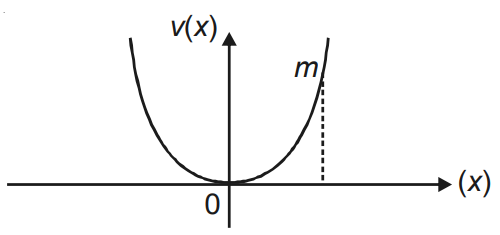 The potential energy curve is a parabola, $V(x) \propto x^2$, so the restoring force is $F = -\frac{dV}{dx} \propto -x$.
A force proportional to displacement and directed towards the origin gives simple harmonic motion about the origin.
The particle is released from rest at a point away from the origin, so at t = 0 it is at an extreme position: x is maximum and the velocity (slope of the x–t graph) is zero.
Hence $x(t) = A\cos\omega t$.
The correct graph is the cosine curve that starts from maximum displacement at t = 0 and oscillates about x = 0. -
Out of the following functions representing motion of a particle, which represents SHM?
(A) $y = \sin\omega t - \cos\omega t$
(B) $y = \sin^3\omega t$
(C) $y = 5\cos\left(\frac{3\pi}{4} - 3\omega t\right)$
(D) $y = 1 + \omega t + \omega^2t^2$A motion is SHM if the displacement is a single sine or cosine function of time, i.e., if $\frac{d^2y}{dt^2} \propto -y$.
(A) $y = \sin\omega t - \cos\omega t = \sqrt{2}\sin\left(\omega t - \frac{\pi}{4}\right)$: a single sine function, so it is SHM with angular frequency $\omega$.
(B) $y = \sin^3\omega t = \frac{1}{4}(3\sin\omega t - \sin3\omega t)$: a superposition of two SHMs of different frequencies; it is periodic but not SHM.
(C) $y = 5\cos\left(\frac{3\pi}{4} - 3\omega t\right) = 5\cos\left(3\omega t - \frac{3\pi}{4}\right)$: a single cosine function, so it is SHM with angular frequency $3\omega$.
(D) $y = 1 + \omega t + \omega^2t^2$: y keeps increasing with time, so the motion is not even periodic.
Hence only (A) and (C) represent SHM.
2010 AIPMT-PRE 1 question
-
The displacement of a particle along the x-axis is given by $x = a\sin^2\omega t$. The motion of the particle corresponds to$x = a\sin^2\omega t$
Velocity: $\frac{dx}{dt} = 2a\omega\sin\omega t\cos\omega t = a\omega\sin2\omega t$
Acceleration: $\frac{d^2x}{dt^2} = 2a\omega^2\cos2\omega t$
For SHM about the origin we need $\frac{d^2x}{dt^2} = -\omega'^2x$, i.e., acceleration proportional to $-x$.
Here $2a\omega^2\cos2\omega t$ is not proportional to $-a\sin^2\omega t$, so the condition $\frac{d^2x}{dt^2} \propto -x$ is not satisfied for the displacement x as given.
Hence the answer accepted is non simple harmonic motion.
Note: writing $x = \frac{a}{2} - \frac{a}{2}\cos2\omega t$ shows the motion is simple harmonic about the shifted mean position $x = \frac{a}{2}$ with frequency $\frac{\omega}{\pi}$; the key of the source PDF treats it as non-SHM because x is measured from the origin.