Looking for classes? Ksquare Career Institute, Bengaluru →

Physics
Ray Optics and Optical Instruments
89 questions from 36 papers, each with its answer.
- 89 questions
- 36 papers
- 5.05% of Physics
Lens made of multiple media - multiple images
-
A lens is made up of 3 different transparent media as shown in figure. A point object O is placed on its axis beyond 2f. How many real images will be obtained on the other side?
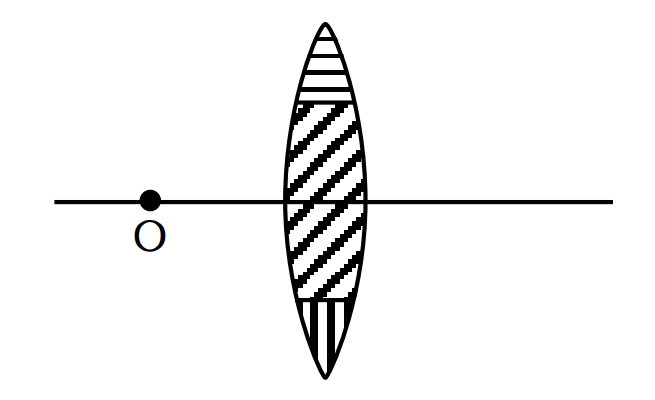 Since the lens is made of three different transparent materials, each material has its own distinct refractive index, resulting in three different effective focal lengths and hence three separate real images.
Refraction through a thin-angle prism
-
A horizontal ray of light is incident on the right angled prism with prism angle $6^\circ$. If the refractive index of the material of the prism is 1.5, then the angle of emergence will be:
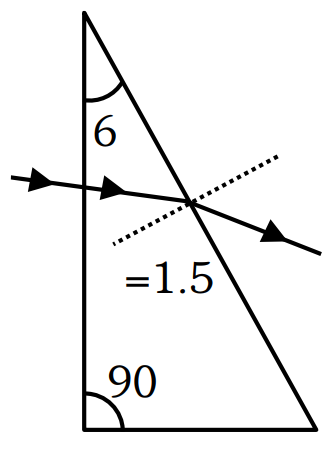 For the given geometry, $A=r_1+r_2=6^\circ$. Since the incident ray is horizontal (normal incidence at the first face for this configuration), $r_1\approx0$, so $r_2\approx6^\circ$. Using $\mu=\dfrac{\sin e}{\sin r_2}$: $1.5=\dfrac{\sin e}{\sin6^\circ}\Rightarrow\sin e=1.5\sin6^\circ\Rightarrow e\approx9^\circ$ (using the small-angle approximation).
Total internal reflection - dependence of critical angle on wavelength
-
Which set of colours will come out in air for a situation shown in figure?
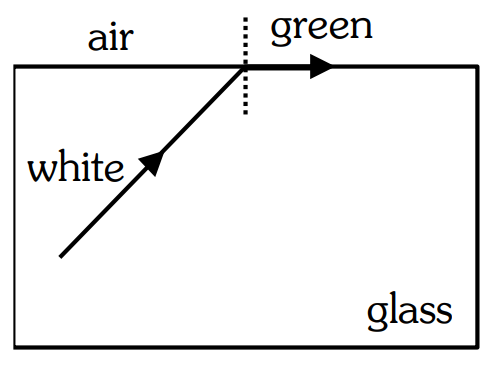 The critical angle $\sin i_c=\dfrac{1}{\mu}\propto\lambda$ (critical angle increases with wavelength, since $\mu$ decreases with increasing wavelength). At the given angle of incidence inside the glass, only colours with a sufficiently large critical angle (i.e., longer wavelengths — yellow, orange and red) can emerge into air without undergoing total internal reflection.
Convex lens producing an equal-size image
-
An object is mounted on a wall. Its image of equal size is to be obtained on a parallel wall with the help of a convex lens placed between these walls. The lens is kept at distance x in front of the second wall. The required focal length of the lens will be:For an equal-size real image, the object and image distances from the lens are equal ($u=v=x$), corresponding to magnification $-1$ (i.e., object at the centre of curvature, $u=2f$). So $x=2f\Rightarrow f=\dfrac{x}{2}$.
That is every question in Ray Optics and Optical Instruments for this filter.
Want a score?
Answers here are not saved. Practise as a test to be marked and see your progress.
Practise as a test