Looking for classes? Ksquare Career Institute, Bengaluru →

Physics
Semiconductor Electronics: Materials, Devices and Simple Circuits
106 questions from 34 papers, each with its answer.
- 106 questions
- 34 papers
- 6.01% of Physics
Logic Gates
-
The following figure shows a logic gate circuit with two inputs A and B and the output C. The voltage waveforms of A, B and C are as shown below -
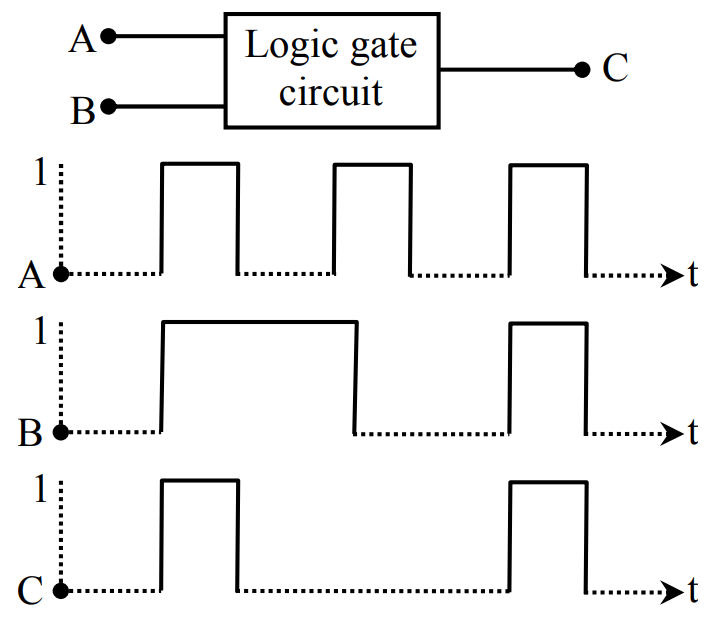
The logic circuit gate is :Read the waveforms interval by interval and compare the output C with the inputs A and B.
In the given waveforms the output C is high (1) only during those intervals in which both the inputs A and B are high (1).
Whenever either A or B (or both) is low (0), the output C is low (0).
This is the truth table of the AND gate: $C = A \cdot B$.
An OR gate would give a high output when any one input is high, and NAND and NOR gates would give a high output when both inputs are low.
So the logic circuit gate is an AND gate.
p-n junction diode
-
A forward biased diode is :-A p-n junction diode is forward biased when its p-side (anode) is at a higher potential than its n-side (cathode).
In every option the p-side is the left terminal and the n-side is towards the right terminal.
Left $-4$ V, right $-3$ V: the p-side is at the lower potential, so the diode is reverse biased.
Left 3 V, right 5 V: the p-side is at the lower potential, so it is reverse biased.
Left $-2$ V, right $+2$ V: the p-side is at the lower potential, so it is reverse biased.
Left 0 V, right $-2$ V: the p-side (0 V) is at a higher potential than the n-side ($-2$ V), so the diode is forward biased.
So the forward biased diode is the one with its left end at 0 V and its right end at $-2$ V.
Transistor: Current Gain
-
A transistor is operated in common emitter configuration at constant collector voltage $V_c = 1.5$ V such that a change in the base current from 100 $\mu$A to 150 $\mu$A produces a change in the collector current from 5 mA to 10 mA. The current gain ($\beta$) is :-The a.c. current gain in the common emitter configuration is $\beta = \dfrac{\Delta I_C}{\Delta I_B}$ at constant collector voltage.
$\Delta I_C = (10 - 5)$ mA $= 5 \times 10^{-3}$ A
$\Delta I_B = (150 - 100)\,\mu$A $= 50 \times 10^{-6}$ A
$\beta = \dfrac{(10 - 5) \times 10^{-3}}{(150 - 100) \times 10^{-6}}$
$\beta = \dfrac{5 \times 10^{-3}}{50 \times 10^{-6}} = 100$
That is every question in Semiconductor Electronics: Materials, Devices and Simple Circuits for this filter.
Want a score?
Answers here are not saved. Practise as a test to be marked and see your progress.
Practise as a test