Looking for classes? Ksquare Career Institute, Bengaluru →

Physics
Work, Energy and Power
71 questions from 36 papers, each with its answer.
- 71 questions
- 36 papers
- 4.02% of Physics
Work Done by a Variable Force
-
Force F on a particle moving in a straight line varies with distance d as shown in the figure. The work done on the particle during its displacement of 12 m is
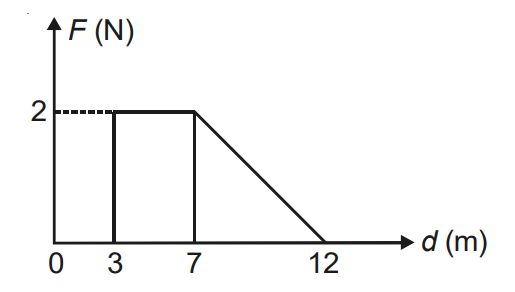 Work done = area under the force–distance graph.
From the graph, the force is 2 N from d = 3 m to d = 7 m and then falls uniformly to zero at d = 12 m.
Area of the rectangle (3 m to 7 m) = $2\times(7 - 3) = 8$ J
Area of the triangle (7 m to 12 m) = $\frac{1}{2}\times(12 - 7)\times2 = 5$ J
Total work = 8 + 5 = 13 J
Potential energy
-
The potential energy of a system increases if work is donePotential energy is defined only for conservative forces, by the relation $\Delta U = -W_{conservative}$
When the system does work against a conservative force, the work done by that conservative force is negative.
Then $\Delta U = -(\text{negative}) = $ positive, i.e., the potential energy increases (for example, raising a body against gravity or compressing a spring).
When a conservative force does work upon the system, U decreases; work involving non-conservative forces does not get stored as potential energy.
Hence the potential energy increases when work is done by the system against a conservative force.
That is every question in Work, Energy and Power for this filter.
Show all 71 questions Next: System of Particles and Rotational Motion
Want a score?
Answers here are not saved. Practise as a test to be marked and see your progress.
Practise as a test