Looking for classes? Ksquare Career Institute, Bengaluru →

Biology
Anatomy of Flowering Plants
86 questions from 36 papers, each with its answer.
- 86 questions
- 36 papers
- 2.44% of Biology
Bulliform Cells in Monocot Leaves
-
Bulliform cells are responsible forBulliform cells are large, empty, colourless cells present in the upper epidermis of grass (monocot) leaves. When they lose water (are flaccid) during water stress, the leaves curl inwards, reducing exposed surface area and water loss; when turgid, the leaves unroll. So bulliform cells are responsible for inward curling of leaves in monocots.
Secondary Growth - Cambium Formation
-
Formation of interfascicular cambium from fully developed parenchyma cells is an example forInterfascicular cambium arises from fully differentiated (mature) parenchyma cells of the medullary rays. These cells regain the capacity to divide, i.e. they become meristematic again. This process is called dedifferentiation.
Xylem Vessel/Tracheid Wall Thickenings
-
In the given figure, which component has thin outer walls and highly thickened inner walls
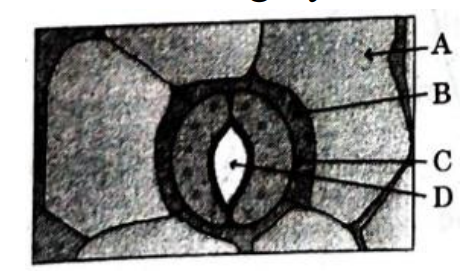 Component C is the guard cell. Guard cells are bean-shaped; their outer walls (away from the stomatal pore) are thin and elastic, while their inner walls (towards the pore) are highly thickened. This wall structure helps in the opening and closing of the stomatal pore.
Simple Tissues and Xylem Composition
-
Given below are two statements: Statement I: Parenchyma is living but collenchyma is dead tissue. Statement II: Gymnosperms lack xylem vessels but presence of xylem vessels is the characteristic of angiosperms. In the light of the above statements, choose the correct answer from the options given below:Statement I is false: both parenchyma and collenchyma are living tissues. Statement II is true: gymnosperms lack vessels in their xylem, whereas the presence of vessels is a characteristic feature of angiosperms. So Statement I is false but Statement II is true.
That is every question in Anatomy of Flowering Plants for this filter.
Show all 86 questions Next: Structural Organisation in Animals
Want a score?
Answers here are not saved. Practise as a test to be marked and see your progress.
Practise as a test