Looking for classes? Ksquare Career Institute, Bengaluru →

Biology
Morphology of Flowering Plants
133 questions from 37 papers, each with its answer.
- 133 questions
- 37 papers
- 3.77% of Biology
Seed Structure and Germination
-
Identify the part of the seed from the given figure which is destined to form root when the seed germinates.
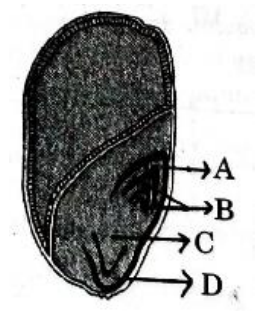 Part C is the radicle, the embryonic root at one end of the embryonal axis. On germination, the radicle grows downward and forms the root of the seedling.
Position of Floral Whorls (Hypogynous/Perigynous/Epigynous)
-
Identify the type of flowers based on the position of calyx, corolla and androecium with respect to the ovary from the given figures (a) and (b)
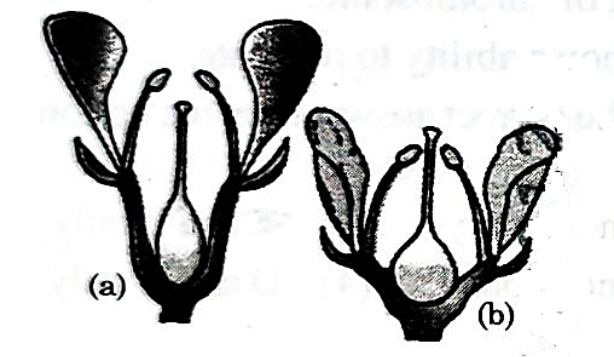 In both figures, the thalamus forms a cup-shaped structure around the ovary and the sepals, petals and stamens arise from its rim, at about the level of the ovary (ovary half-inferior). So both (a) and (b) are perigynous flowers.
Actinomorphic and Zygomorphic Flowers
-
Which of the following is an example of actinomorphic flower?An actinomorphic flower can be divided into two equal radial halves in any radial plane through its centre (radial symmetry). $Datura$ has actinomorphic flowers, whereas $Pisum$, $Sesbania$ and $Cassia$ have zygomorphic flowers.
Floral Features - Aestivation, Flower Type, Fruit Type, Placentation
-
Match List-I with List-II regarding floral features of the given plants.
Pick the matching item from Column II for each row.
Column I
- A. $Rose$
- B. $Pea$
- C. $Cotton$
- D. $Mango$
Column II
- I. Twisted aestivation
- II. Perigynous flower
- III. Drupe
- IV. Marginal placentation
Correct answer: A → II, B → IV, C → I, D → III
Rose – perigynous flower Pea – marginal placentation Cotton – twisted aestivation Mango – drupe (fleshy fruit with a hard stony endocarp) Correct match: A-II, B-IV, C-I, D-III.
Types of Stamen (Cohesion of Filaments)
-
Match List-I with List-II regarding types of stamens and their examples.
Pick the matching item from Column II for each row.
Column I
- A. Monoadelphous
- B. Diadelphous
- C. Polyadelphous
- D. Epiphyllous
Column II
- I. $Citrus$
- II. $Pea$
- III. $Lily$
- IV. China-rose
Correct answer: A → IV, B → II, C → I, D → III
Monoadelphous (filaments fused into one bundle) – China-rose Diadelphous (two bundles) – pea Polyadelphous (more than two bundles) – $Citrus$ Epiphyllous (stamens attached to perianth) – lily Correct match: A-IV, B-II, C-I, D-III.
That is every question in Morphology of Flowering Plants for this filter.
Want a score?
Answers here are not saved. Practise as a test to be marked and see your progress.
Practise as a test