Looking for classes? Ksquare Career Institute, Bengaluru →

Biology
Sexual Reproduction in Flowering Plants
126 questions from 36 papers, each with its answer.
- 126 questions
- 36 papers
- 3.57% of Biology
Pollination in Hydrophytes
-
Identify the set of correct statements: A. The flowers of $Vallisneria$ are colourful and produce nectar B. The flowers of waterlily are not pollinated by water. C. In most of water-pollinated species, the pollen grains are protected from wetting. D. Pollen grains of some hydrophytes are long and ribbon like. E. In some hydrophytes, the pollen grains are carried passively inside water. Choose the correct answer from the options given below:A. Flowers of $Vallisneria$ are not colourful and do not produce nectar – incorrect. B. Flowers of water lily emerge above the water level and are pollinated by insects or wind, not by water – correct. C. In most water-pollinated species, pollen grains are protected from wetting by a mucilaginous covering – correct. D. Pollen grains of some hydrophytes (e.g. seagrasses) are long and ribbon-like – correct. E. In some hydrophytes such as $Vallisneria$, pollen grains are carried passively inside water – correct. So B, C, D and E only are correct.
Anemophily (Wind Pollination) Adaptations
-
Identify the correct description about the given figure:
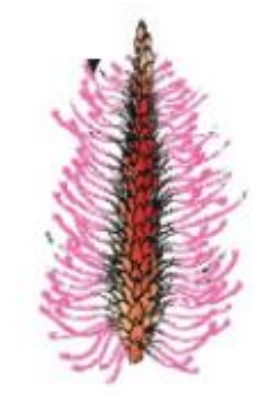 The figure shows a wind-pollinated plant inflorescence (e.g. maize/grass). Wind-pollinated flowers have well-exposed stamens so that pollen is easily dispersed by wind, and large, feathery stigmas to trap air-borne pollen.
That is every question in Sexual Reproduction in Flowering Plants for this filter.
Want a score?
Answers here are not saved. Practise as a test to be marked and see your progress.
Practise as a test