Looking for classes? Ksquare Career Institute, Bengaluru →

Chemistry
Hydrocarbons
75 questions from 35 papers, each with its answer.
- 75 questions
- 35 papers
- 4.26% of Chemistry
Electrophilic substitution vs free-radical addition halogenation of benzene
-
The number of chlorine atoms present in the organic products X and Y of the following reactions, respectively, are:
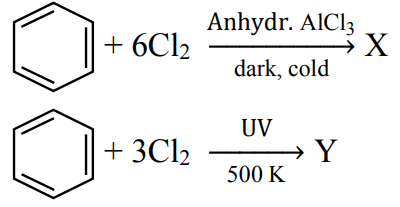 Benzene $+ 6Cl_2 \xrightarrow[dark,\ cold]{Anhydr.\ AlCl_3} C_6Cl_6$ (X, hexachlorobenzene – electrophilic substitution of all six H) Benzene $+ 3Cl_2 \xrightarrow[500K]{UV} C_6H_6Cl_6$ (Y, benzene hexachloride – free-radical addition) Number of chlorine atoms in X and Y are 6 and 6 respectively.
Friedel-Crafts alkylation, nitration, and separation of positional isomers
-
Two products X and Y are formed in the following reaction sequence
 The suitable method that can be used for the separation of products X and Y is:
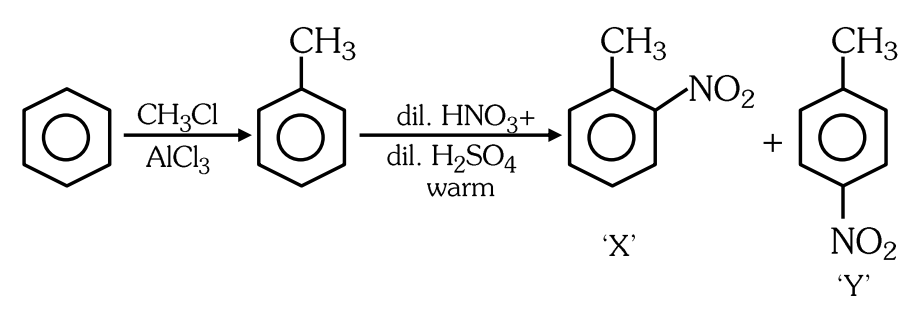 Benzene $\xrightarrow[AlCl_3]{CH_3Cl}$ Toluene (W) (Friedel-Crafts alkylation)
Toluene $\xrightarrow[dil.\ H_2SO_4,\ warm]{dil.\ HNO_3}$ o-nitrotoluene (X) + p-nitrotoluene (Y)
X and Y are positional isomers with different boiling points, so they can be separated by fractional distillation.
That is every question in Hydrocarbons for this filter.
Want a score?
Answers here are not saved. Practise as a test to be marked and see your progress.
Practise as a test