Looking for classes? Ksquare Career Institute, Bengaluru →

Chemistry
Organic Chemistry - Some Basic Principles and Techniques
88 questions from 35 papers, each with its answer.
- 88 questions
- 35 papers
- 5% of Chemistry
Hybridization and Bond Dissociation Energy
-
Among the given compounds I-III, the correct order of bond dissociation energy of C–H bond marked with * is:
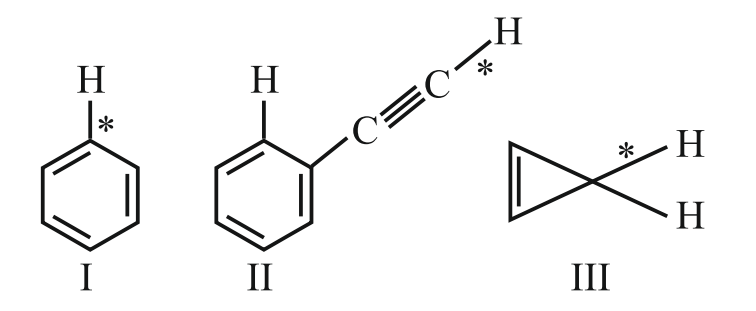
Bond dissociation energy increases with greater s-character: $sp$ ($50\%$ s, alkyne I) > $sp^2$ ($33.3\%$ s, aryl II) > $sp^3$ (cyclopropyl III). Thus $\text{I} > \text{II} > \text{III}$.
The strength and bond dissociation energy (BDE) of a $\text{C}-\text{H}$ bond depends on the hybridization of carbon. Higher s-character brings the bonded electron pair closer to the nucleus, increasing bond strength and BDE: 1. In ethyne (I), carbon is $sp$ hybridized ($50\%$ s-character), giving the highest BDE ($\,\approx 550\text{ kJ/mol}$). 2. In benzene (II), carbon is $sp^2$ hybridized ($33.3\%$ s-character), with intermediate BDE ($\,\approx 464\text{ kJ/mol}$). 3. In cyclopropane (III), the exocyclic C-H bond has predominant $sp^3$ character with lower BDE ($\,\approx 445\text{ kJ/mol}$). Therefore, the correct decreasing order of bond dissociation energy is I > II > III.
That is every question in Organic Chemistry - Some Basic Principles and Techniques for this filter.
Want a score?
Answers here are not saved. Practise as a test to be marked and see your progress.
Practise as a test