Looking for classes? Ksquare Career Institute, Bengaluru →

Physics
Current Electricity
130 questions from 38 papers, each with its answer.
- 130 questions
- 38 papers
- 7.37% of Physics
Potentiometer
-
A potentiometer circuit is set up as shown. The potential gradient across the potentiometer wire is k volt/cm and the ammeter, present in the circuit, reads 1.0 A when two way key is switched off. The balance points, when the key between the terminals (i) 1 and 2 (ii) 1 and 3, is plugged in, are found to be at lengths $l_1$ cm and $l_2$ cm respectively. The magnitudes of the resistors R and X, in ohms, are then equal, respectively, to
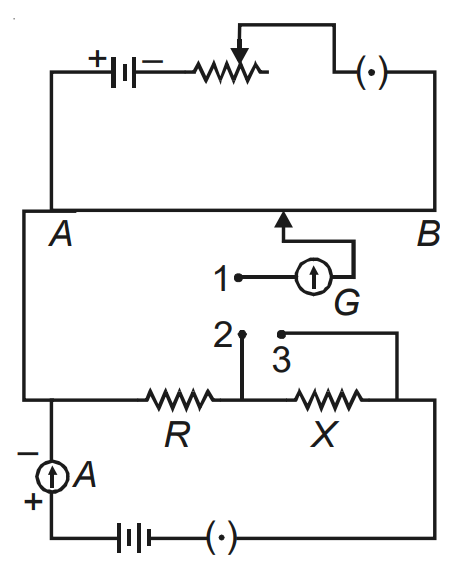 The current through R and X in the secondary circuit is I = 1.0 A.
With the key between 1 and 2, the potential difference across R alone is balanced: $V_R = IR = kl_1$
Since I = 1 A, $R = kl_1$ ohm
With the key between 1 and 3, the potential difference across R and X in series is balanced: $I(R + X) = kl_2$
$R + X = kl_2$, so $X = kl_2 - kl_1$
$X = k(l_2 - l_1)$ ohm
So R and X are $kl_1$ and $k(l_2 - l_1)$ respectively.
Chemical effect of current
-
In producing chlorine by electrolysis 100 kW power at 125 V is being consumed. How much chlorine per minute is liberated? (E.C.E. of chlorine is $0.367\times10^{-6}$ kg/C)Current drawn: $I = \frac{P}{V} = \frac{100\times10^3}{125} = 800$ A
Time: t = 1 minute = 60 s
Faraday's first law: mass liberated $m = ZIt$
$m = 0.367\times10^{-6}\times800\times60$
$m = 0.367\times10^{-6}\times48000 = 17.6\times10^{-3}$ kg
$m \approx 17.61\times10^{-3}$ kg
That is every question in Current Electricity for this filter.
Want a score?
Answers here are not saved. Practise as a test to be marked and see your progress.
Practise as a test