Looking for classes? Ksquare Career Institute, Bengaluru →

Physics
Electromagnetic Induction
40 questions from 30 papers, each with its answer.
- 40 questions
- 30 papers
- 2.27% of Physics
Self inductance - series and parallel inductors
-
Two identical inductors are connected in two different configurations P and Q, where a time varying current I(t) is flowing, as shown in the figure. The induced emf between points a and b for configuration P is $E_P$ and that for configuration Q is $E_Q$. The ratio $E_P/E_Q$ is: [Neglect the effect of mutual inductance.]
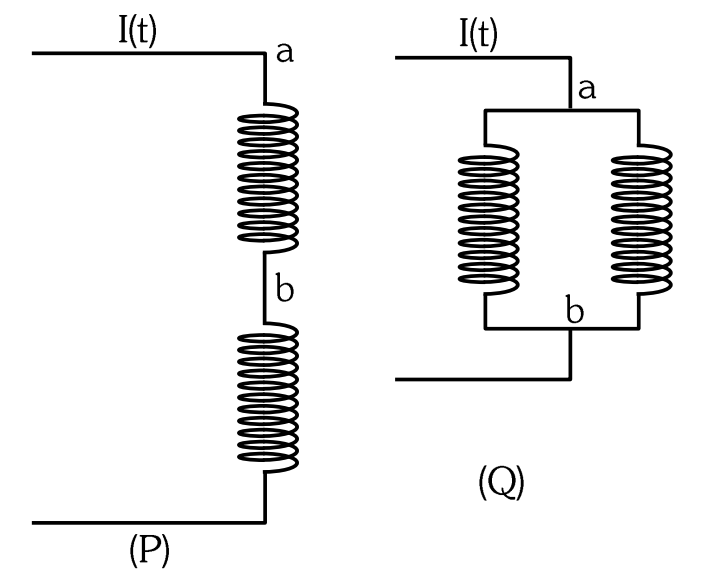 In P, a and b are across one inductor carrying the full current: $E_P=L\frac{di}{dt}$. In Q, the current splits equally between the two parallel inductors: $E_Q=L\frac{d(i/2)}{dt}=\frac{L}{2}\frac{di}{dt}$. So $\frac{E_P}{E_Q}=2$.
Faraday's law - induced emf and power
-
A conducting loop of finite resistance lies on the x-y plane. There is a constant magnetic field in the z direction. The area of the loop varies with time t, as $A=A_0(1+\sin t)$ in appropriate units. The figure that correctly indicates the qualitative behaviour of the power P dissipated in the loop as a function of time is:$\phi=BA=BA_0(1+\sin t)$. $e=-\frac{d\phi}{dt}=-BA_0\cos t$, so $P=\frac{e^2}{R}=\frac{B^2A_0^2\cos^2t}{R}$, i.e. $P\propto\cos^2t$. P starts at its maximum at t = 0 and falls to zero periodically.
That is every question in Electromagnetic Induction for this filter.
Want a score?
Answers here are not saved. Practise as a test to be marked and see your progress.
Practise as a test