Looking for classes? Ksquare Career Institute, Bengaluru →

Electrostatic Potential and Capacitance
Combination of Capacitors
8 questions from 8 papers, each with its answer.
- questions
- 8
- papers
- 8
- years asked, 2017–2026
- 4 of 10
- of Electrostatic Potential and Capacitance
- 10.53%
Appears in
Concepts tested
- Series-parallel combination of capacitors 2
- Capacitors in series
- Charge on capacitors in series and parallel
- Combination of capacitors
- Energy stored in capacitors
- equivalent capacitance of a network
- series-parallel capacitors
All Questions
2024 1 question
-
In the following circuit, the equivalent capacitance between terminal $A$ and terminal $B$ is:
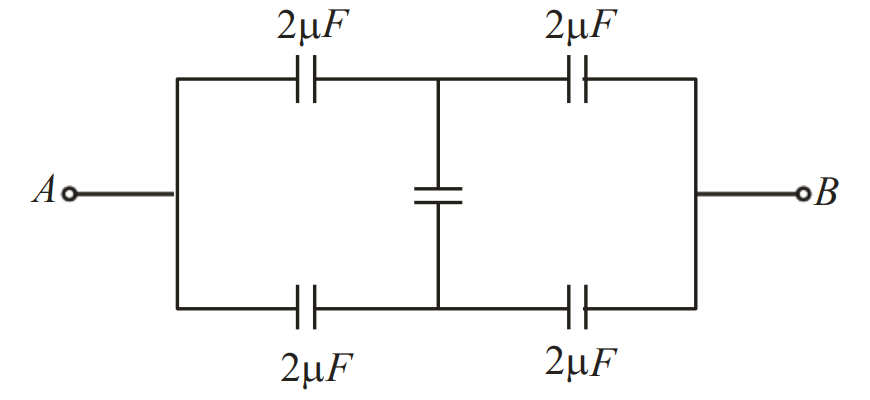
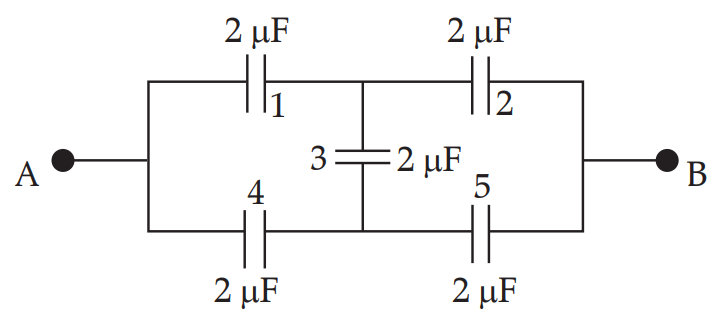
The bridge is balanced (all capacitors equal), so the middle capacitor can be neglected. Upper branch: two 2 $\mu F$ in series $= 1\ \mu F$ Lower branch: two 2 $\mu F$ in series $= 1\ \mu F$ The two branches are in parallel: $C = 1 + 1 = 2\ \mu F$
2023 1 question
-
The equivalent capacitance of the system shown in the following circuit is:
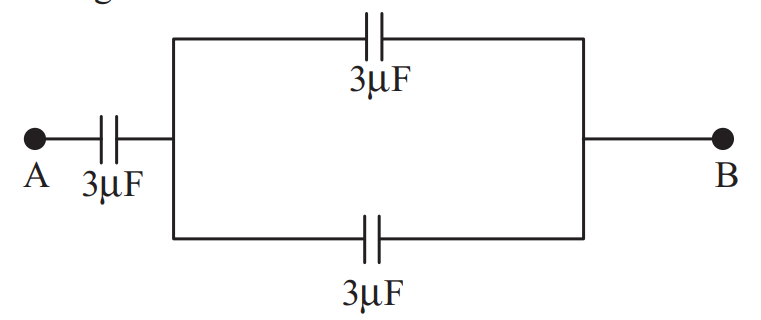
Two $3\ \mu F$ in parallel give $6\ \mu F$, which is in series with $3\ \mu F$: $2\ \mu F$.
$3\ \mu F$ and $3\ \mu F$ in parallel $\Rightarrow C_{eqv}=3+3=6\ \mu F$ Now $C'_{eqv}=\frac{3\times6}{9}=2\ \mu F$
2022 Phase 2 1 question
-
The effective capacitances of two capacitors are 3 $\mu F$ and 16 $\mu F$, when they are connected in series and parallel respectively. The capacitance of two capacitors are:Series: $\frac{C_1C_2}{C_1+C_2}=3$; parallel: $C_1+C_2=16$. So $C_1C_2=48$. $(C_1-C_2)^2=(C_1+C_2)^2-4C_1C_2=256-192=64 \Rightarrow C_1-C_2=8$. Hence $C_1=12\ \mu F$, $C_2=4\ \mu F$.
2021 1 question
-
The equivalent capacitance of the combination shown in the figure is:
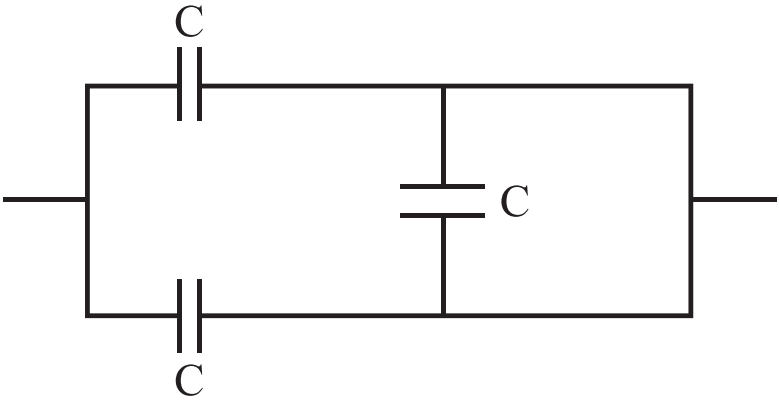
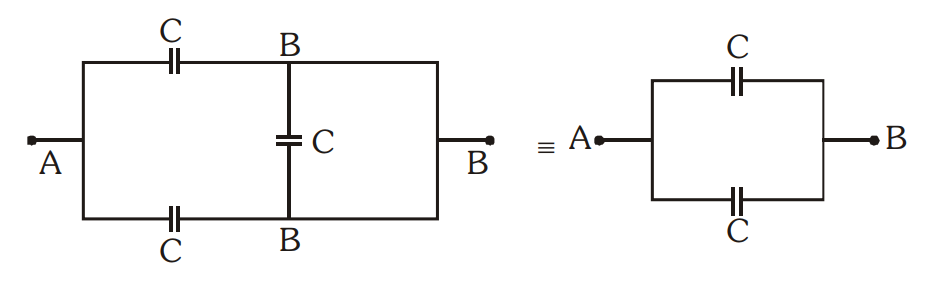
Both plates of the middle capacitor are connected to the same point (B–B), so it gets short-circuited.
The remaining two capacitors are in parallel: $C_{eq} = C + C = 2C$
2010 AIPMT-PRE 1 question
-
A series combination of $n_1$ capacitors, each of value $C_1$, is charged by a source of potential difference 4V. When another parallel combination of $n_2$ capacitors, each of value $C_2$, is charged by a source of potential difference V, it has the same (total) energy stored in it, as the first combination has. The value of $C_2$, in terms of $C_1$, is thenSeries combination of $n_1$ capacitors each of $C_1$: $C_s = \frac{C_1}{n_1}$
Energy stored at potential difference 4V: $U_1 = \frac{1}{2}C_s(4V)^2 = \frac{1}{2}\frac{C_1}{n_1}\times16V^2 = \frac{8C_1V^2}{n_1}$
Parallel combination of $n_2$ capacitors each of $C_2$: $C_p = n_2C_2$
Energy stored at potential difference V: $U_2 = \frac{1}{2}n_2C_2V^2$
Given $U_1 = U_2$: $\frac{8C_1V^2}{n_1} = \frac{1}{2}n_2C_2V^2$
$C_2 = \frac{16C_1}{n_1n_2}$
2009 AIPMT 1 question
-
Three capacitors each of capacitance C and of breakdown voltage V are joined in series. The capacitance and breakdown voltage of the combination will beFor capacitors in series: $\frac{1}{C_{eq}} = \frac{1}{C} + \frac{1}{C} + \frac{1}{C} = \frac{3}{C}$
$C_{eq} = \frac{C}{3}$
In series the applied voltage divides among the capacitors; since they are identical, each gets one-third of the total.
Each capacitor can withstand V, so the combination can withstand V + V + V = 3V before breakdown.
Hence the capacitance is $\frac{C}{3}$ and the breakdown voltage is 3V.
2005 AIPMT 1 question
-
A network of four capacitors of capacity equal to $C_1 = C$, $C_2 = 2C$, $C_3 = 3C$ and $C_4 = 4C$ are connected to a battery as shown in the figure. The ratio of the charges on $C_2$ and $C_4$ is -
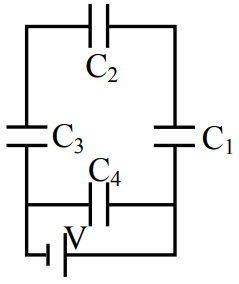 $C_4 = 4C$ is connected directly across the battery, so $Q_4 = 4CV$.
$C_1$, $C_2$ and $C_3$ are in series: $\dfrac{1}{C_s} = \dfrac{1}{C} + \dfrac{1}{2C} + \dfrac{1}{3C} = \dfrac{6 + 3 + 2}{6C} = \dfrac{11}{6C}$
$C_s = \dfrac{6C}{11}$
Capacitors in series carry the same charge, so $Q_2 = C_sV = \dfrac{6CV}{11}$
$\dfrac{Q_2}{Q_4} = \dfrac{6CV}{11} \times \dfrac{1}{4CV}$
$\dfrac{Q_2}{Q_4} = \dfrac{6}{44} = \dfrac{3}{22}$
2003 AIPMT 1 question
-
Three capacitors each of capacity 4 $\mu F$ are to be connected in such a way that the effective capacitance is 6 $\mu F$. This can be done by -Check each arrangement (C = 4 $\mu F$):
All in series: $\dfrac{C}{3} = \dfrac{4}{3}\ \mu F$
All in parallel: $3C = 12\ \mu F$
Two in series and this pair in parallel with the third: $\dfrac{C}{2} + C = 2 + 4 = 6\ \mu F$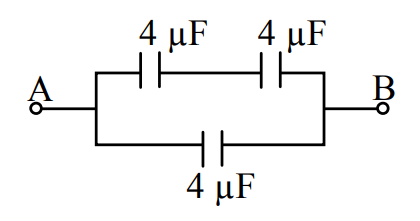
Two in parallel and this pair in series with the third: $\dfrac{8 \times 4}{8 + 4} = \dfrac{8}{3}\ \mu F$
So $C_{AB} = (2 + 4)\ \mu F = 6\ \mu F$ is obtained by connecting two in series and one in parallel.