Looking for classes? Ksquare Career Institute, Bengaluru →

Physics
Laws of Motion
72 questions from 37 papers, each with its answer.
- 72 questions
- 37 papers
- 4.08% of Physics
Conservation of linear momentum
-
A mass of 1 kg is thrown up with a velocity of 100 m/s. After 5 seconds, it explodes into two parts. One part of mass 400 g comes down with a velocity 25 m/s. Calculate the velocity of other part :Velocity after 5 seconds (taking g = 10 m/s$^2$): $v = 100 - 10 \times 5 = 50$ m/s upward.
The explosion is due to internal forces, so momentum is conserved just before and just after it. Take upward as $+\hat{j}$:
$1 \times 50\hat{j} = 0.4 \times 25(-\hat{j}) + 0.6\vec{v}$
$50\hat{j} + 10\hat{j} = 0.6\vec{v}$
$\vec{v} = \dfrac{60\hat{j}}{0.6} = 100\hat{j}$ m/s
So the other part moves with 100 m/s upward.
Impulse and Change in Momentum
-
A body of mass 3 kg hits a wall at an angle of $60^\circ$ and returns at the same angle. The impact time was 0.2 s. Calculate the force exerted on the wall :
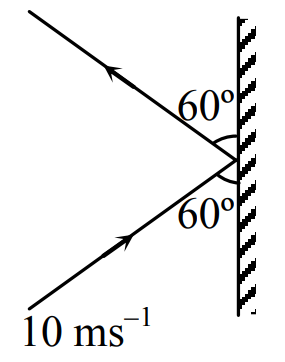 The velocity makes $60^\circ$ with the wall, i.e. $30^\circ$ with the normal to the wall.

The component along the wall ($v\sin 30^\circ$) is unchanged. The component along the normal ($v\cos 30^\circ$) is reversed.
Change in momentum $\Delta p = mv\cos 30^\circ - (-mv\cos 30^\circ) = 2mv\cos 30^\circ$
$F = \dfrac{\Delta p}{\Delta t} = \dfrac{2 \times 3 \times 10 \times \frac{\sqrt{3}}{2}}{0.2} = \dfrac{30\sqrt{3}}{0.2}$
$F = 150\sqrt{3}$ N
That is every question in Laws of Motion for this filter.
Want a score?
Answers here are not saved. Practise as a test to be marked and see your progress.
Practise as a test