Looking for classes? Ksquare Career Institute, Bengaluru →

Physics
Mechanical Properties of Fluids
34 questions from 22 papers, each with its answer.
- 34 questions
- 22 papers
- 1.93% of Physics
Surface Tension
-
Consider a water tank shown in the figure. It has one wall at $x = L$ and can be taken to be very wide in the $z$ direction. When filled with a liquid of surface tension $S$ and density $\rho$, the liquid surface makes angle $\theta_{0} (\theta_{0} \ll 1)$ with the $x$-axis at $x = L$. If $y(x)$ is the height of the surface then the equation for $y(x)$ is:
(take $\theta(x) = \sin\theta(x) = \tan\theta(x) = \frac{dy}{dx}$, $g$ is the acceleration due to gravity)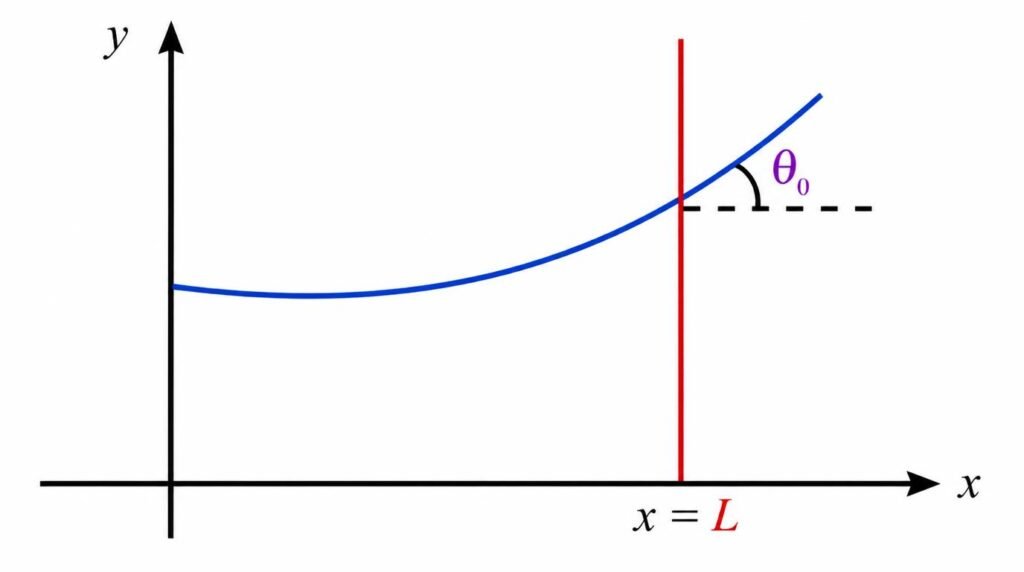
Balancing the vertical surface tension force component with the weight of the elevated liquid yields $\frac{d^2y}{dx^2} = \frac{\rho g}{S} y$.
For an element of width $dx$ and length $z$ along the surface: The net vertical force due to surface tension is $dF_y = S z \, d\theta = S z \left(\frac{d^2y}{dx^2}\right) dx$. In equilibrium, this balances the weight of the liquid column lifted above the zero level, which is $dW = (dx \cdot z \cdot y) \rho g$. Equating them gives $S z \left(\frac{d^2y}{dx^2}\right) dx = \rho g z y \, dx \implies \frac{d^2y}{dx^2} = \frac{\rho g}{S} y$.
That is every question in Mechanical Properties of Fluids for this filter.
Want a score?
Answers here are not saved. Practise as a test to be marked and see your progress.
Practise as a test