Looking for classes? Ksquare Career Institute, Bengaluru →

Physics
System of Particles and Rotational Motion
100 questions from 38 papers, each with its answer.
- 100 questions
- 38 papers
- 5.67% of Physics
Rigid Body Equilibrium
-
A uniform rod of mass $20\text{ kg}$ and length $5\text{ m}$ leans against a smooth vertical wall making an angle of $60^\circ$ with it. The other end rests on a rough horizontal floor. The friction force that the floor exerts on the rod is (take $g = 10\text{ m/s}^2$):
Torque balance about the ground contact point gives normal force from wall $N_w = \frac{W}{2} \cot 30^\circ = 100\sqrt{3}\text{ N}$. Horizontal equilibrium requires friction $f = N_w = 100\sqrt{3}\text{ N}$.
The rod makes an angle of $60^\circ$ with the vertical wall, so its angle with the horizontal floor is $\theta = 90^\circ - 60^\circ = 30^\circ$. Weight of the rod is $W = mg = 20 \times 10 = 200\text{ N}$, acting at the midpoint. Taking torque about the bottom contact point O: $\sum \tau_O = 0 \implies N_w (l \sin\theta) = W \left(\frac{l}{2}\right) \cos\theta \implies N_w = \frac{W}{2} \cot\theta = \frac{200}{2} \cot 30^\circ = 100\sqrt{3}\text{ N}$. For horizontal translational equilibrium, the friction force exerted by the floor balances $N_w$: $f = N_w = 100\sqrt{3}\text{ N}$.
Moment of Inertia of Bodies with Cavities
-
A sphere of radius $R$ is cut from a larger solid sphere of radius $2R$ as shown in the figure (cavity tangent to the outer sphere and passing through origin). The ratio of the moment of inertia of the smaller sphere to that of the rest part of the sphere about the Y-axis is:
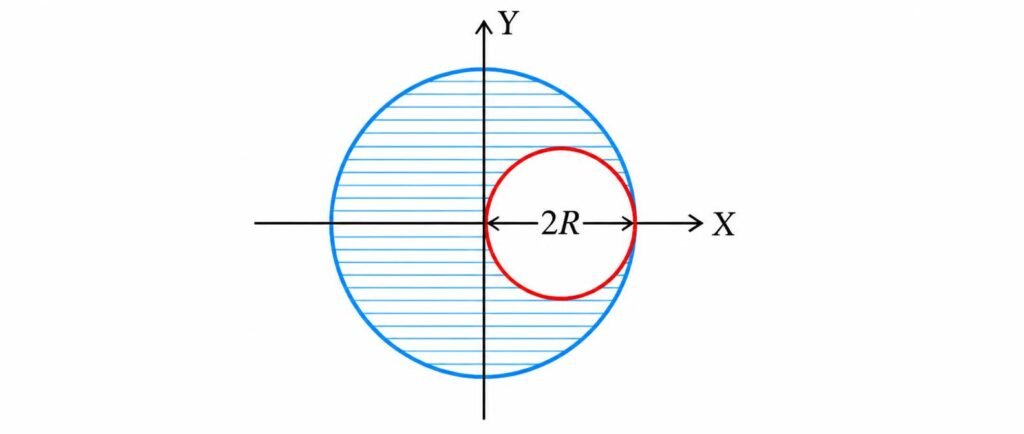
Using parallel axis theorem, $I_s = \frac{7}{5} m_s R^2$ and $I_L = \frac{64}{5} m_s R^2$. Remaining part has $I_r = \frac{57}{5} m_s R^2$. Ratio is $I_s / I_r = 7/57$.
Mass of smaller sphere is $m_s = \frac{4}{3}\pi R^3 \rho$. Large complete sphere has mass $M = \frac{4}{3}\pi (2R)^3 \rho = 8 m_s$. Moment of inertia of large sphere about Y-axis through its center: $I_L = \frac{2}{5} M (2R)^2 = \frac{2}{5}(8m_s)(4R^2) = \frac{64}{5} m_s R^2$. The center of the small sphere is shifted by distance $d = R$ from the Y-axis. By the parallel axis theorem: $I_s = I_{cm} + m_s d^2 = \frac{2}{5} m_s R^2 + m_s R^2 = \frac{7}{5} m_s R^2$. Moment of inertia of the remaining part about the Y-axis is $I_r = I_L - I_s = \frac{64}{5} m_s R^2 - \frac{7}{5} m_s R^2 = \frac{57}{5} m_s R^2$. The required ratio is $\frac{I_s}{I_r} = \frac{(7/5) m_s R^2}{(57/5) m_s R^2} = \frac{7}{57}$.
That is every question in System of Particles and Rotational Motion for this filter.
Want a score?
Answers here are not saved. Practise as a test to be marked and see your progress.
Practise as a test