Looking for classes? Ksquare Career Institute, Bengaluru →

Physics
Work, Energy and Power
71 questions from 36 papers, each with its answer.
- 71 questions
- 36 papers
- 4.02% of Physics
Potential Energy of a Spring
-
A mass of 0.5 kg moving with a speed of 1.5 m/s on a horizontal smooth surface, collides with a nearly weightless spring of force constant k = 50 N/m. The maximum compression of the spring would be :-
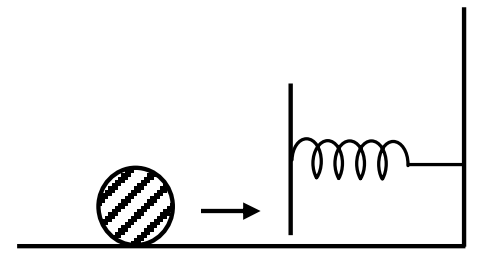 The surface is smooth, so mechanical energy is conserved. At maximum compression the mass momentarily stops, and all its kinetic energy is stored as elastic potential energy of the spring.
According to the question: $\dfrac{1}{2}mv^2 = \dfrac{1}{2}kx^2$
$\Rightarrow x = v\sqrt{\dfrac{m}{k}}$
$x = 1.5\sqrt{\dfrac{0.5}{50}} = 1.5\sqrt{0.01} = 1.5 \times 0.1$
$x = 0.15$ m
So the maximum compression of the spring is 0.15 m.
Relation between Kinetic Energy and Momentum
-
A particle of mass $m_1$ is moving with a velocity $v_1$ and another particle of mass $m_2$ is moving with a velocity $v_2$. Both of them have the same momentum but their different kinetic energies are $E_1$ and $E_2$ respectively. If $m_1 \gt m_2$ then :Kinetic energy in terms of momentum: $E = \dfrac{1}{2}mv^2 = \dfrac{(mv)^2}{2m} = \dfrac{p^2}{2m}$
Both particles have the same momentum p, so $E \propto \dfrac{1}{m}$
$\dfrac{E_1}{E_2} = \dfrac{m_2}{m_1}$
Since $m_1 \gt m_2$, $\dfrac{E_1}{E_2} \lt 1$
$\Rightarrow E_1 \lt E_2$
Kinetic Energy in Free Fall
-
A ball of mass 2 kg and another of mass 4 kg are dropped together from a 60 feet tall building. After a fall of 30 feet each towards earth, their respective kinetic energies will be in the ratio of-Both balls are dropped from rest and fall the same height h = 30 ft. In free fall the velocity does not depend on mass.
Here $v_1 = v_2 = \sqrt{2gh}$
$\dfrac{KE_1}{KE_2} = \dfrac{\frac{1}{2}m_1v_1^2}{\frac{1}{2}m_2v_2^2} = \dfrac{m_1}{m_2}$
$= \dfrac{2}{4} = \dfrac{1}{2}$
So their kinetic energies are in the ratio 1 : 2.
That is every question in Work, Energy and Power for this filter.
Show all 71 questions Next: System of Particles and Rotational Motion
Want a score?
Answers here are not saved. Practise as a test to be marked and see your progress.
Practise as a test