Looking for classes? Ksquare Career Institute, Bengaluru →

Physics
Work, Energy and Power
71 questions, each with its answer.
-
A body of mass 1 kg begins to move under the action of a time dependent force $\vec{F} = (2t\hat{i} + 3t^2\hat{j})$ N, where $\hat{i}$ and $\hat{j}$ are unit vectors along X and Y axis. What power will be developed by the force at the time (t)?
Integrate a(t) to get v(t), then $P = \vec{F}\cdot\vec{v}$.
$\vec{a} = \frac{\vec{F}}{m} = 2t\hat{i} + 3t^2\hat{j}$ (m = 1 kg)
$d\vec{v} = (2t\hat{i} + 3t^2\hat{j})dt \Rightarrow \vec{v} = t^2\hat{i} + t^3\hat{j}$
Power $P = \vec{F}\cdot\vec{v} = (2t\hat{i} + 3t^2\hat{j})\cdot(t^2\hat{i} + t^3\hat{j})$
$P = (2t^3 + 3t^5)$ W
Note: the source solution's final line prints $(2t^3 + 4t^5)$ W, which is the keyed option; the dot product actually gives $2t^3 + 3t^5$, which matches none of the options. Please check this question before use. -
What is the minimum velocity with which a body of mass m must enter a vertical loop of radius R so that it can complete the loop?
Needs $\sqrt{gR}$ at the top, hence $\sqrt{5gR}$ at the bottom.
At the top, the minimum condition is $\frac{mv_1^2}{R} = mg \Rightarrow v_1 = \sqrt{Rg}$
Conservation of energy: $\frac{1}{2}mv^2 = \frac{1}{2}mv_1^2 + mg(2R)$
$\frac{mv^2}{2} = \frac{mgR}{2} + 2mgR = \frac{5mgR}{2}$
$v = \sqrt{5gR}$ -
A bullet of mass 10g moving horizontally with a velocity of 400 $ms^{-1}$ strikes a wooden block of mass 2 kg which is suspended by a light inextensible string of length 5 m. As a result, the centre of gravity of the block is found to rise a vertical distance of 10 cm. The speed of the bullet after it emerges out horizontally from the block will be:
Get block speed from its rise, then conserve momentum.
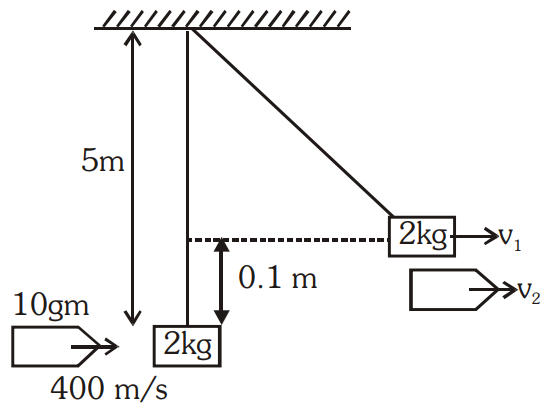
Momentum conservation: $\frac{10}{1000}\times400 + 0 = 2\times v_1 + \frac{10}{1000}\times v_2 \Rightarrow 4 = 2v_1 + 0.01v_2$ ...(1)
Work–energy theorem for the block: $2\times10\times0.1 = \frac{1}{2}\times2\times v_1^2 \Rightarrow v_1 = \sqrt{2} = 1.4$ m/s
Putting $v_1$ in (1): $4 = 2\times1.4 + 0.01v_2 \Rightarrow v_2 = 120$ m/s -
Two identical balls A and B having velocities of 0.5 m/s and –0.3 m/s respectively collide elastically in one dimension. The velocities of B and A after the collision respectively will be:
Equal masses in an elastic head-on collision exchange velocities.
Since both bodies are identical and the collision is elastic, the velocities are interchanged after collision.
$v_A = -0.3$ m/s and $v_B = 0.5$ m/s -
A particle moves from a point $(-2\hat{i} + 5\hat{j})$ to $(4\hat{j} + 3\hat{k})$ when a force of $(4\hat{i} + 3\hat{j})$ N is applied. How much work has been done by the force?
$W = \vec{F}\cdot\Delta\vec{r}$.
Displacement $\vec{s} = (4\hat{j} + 3\hat{k}) - (-2\hat{i} + 5\hat{j}) = 2\hat{i} - \hat{j} + 3\hat{k}$
$W = \vec{F}\cdot\vec{s} = (4\hat{i} + 3\hat{j})\cdot(2\hat{i} - \hat{j} + 3\hat{k}) = 8 - 3 = 5$ J -
Two similar springs P and Q have spring constants $K_P$ and $K_Q$, such that $K_P > K_Q$. They are stretched, first by the same amount (case a), then by the same force (case b). The work done by the springs $W_P$ and $W_Q$ are related as in case (a) and case (b), respectively:Given $K_P > K_Q$.
Case (a), same extension x: $W = \frac{1}{2}Kx^2 \Rightarrow W \propto K$, so $W_P > W_Q$.
Case (b), same force F: $x = \frac{F}{K}$, so $W = \frac{F^2}{2K} \Rightarrow W \propto \frac{1}{K}$, so $W_Q > W_P$. -
A block of mass 10 kg, moving in x direction with a constant speed of 10 m$s^{-1}$, is subjected to a retarding force F = 0.1x J/m during its travel from x = 20 m to 30 m. Its final KE will beWork done by the retarding force: $W = -\int_{20}^{30} 0.1x\,dx = -0.1\left[\frac{x^2}{2}\right]_{20}^{30} = -0.05(900 - 400) = -25$ J
Initial KE $= \frac{1}{2}\times 10\times 10^2 = 500$ J
By the work-energy theorem, $KE_{final} = KE_{initial} + W = 500 - 25 = 475$ J -
A particle of mass m is driven by a machine that delivers a constant power k watts. If the particle starts from rest the force on the particle at time t isWork done in time t: $W = Pt = kt$
By the work-energy theorem, $\frac{1}{2}mv^2 = kt \Rightarrow v = \sqrt{\frac{2kt}{m}}$
$P = Fv \Rightarrow F = \frac{k}{v} = k\sqrt{\frac{m}{2kt}} = \sqrt{\frac{mk}{2t}}$
$F = \sqrt{\frac{mk}{2}}\,t^{-1/2}$ -
Two particles of masses $m_1$, $m_2$ move with initial velocities $u_1$ and $u_2$. On collision, one of the particles gets excited to a higher level, after absorbing energy $\varepsilon$. If final velocities of particles be $v_1$ and $v_2$ then we must haveTotal energy is conserved in any collision:
Initial KE = Final KE + excitation energy
$\frac{1}{2}m_1u_1^2 + \frac{1}{2}m_2u_2^2 = \frac{1}{2}m_1v_1^2 + \frac{1}{2}m_2v_2^2 + \varepsilon$
$\frac{1}{2}m_1u_1^2 + \frac{1}{2}m_2u_2^2 - \varepsilon = \frac{1}{2}m_1v_1^2 + \frac{1}{2}m_2v_2^2$ -
A ball is thrown vertically downwards from a height of 20 m with an initial velocity $u_0$. It collides with the ground, loses 50 percent of its energy in collision and rebounds to the same height. The initial velocity $u_0$ is: (Take g = 10 $ms^{-2}$)Rebound speed: $v = \sqrt{2gh} = \sqrt{2\times10\times20} = 20$ m/s
Energy just after rebound: $E = \frac{1}{2}mv^2 = 200m$
50% is lost in the collision, so the energy just before collision = 400m.
$\frac{1}{2}mu_0^2 + mgh = 400m \Rightarrow \frac{1}{2}u_0^2 + 200 = 400 \Rightarrow u_0 = 20$ m/s -
On a frictionless surface, a block of mass M moving at speed v collides elastically with another block of same mass M which is initially at rest. After collision the first block moves at an angle $\theta$ to its initial direction and has a speed $\frac{v}{3}$. The second block's speed after the collision is:In an elastic collision kinetic energy is conserved:
$\frac{1}{2}Mv^2 = \frac{1}{2}M\left(\frac{v}{3}\right)^2 + \frac{1}{2}Mv'^2$
$v' = \sqrt{v^2 - \frac{v^2}{9}} = \frac{2\sqrt2}{3}v$ -
A body of mass (4m) is lying in x-y plane at rest. It suddenly explodes into three pieces. Two pieces, each of mass (m) move perpendicular to each other with equal speeds (v). The total kinetic energy generated due to explosion is:The third piece has mass 2m. By conservation of linear momentum: $2mv_1 = \sqrt2\,mv \Rightarrow v_1 = \frac{v}{\sqrt2}$
Total KE $= \frac{1}{2}mv^2 + \frac{1}{2}mv^2 + \frac{1}{2}(2m)v_1^2 = mv^2 + \frac{mv^2}{2} = \frac{3}{2}mv^2$ -
The upper half of an inclined plane of inclination $\theta$ is perfectly smooth while lower half is rough. A block starting from rest at the top of the plane will again come to rest at the bottom, if the coefficient of friction between the block and lower half of the plane is given by:Let each half have length s. Work-energy theorem ($W = \Delta KE$):
$(mg\sin\theta)(2s) - (\mu mg\cos\theta)(s) = 0 - 0$
$\mu = 2\tan\theta$ -
A uniform force of $(3\hat i + \hat j)$ newton acts on a particle of mass 2 kg. Hence the particle is displaced from position $(2\hat i + \hat k)$ meter to position $(4\hat i + 3\hat j - \hat k)$ meter. The work done by the force on the particle is:$W = \vec F\cdot\vec S = (3\hat i + \hat j)\cdot[(4 - 2)\hat i + (3 - 0)\hat j + (-1 - 1)\hat k]$
$= (3\hat i + \hat j)\cdot(2\hat i + 3\hat j - 2\hat k) = 3(2) + 1(3) + 0(-2) = 9$ J -
Two spheres A and B of masses $m_1$ and $m_2$ respectively collide. A is at rest initially and B is moving with velocity v along x-axis. After collision B has a velocity $\frac{v}{2}$ in a direction perpendicular to the original direction. The mass A moves after collision in the directionLet A move with speed $v_1$ at angle $\theta$ to the x-axis after the collision.
Momentum along x: $m_1v_1\cos\theta = m_2v$ ...(i)
Momentum along y: $m_1v_1\sin\theta = m_2\frac{v}{2}$ ...(ii) (equal and opposite to B's y-momentum)
Dividing (ii) by (i): $\tan\theta = \frac{1}{2}$
$\theta = \tan^{-1}\left(\frac{1}{2}\right)$ to the x-axis -
The potential energy of a particle in a force field is: $U = \frac{A}{r^2} - \frac{B}{r}$, where A and B are positive constants and r is the distance of particle from the centre of the field. For stable equilibrium the distance of the particle is$F = -\frac{dU}{dr} = -\left(-\frac{2A}{r^3} + \frac{B}{r^2}\right) = \frac{2A}{r^3} - \frac{B}{r^2}$
For equilibrium F = 0: $\frac{2A}{r^3} = \frac{B}{r^2}$
$r = \frac{2A}{B}$
At this r, $\frac{d^2U}{dr^2} > 0$ (U is a minimum), so the equilibrium is stable. -
A car of mass m starts from rest and accelerates so that the instantaneous power delivered to the car has a constant magnitude $P_0$. The instantaneous velocity of this car is proportional to$P_0 = Fv = m\frac{dv}{dt}v$
$v\,dv = \frac{P_0}{m}dt$
Integrating from rest: $\frac{v^2}{2} = \frac{P_0}{m}t$
$v = \sqrt{\frac{2P_0t}{m}} \Rightarrow v \propto t^{1/2}$ -
A mass m moving horizontally (along the x-axis) with velocity v collides and sticks to a mass of 3m moving vertically upward (along the y-axis) with velocity 2v. The final velocity of the combination isThe masses stick together, so the collision is perfectly inelastic; linear momentum is conserved.
Initial momentum = $m(v\hat{i}) + 3m(2v\hat{j}) = mv\hat{i} + 6mv\hat{j}$
Final momentum = $(m + 3m)\vec{V} = 4m\vec{V}$
$4m\vec{V} = mv\hat{i} + 6mv\hat{j}$
$\vec{V} = \frac{mv\hat{i} + 6mv\hat{j}}{4m}$
$\vec{V} = \frac{1}{4}v\hat{i} + \frac{3}{2}v\hat{j}$ -
A body projected vertically from the earth reaches a height equal to earth's radius before returning to the earth. The power exerted by the gravitational force is greatestPower delivered by a force is $P = \vec{F}\cdot\vec{v} = Fv\cos\theta$
Just after projection, the velocity is upward and gravity is downward, so $\theta = 180^\circ$ and the power is negative.
At the highest point, v = 0, so the power is zero.
Just before the body hits the earth, the velocity is downward, i.e., along the force ($\theta = 0^\circ$, $\cos\theta = 1$).
At that instant the speed is maximum and the gravitational force is also maximum (the body is nearest to the earth), so $P = Fv$ is the greatest.
Hence the power is greatest at the instant just before the body hits the earth. -
The potential energy of a system increases if work is donePotential energy is defined only for conservative forces, by the relation $\Delta U = -W_{conservative}$
When the system does work against a conservative force, the work done by that conservative force is negative.
Then $\Delta U = -(\text{negative}) = $ positive, i.e., the potential energy increases (for example, raising a body against gravity or compressing a spring).
When a conservative force does work upon the system, U decreases; work involving non-conservative forces does not get stored as potential energy.
Hence the potential energy increases when work is done by the system against a conservative force. -
Force F on a particle moving in a straight line varies with distance d as shown in the figure. The work done on the particle during its displacement of 12 m is
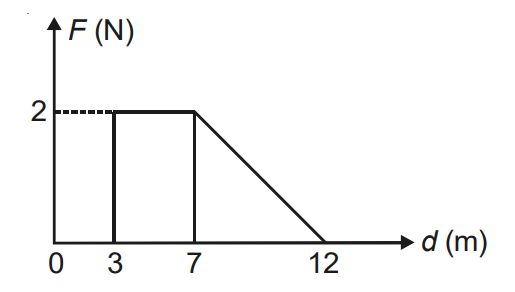 Work done = area under the force–distance graph.
From the graph, the force is 2 N from d = 3 m to d = 7 m and then falls uniformly to zero at d = 12 m.
Area of the rectangle (3 m to 7 m) = $2\times(7 - 3) = 8$ J
Area of the triangle (7 m to 12 m) = $\frac{1}{2}\times(12 - 7)\times2 = 5$ J
Total work = 8 + 5 = 13 J -
A particle of mass M starting from rest undergoes uniform acceleration. If the speed acquired in time T is V, the power delivered to the particle isBy the work–energy theorem, work done on the particle = gain in kinetic energy: $W = \frac{1}{2}MV^2 - 0 = \frac{1}{2}MV^2$
This work is delivered in time T.
Power delivered (average) = $\frac{W}{T}$
$P = \frac{1}{2}\frac{MV^2}{T}$ -
An engine pumps water through a hose pipe. Water passes through the pipe and leaves it with a velocity of 2 m/s. The mass per unit length of water in the pipe is 100 kg/m. What is the power of the engine?Mass of water flowing out per second: $\frac{dm}{dt} = (\text{mass per unit length})\times v = 100\times2 = 200$ kg/s
Force exerted by the engine on the water = rate of change of momentum = $v\frac{dm}{dt} = 2\times200 = 400$ N
Power = force × velocity = $Fv = 400\times2$
In symbols, with $\lambda$ = mass per unit length: $P = \lambda v^3 = 100\times2^3$
P = 800 W -
A ball moving with velocity 2 m/s collides head on with another stationary ball of double the mass. If the coefficient of restitution is 0.5, then their velocities (in m/s) after collision will beLet the masses be m and 2m and the velocities after collision be $v_1$ and $v_2$.
Conservation of momentum: $m\times2 + 2m\times0 = mv_1 + 2mv_2$, so $v_1 + 2v_2 = 2$ ... (i)
Coefficient of restitution: $e = \frac{v_2 - v_1}{u_1 - u_2}$, so $v_2 - v_1 = 0.5\times(2 - 0) = 1$ ... (ii)
Adding (i) and (ii): $3v_2 = 3$, so $v_2 = 1$ m/s
From (ii): $v_1 = v_2 - 1 = 0$
The velocities after collision are 0 and 1 m/s. -
A block of mass M is attached to the lower end of a vertical spring. The spring is hung from a ceiling and has force constant value k. The mass is released from rest with the spring initially unstretched. The maximum extension produced in the length of the spring will beThe block is released from rest and comes momentarily to rest again at the maximum extension x, so its kinetic energy is zero at both positions.
Loss of gravitational potential energy = gain in elastic potential energy of the spring.
$Mgx = \frac{1}{2}kx^2$
$x = \frac{2Mg}{k}$
(This is twice the equilibrium extension Mg/k, because the block overshoots the equilibrium position and oscillates about it.)
Want a score?
Answers here are not saved. Practise as a test to be marked and see your progress.
Practise as a test