Looking for classes? Ksquare Career Institute, Bengaluru →

Chemistry
Aldehydes, Ketones and Carboxylic Acids
91 questions from 38 papers, each with its answer.
- 91 questions
- 38 papers
- 5.17% of Chemistry
Carboxylic acids
-
In a set of reactions, ethyl benzene yielded a product D.

'D' would beStep 1: alkaline $KMnO_4$ oxidises the whole alkyl side chain of an alkylbenzene to –COOH, whatever its length: $C_6H_5CH_2CH_3 \rightarrow C_6H_5COOH$. So B is benzoic acid.
Step 2: $Br_2$/$FeCl_3$ brings about electrophilic substitution in the ring. The –COOH group is deactivating and meta directing, so bromine enters the meta position: C is m-bromobenzoic acid.
Step 3: with ethanol and acid the carboxylic acid is esterified (Fischer esterification): m-$BrC_6H_4COOH + C_2H_5OH \xrightarrow{H^+}$ m-$BrC_6H_4COOC_2H_5 + H_2O$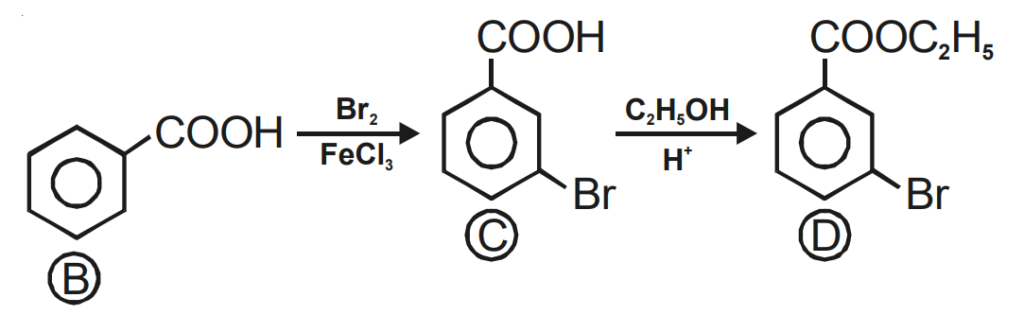
Hence D is ethyl m-bromobenzoate.
Named reactions
-
Which of the following reactions will not result in the formation of carbon-carbon bonds?Friedel–Crafts acylation: $C_6H_6 + RCOCl \xrightarrow{AlCl_3} C_6H_5COR$; a new ring carbon–acyl carbon bond is formed.
Reimer–Tiemann reaction: phenol + $CHCl_3$ + NaOH gives salicylaldehyde; a –CHO group is attached to the ring through a new C–C bond.
Wurtz reaction: $2RX + 2Na \rightarrow R-R + 2NaX$; two alkyl groups are joined by a new C–C bond.
Cannizzaro reaction: an aldehyde without α-hydrogen undergoes disproportionation in concentrated alkali; one molecule is oxidised to the acid salt and another is reduced to the alcohol by hydride transfer, e.g., $2HCHO + KOH \rightarrow HCOOK + CH_3OH$. Only C–H and C–O bonds change.
Hence the Cannizzaro reaction does not form a carbon–carbon bond.
Derivatives of carboxylic acids
-
Among the given compounds, the most susceptible to nucleophilic attack at the carbonyl group isReactivity of acid derivatives towards nucleophiles depends on how electron-deficient the carbonyl carbon is and on how good the leaving group is.
In $CH_3COCl$, chlorine withdraws electrons strongly by its −I effect and its 3p orbital overlaps poorly with the 2p of carbon, so there is little resonance donation; the carbonyl carbon is the most electrophilic.
$Cl^-$ is also the weakest base among the leaving groups ($Cl^-$, $CH_3COO^-$, $CH_3O^-$, $NH_2^-$), so it is the best leaving group.
In the anhydride, ester and amide the lone pair on O or N is donated to the carbonyl group by resonance, reducing its electrophilicity; the effect is greatest in the amide.
Order of reactivity: $CH_3COCl > CH_3COOCOCH_3 > CH_3COOCH_3 > CH_3CONH_2$
Hence $CH_3COCl$ is the most susceptible to nucleophilic attack.
That is every question in Aldehydes, Ketones and Carboxylic Acids for this filter.
Want a score?
Answers here are not saved. Practise as a test to be marked and see your progress.
Practise as a test