Looking for classes? Ksquare Career Institute, Bengaluru →

Physics
Current Electricity
130 questions from 38 papers, each with its answer.
- 130 questions
- 38 papers
- 7.37% of Physics
Kirchhoff's rules
-
In the circuit shown in the figure, if the potential at point A is taken to be zero, the potential at point B is
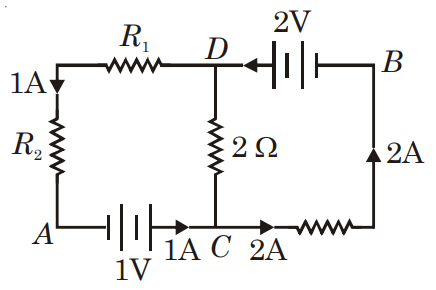 Start from A, where $V_A = 0$, and move along the lower branch A → C → B, adding the potential changes.
Across the 1 V cell from A to C the potential rises by 1 V: $V_C = 0 + 1 = 1$ V
At C the two currents join; the current in the 2 $\Omega$ resistor between D and C is 1 A flowing from D to C, so D is higher than C by $1\times2 = 2$ V: $V_D = 1 + 2 = 3$ V
Going from D to B through the 2 V cell the potential falls by 2 V: $V_B = 3 - 2 = 1$ V
In one line: $0 + 1 + 2 - 2 = V_B$
$V_B = +1$ V
Thermoelectric effect
-
A thermocouple of negligible resistance produces an e.m.f. of 40 $\mu$V/$^\circ C$ in the linear range of temperature. A galvanometer of resistance 10 ohm whose sensitivity is 1 $\mu$A/div, is employed with the thermocouple. The smallest value of temperature difference that can be detected by the system will beThe smallest current the galvanometer can detect is that for one division: $I_{min} = 1\ \mu A$
The thermocouple has negligible resistance, so the circuit resistance is that of the galvanometer, 10 $\Omega$.
Smallest detectable emf: $V_{min} = I_{min}\times R = 1\ \mu A\times10\ \Omega = 10\ \mu V$
The thermocouple gives 40 $\mu$V for each $^\circ C$ of temperature difference.
Smallest detectable temperature difference $= \frac{10\ \mu V}{40\ \mu V/^\circ C}$
$= 0.25^\circ C$
That is every question in Current Electricity for this filter.
Want a score?
Answers here are not saved. Practise as a test to be marked and see your progress.
Practise as a test