Looking for classes? Ksquare Career Institute, Bengaluru →

Physics
Electric Charges and Fields
42 questions from 29 papers, each with its answer.
- 42 questions
- 29 papers
- 2.38% of Physics
Gauss's law
-
A hollow cylinder has a charge $q$ coulomb within it. If $\phi$ is the electric flux in units of volt-metre associated with the curved surface B, the flux linked with the plane surface A in units of volt-metre will be
(A and C are the two plane end faces of the cylinder and B is its curved surface.)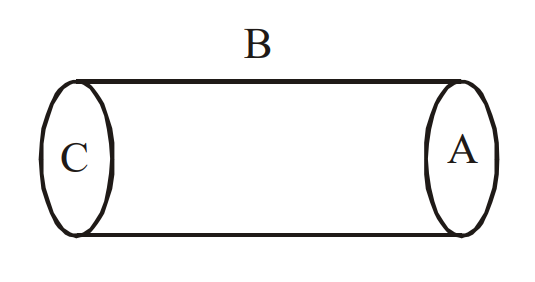 By Gauss's law, the total flux through the closed cylindrical surface is $\phi_{total} = \phi_A + \phi_B + \phi_C = \dfrac{q}{\varepsilon_0}$
Here $q$ is the total charge enclosed.
As given, the flux associated with the curved surface B is $\phi_B = \phi$.
The charge is placed symmetrically, so the flux linked with the two plane surfaces A and C is equal. Let $\phi_A = \phi_C = \phi'$.
Therefore $\dfrac{q}{\varepsilon_0} = 2\phi' + \phi_B = 2\phi' + \phi$
$2\phi' = \dfrac{q}{\varepsilon_0} - \phi$
$\Rightarrow \phi' = \dfrac{1}{2}\left(\dfrac{q}{\varepsilon_0} - \phi\right)$
Electric Dipole
-
Three point charges $+q$, $-2q$ and $+q$ are placed at points $(x = 0, y = a, z = 0)$, $(x = 0, y = 0, z = 0)$ and $(x = a, y = 0, z = 0)$ respectively. The magnitude and direction of the electric dipole moment vector of this charge assembly areThe three point charges $+q$, $-2q$ and $+q$ are placed at B $(0, a, 0)$, O $(0, 0, 0)$ and A $(a, 0, 0)$.
The charge $-2q$ at the origin can be treated as two charges $-q$ and $-q$.
So the system consists of two dipoles: one due to $-q$ at O and $+q$ at A, and the other due to $-q$ at O and $+q$ at B.
Each dipole moment has magnitude $qa$ and points from the negative to the positive charge: one along $\vec{OA}$ (+x direction) and the other along $\vec{OB}$ (+y direction).
The two moments are perpendicular, so the net dipole moment is $p_{net} = \sqrt{(qa)^2 + (qa)^2} = \sqrt{2}\,qa$
Its direction is along OP, at an angle of $45^\circ$ with the positive x-axis, i.e. along the line joining $(0, 0, 0)$ and $(a, a, 0)$.
That is every question in Electric Charges and Fields for this filter.
Show all 42 questions Next: Electrostatic Potential and Capacitance
Want a score?
Answers here are not saved. Practise as a test to be marked and see your progress.
Practise as a test