Looking for classes? Ksquare Career Institute, Bengaluru →

Physics
Electrostatic Potential and Capacitance
76 questions from 37 papers, each with its answer.
- 76 questions
- 37 papers
- 4.31% of Physics
Equipotential surfaces and work done
-
As per this diagram a point charge $+q$ is placed at the origin O. Work done in taking another point charge $-Q$ from the point A, coordinates $(0, a)$, to another point B, coordinates $(a, 0)$, along the straight path AB is
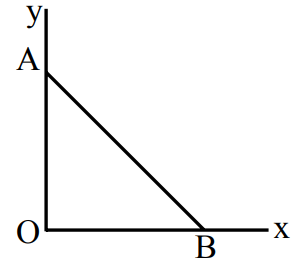 The work done by an external agent in moving a charge $Q'$ from A to B is $W = Q'(V_B - V_A)$; it depends only on the end points, not on the path.
Points A $(0, a)$ and B $(a, 0)$ are both at a distance $a$ from the charge $+q$ at the origin.
$V_A = \dfrac{1}{4\pi\varepsilon_0}\dfrac{q}{a}$ and $V_B = \dfrac{1}{4\pi\varepsilon_0}\dfrac{q}{a}$, so $V_A = V_B$.
Work done $= (-Q)(V_B - V_A) = \dfrac{1}{4\pi\varepsilon_0}\left[\dfrac{(-qQ)}{a} - \dfrac{(-qQ)}{a}\right]$
$= 0$
A and B lie on the same equipotential surface (a sphere of radius $a$ about the charge), so no net work is done even along the straight path AB.
That is every question in Electrostatic Potential and Capacitance for this filter.
Want a score?
Answers here are not saved. Practise as a test to be marked and see your progress.
Practise as a test