Looking for classes? Ksquare Career Institute, Bengaluru →

Physics
Laws of Motion
72 questions from 37 papers, each with its answer.
- 72 questions
- 37 papers
- 4.08% of Physics
Static Friction
-
The coefficient of static friction, $\mu_s$, between block A of mass 2 kg and the table as shown in the figure is 0.2. What would be the maximum mass value of block B so that the two blocks do not move ? The string and the pulley are assumed to be smooth and massless. (g = 10 m/s$^2$)
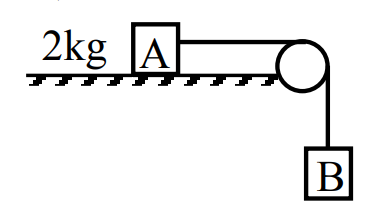 For the blocks not to move, the tension T in the string must balance the weight of B, and the friction on A must balance T.
For block B: $T = m_Bg$
For block A, the maximum static friction available is $f_{max} = \mu_s N = \mu_s m_A g$.
For the maximum value of $m_B$ (blocks just on the verge of moving): $T = m_Bg = \mu_s(m_Ag)$
$\Rightarrow m_B = \mu_s m_A = 0.2 \times 2 = 0.4$ kg
So the maximum mass of block B is 0.4 kg.
That is every question in Laws of Motion for this filter.
Want a score?
Answers here are not saved. Practise as a test to be marked and see your progress.
Practise as a test