Looking for classes? Ksquare Career Institute, Bengaluru →

Physics
Semiconductor Electronics: Materials, Devices and Simple Circuits
106 questions from 34 papers, each with its answer.
- 106 questions
- 34 papers
- 6.01% of Physics
p-n junction diode
-
In the following figure, the diodes which are forward biased are
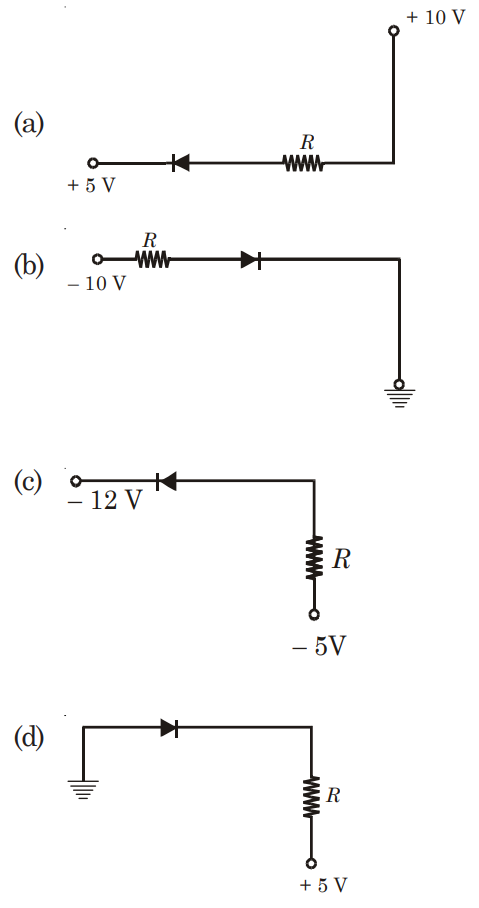 A diode is forward biased when its p-side (anode) is at a higher potential than its n-side (cathode).
(a): the p-side is connected (through R) to +10 V and the n-side to +5 V; p is at the higher potential, so it is forward biased.
(b): the p-side is connected (through R) to −10 V and the n-side to earth (0 V); p is at the lower potential, so it is reverse biased.
(c): the p-side is connected (through R) to −5 V and the n-side to −12 V; −5 V is higher than −12 V, so it is forward biased.
(d): the p-side is earthed (0 V) and the n-side is connected (through R) to +5 V; p is at the lower potential, so it is reverse biased.
Hence the forward biased diodes are (c) and (a).
Extrinsic semiconductors
-
Pure Si at 500 K has equal number of electron ($n_e$) and hole ($n_h$) concentrations of $1.5\times10^{16}\ m^{-3}$. Doping by indium increases $n_h$ to $4.5\times10^{22}\ m^{-3}$. The doped semiconductor is ofIndium is a trivalent impurity (acceptor); it creates holes, so the doped semiconductor is p-type.
For a semiconductor in thermal equilibrium, $n_en_h = n_i^2$ (mass action law).
$n_i = 1.5\times10^{16}\ m^{-3}$, so $n_i^2 = 2.25\times10^{32}\ m^{-6}$
$n_e = \frac{n_i^2}{n_h} = \frac{2.25\times10^{32}}{4.5\times10^{22}}$
$n_e = 0.5\times10^{10} = 5\times10^9\ m^{-3}$
So it is p-type with electron concentration $n_e = 5\times10^9\ m^{-3}$.
Zener diode as a voltage regulator
-
A zener diode, having breakdown voltage equal to 15 V, is used in a voltage regulator circuit shown in figure. The current through the diode is
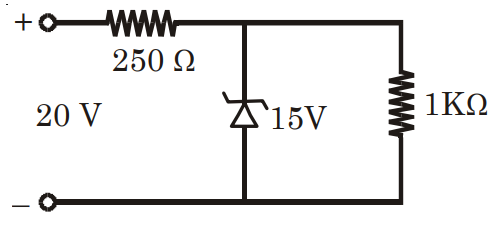 In the circuit the 20 V supply is connected through a 250 $\Omega$ series resistor to the zener diode, and a 1 k$\Omega$ load is in parallel with the zener.
The zener is in breakdown, so the voltage across it and across the load is 15 V.
Voltage across the series resistor = 20 − 15 = 5 V
Current through the series resistor: $I = \frac{5}{250} = 0.02$ A = 20 mA
Current through the load: $I_L = \frac{15}{1000} = 0.015$ A = 15 mA
Current through the zener diode: $I_Z = I - I_L = 20 - 15 = 5$ mA
That is every question in Semiconductor Electronics: Materials, Devices and Simple Circuits for this filter.
Want a score?
Answers here are not saved. Practise as a test to be marked and see your progress.
Practise as a test