Looking for classes? Ksquare Career Institute, Bengaluru →

Physics
Work, Energy and Power
71 questions from 36 papers, each with its answer.
- 71 questions
- 36 papers
- 4.02% of Physics
Motion in a vertical circle
-
A stone is tied to a string of length '$l$' and is whirled in a vertical circle with the other end of the string as the centre. At a certain instant of time, the stone is at its lowest position and has a speed 'u'. The magnitude of the change in velocity as it reaches a position where the string is horizontal (g being acceleration due to gravity) is :-Let A be the lowest point (speed $V_A = u$, horizontal) and P the point where the string is horizontal (height $l$ above A).
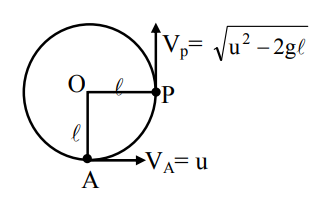
By conservation of energy between A and P: $\dfrac{1}{2}mu^2 = \dfrac{1}{2}mV_P^2 + mgl$
$\Rightarrow V_P = \sqrt{u^2 - 2gl}$
At A the velocity is horizontal; at P (string horizontal) the velocity is vertical. So the angle between $\vec{V}_A$ and $\vec{V}_P$ is $90^\circ$.
Magnitude of change in velocity $= |\vec{V}_P - \vec{V}_A| = \sqrt{V_P^2 + V_A^2}$ (because the two vectors are perpendicular)
$= \sqrt{(u^2 - 2gl) + u^2} = \sqrt{2u^2 - 2gl}$
$= \sqrt{2(u^2 - gl)}$
That is every question in Work, Energy and Power for this filter.
Show all 71 questions Next: System of Particles and Rotational Motion
Want a score?
Answers here are not saved. Practise as a test to be marked and see your progress.
Practise as a test