Looking for classes? Ksquare Career Institute, Bengaluru →

Biology
Biotechnology: Principles and Processes
132 questions from 36 papers, each with its answer.
- 132 questions
- 36 papers
- 3.74% of Biology
Restriction Enzymes
-
Which one of the following represents a palindromic sequence in DNA?A palindromic sequence in DNA is a sequence of base pairs that reads the same on the two strands when the orientation of reading is kept the same (5′ → 3′ on both strands).
Take 5′ - GAATTC - 3′ with its complementary strand 3′ - CTTAAG - 5′.
Reading the upper strand 5′ → 3′ gives GAATTC; reading the lower strand 5′ → 3′ also gives GAATTC.
This is the recognition sequence of the restriction enzyme EcoRI.
In the other sequences the two strands are not even proper complements of each other and they do not read the same in the 5′ → 3′ direction.
Hence the palindromic sequence is 5′ - GAATTC - 3′ / 3′ - CTTAAG - 5′.
Cloning Vectors
-
In genetic engineering, the antibiotics are usedA cloning vector carries a selectable marker, which helps to identify and eliminate the non-transformants and selectively permit the growth of the transformants.
Genes coding for resistance to antibiotics such as ampicillin, tetracycline, chloramphenicol and kanamycin are the usual selectable markers (e.g., $amp^R$ and $tet^R$ in pBR322).
When the cells are plated on a medium containing the antibiotic, only the cells that have taken up the plasmid survive, so the transformants are selected.
The sequence from where replication starts is the origin of replication (ori), which is a different feature of the vector.
Hence, in genetic engineering, antibiotics are used as selectable markers.
Note: the coaching key in the source PDF marks 'To select healthy vectors'; the NCERT description (and the official answer) is that antibiotic resistance acts as a selectable marker, so that is taken as correct here.
Polymerase chain reaction
-
The figure below shows three steps (A, B, C) of Polymerase Chain Reaction (PCR). Select the option giving correct identification together with what it represents.
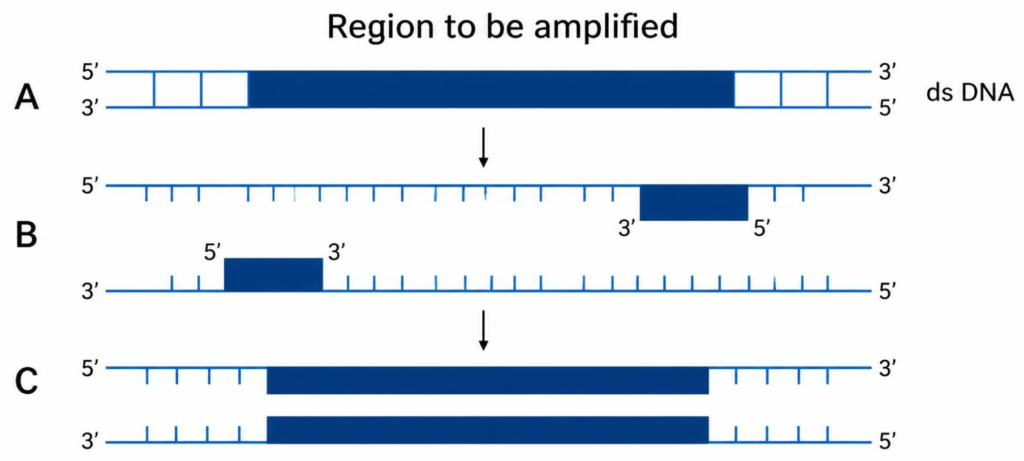 Each cycle of PCR has three steps in a fixed order: denaturation, annealing and extension.
Step A is denaturation: the double-stranded DNA is heated to a high temperature (about $94^\circ C$) so that the two strands separate. It is not annealing, and it does not occur at about $50^\circ C$.
Step B is annealing: two sets of primers bind to the complementary regions of the separated strands at a lower temperature. It is not denaturation.
Step C is extension: the thermostable DNA polymerase (Taq polymerase from $Thermus\ aquaticus$) extends the primers using the nucleotides provided, copying the template.
Hence the correct identification is C – extension in the presence of heat stable DNA polymerase.
Methods of gene transfer
-
Biolistics (gene-gun) is suitable forIn biolistics (the gene-gun method), cells are bombarded with high-velocity micro-particles of gold or tungsten coated with DNA.
The particles penetrate the thick cell wall and deliver the DNA into the cell, so the method is suitable for plant cells.
It is a direct, vector-less method of introducing alien DNA into the host, i.e., of transformation.
DNA fingerprinting uses probes and electrophoresis, disarming of pathogen vectors is done by removing their disease-causing genes, and recombinant DNA is constructed using restriction enzymes and DNA ligase.
Hence biolistics is suitable for the transformation of plant cells.
That is every question in Biotechnology: Principles and Processes for this filter.
Show all 132 questions Next: Biotechnology and its Applications
Want a score?
Answers here are not saved. Practise as a test to be marked and see your progress.
Practise as a test