Looking for classes? Ksquare Career Institute, Bengaluru →

Chemistry
Start Practice Clear paper filter
Showing 1–25 of 45 questions
-
Which among the following salt solutions is basic in nature?Sodium acetate is the salt of a strong base (NaOH) and a weak acid (acetic acid); on hydrolysis, the acetate ion produces $OH^-$ ions, making the solution basic. The other three are salts of a weak base (ammonium hydroxide) and strong acids, so their solutions are acidic.
-
If 8 g of a non-electrolyte solute is dissolved in 114 g of n-octane to reduce its vapour pressure to 80%, the molar mass (in g mol$^{-1}$) of the solute is [Given that molar mass of n-octane is 114 g mol$^{-1}$]$\dfrac{P^0-P_s}{P^0}=\dfrac{n_{solute}}{n_{solute}+n_{solvent}}\approx\dfrac{n_{solute}}{n_{solvent}}$ (dilute solution). Here $\dfrac{P^0-P_s}{P^0}=1-0.8=0.2$. Moles of octane $=\dfrac{114}{114}=1$. $0.2=\dfrac{8/M}{1}\Rightarrow M=\dfrac{8}{0.2}=40\ g\,mol^{-1}$.
-
Identify compound (A) in the following reaction:
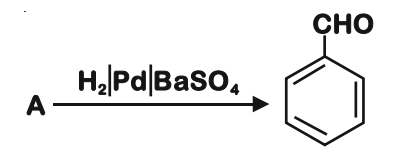 In the Rosenmund reduction, an acid chloride is selectively reduced to an aldehyde using $H_2$ over a poisoned Pd-$BaSO_4$ catalyst. So A must be benzoyl chloride ($C_6H_5COCl$), which is reduced to benzaldehyde.
 -
Identify the incorrect statement from the following:While +3 is the most common and characteristic oxidation state of lanthanoids, some lanthanoids also show +2 and +4 oxidation states (e.g. $Ce^{4+}$, $Eu^{2+}$), so the statement that lanthanoids reveal only the +3 oxidation state is incorrect.
-
The half-life for a zero order reaction having 0.02 M initial concentration of reactant is 100 s. The rate constant (in mol L$^{-1}$ s$^{-1}$) for the reaction isFor a zero order reaction, $t_{1/2}=\dfrac{[A_0]}{2k}\Rightarrow k=\dfrac{[A_0]}{2t_{1/2}}=\dfrac{0.02}{2\times100}=1.0\times10^{-4}\ mol\,L^{-1}s^{-1}$.
-
Match the coordination number and type of hybridisation with distribution of hybrid orbitals in space based on Valence bond theory.
Pick the matching item from Column II for each row.
Column I
- a. 4, sp3
- b. 4, dsp2
- c. 5, sp3d
- d. 6, d2sp3
Column II
- i. trigonal bipyramidal
- ii. octahedral
- iii. tetrahedral
- iv. square planar
Correct answer: a → iii, b → iv, c → i, d → ii
4, $sp^3$ hybridisation gives tetrahedral geometry (a-iii); 4, $dsp^2$ hybridisation gives square planar geometry (b-iv); 5, $sp^3d$ hybridisation gives trigonal bipyramidal geometry (c-i); 6, $d^2sp^3$ hybridisation gives octahedral geometry (d-ii). -
Match the element in column I with that in column II.
Pick the matching item from Column II for each row.
Column I
- a. Copper
- b. Fluorine
- c. Silicon
- d. Cerium
Column II
- i. Non-metal
- ii. Transition Metal
- iii. Lanthanoid
- iv. Metalloid
Correct answer: a → ii, b → i, c → iv, d → iii
Copper is a transition metal (a-ii); Fluorine is a non-metal (b-i); Silicon is a metalloid (c-iv); Cerium is a lanthanoid (d-iii). -
In collision theory of chemical reaction, $Z_{AB}$ representsIn collision theory, $Z_{AB}$ represents the collision frequency of the reactants A and B, i.e. the number of collisions per unit time per unit volume.
-
At standard conditions, if the change in the enthalpy for the following reaction is $-109\ kJ\,mol^{-1}$: $H_2(g)+Br_2(g)\rightarrow2HBr(g)$. Given that bond energy of $H_2$ and $Br_2$ is $435\ kJ\,mol^{-1}$ and $192\ kJ\,mol^{-1}$, respectively, what is the bond energy (in kJ mol$^{-1}$) of HBr?$\Delta H=\text{(bonds broken)}-\text{(bonds formed)}=(435+192)-2\times BE(HBr)$. $-109=627-2\,BE(HBr)\Rightarrow2\,BE(HBr)=736\Rightarrow BE(HBr)=368\ kJ\,mol^{-1}$.
-
The solubility product for a salt of the type AB is $4\times10^{-8}$. What is the molarity of its standard solution?For AB type salt, $K_{sp}=s^2\Rightarrow s=\sqrt{K_{sp}}=\sqrt{4\times10^{-8}}=2\times10^{-4}$ mol/L.
-
The potential energy (y) curve for $H_2$ formation as a function of internuclear distance (x) of the H atoms is shown below, with asymptote at 'a', minimum at 'b', and reference level at 'c'.
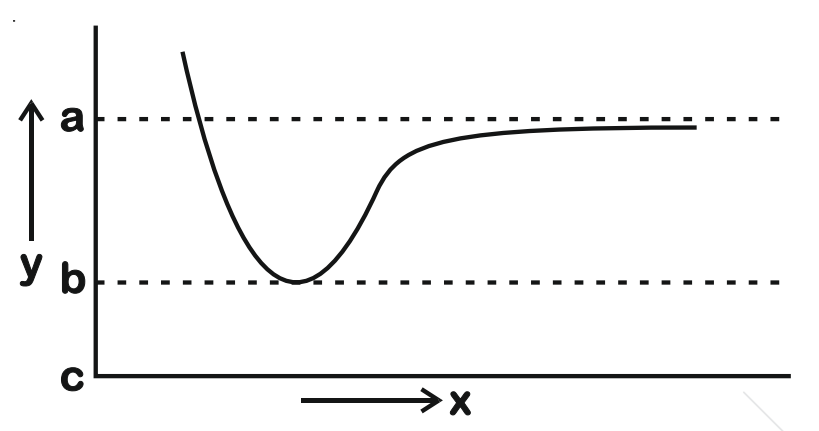 The bond energy of $H_2$ isThe bond energy corresponds to the depth of the potential energy well, i.e. the difference between the potential energy at infinite separation (level 'a') and the minimum potential energy at the equilibrium bond length (level 'b'): bond energy $=(b-a)$ in magnitude (the curve dips to a lower, i.e., more negative, energy at 'b').
 -
Match the elements in Column I with methods of purification in Column II.
Pick the matching item from Column II for each row.
Column I
- a. Boron
- b. Tin
- c. Zirconium
- d. Nickel
Column II
- i. Van Arkel method
- ii. Mond's process
- iii. Liquation
- iv. Zone refining
Correct answer: a → iv, b → iii, c → i, d → ii
Boron is purified by zone refining (a-iv); Tin is purified by liquation (b-iii); Zirconium is purified by the Van Arkel method (c-i); Nickel is purified by Mond's process (d-ii). -
A liquid compound (x) can be purified by steam distillation only if it isSteam distillation is used to purify liquid compounds that are steam volatile (has an appreciable vapour pressure at $100^\circ C$) and immiscible with water, so that a mixture of the compound and water can be distilled at a temperature below $100^\circ C$.
-
What is the role of gypsum, $CaSO_4\cdot2H_2O$ in setting of cement? Identify the correct option from the following:Gypsum is added to cement clinker to slow down (retard) the setting process of cement, preventing it from setting too quickly and allowing time for it to be used effectively.
-
Which of the following substituted phenols is the strongest acid?Electron-withdrawing groups (like $-NO_2$) stabilise the phenoxide ion by delocalising the negative charge (through resonance and inductive effect), increasing acidity. Electron-donating groups ($-CH_3$, $-OCH_3$, $-C_2H_5$) destabilise the phenoxide ion, decreasing acidity. So p-nitrophenol, with the strong EWG $-NO_2$, is the strongest acid among the given options.
-
Deficiency of which vitamin causes osteomalacia?Deficiency of Vitamin D causes osteomalacia in adults (softening of bones due to impaired calcium absorption) and rickets in children.
-
Which one of the following reactions does not come under hydrolysis type reaction?Reactions (1), (2) and (3) are all hydrolysis reactions in which water reacts to break bonds of the compound (P-O, Si-Cl, Li-N), forming new O-H/other bonds. Reaction (4), $2F_2+2H_2O\rightarrow4HF+O_2$, is a redox reaction (fluorine displaces oxygen from water; fluorine is reduced and oxygen is oxidised), not a hydrolysis reaction.
-
Which one of the following compounds shows both, Frenkel as well as Schottky defects?AgBr is unusual in that it shows both Frenkel defects (due to the small size of $Ag^+$, which can move to interstitial sites) and Schottky defects (as the sizes of $Ag^+$ and $Br^-$ are not too different).
-
Which of the following is not true about chloramphenicol?Chloramphenicol is a broad-spectrum antibiotic, effective against both gram-positive and gram-negative bacteria — so the statement that it inhibits the growth of only gram-positive bacteria is not true.
-
The oxidation number of the underlined atom in the following species: (1) $H\underline{Au}Cl_4$ is +3 (2) $\underline{Cu}_2O$ is $-1$ (3) $\underline{Cl}O_3^-$ is +5 (4) $K_2\underline{Cr}_2O_7$ is +6. Identify the incorrect option.In $Cu_2O$, oxygen is $-2$; for charge balance, $2x+(-2)=0\Rightarrow x=+1$. So copper in $Cu_2O$ is $+1$, not $-1$ — the statement in option (2) is incorrect. (Options 1, 3, 4 are correctly assigned oxidation states.)
-
Which of the following will NOT undergo $S_N1$ reaction with $OH^-$?$S_N1$ reactions proceed via a carbocation intermediate and are favoured when the carbocation is stabilised. Benzyl chloride (resonance-stabilised benzylic cation), allyl chloride (resonance-stabilised allylic cation), and tert-butyl chloride (stable tertiary carbocation) all readily undergo $S_N1$. 2-Phenylethyl chloride would form an unstabilised primary carbocation (the phenyl ring is not directly attached to the carbon bearing the leaving group), so it does not readily undergo $S_N1$.
-
Reaction of propanamide with ethanolic sodium hydroxide and bromine will giveIn the Hofmann bromamide degradation reaction, an amide $RCONH_2$ reacts with $Br_2$ and alcoholic $NaOH$ to give a primary amine with one carbon less than the starting amide: $CH_3CH_2CONH_2$ (propanamide) $\rightarrow CH_3CH_2NH_2$ (ethylamine).
-
In which of the sols, the colloidal particles are with negative charge?Starch sol carries negatively charged colloidal particles. (Hydrated $Al_2O_3$ and haemoglobin form positively charged sols; $TiO_2$ sol particles are also positively charged.)
-
The minimum pressure required to compress 600 dm$^3$ of a gas at 1 bar to 150 dm$^3$ at 40°C isAt constant temperature, Boyle's law gives $P_1V_1=P_2V_2\Rightarrow1\times600=P_2\times150\Rightarrow P_2=4.0$ bar.
-
The number of angular nodes and radial nodes in 3s orbital areFor an ns orbital, angular nodes $=l=0$. Radial nodes $=n-l-1=3-0-1=2$. So 3s has 0 angular nodes and 2 radial nodes.