Looking for classes? Ksquare Career Institute, Bengaluru →

Chemistry
Start Practice Clear paper filter
Showing 1–25 of 45 questions
-
For the following reaction sequence, choose the correct option.
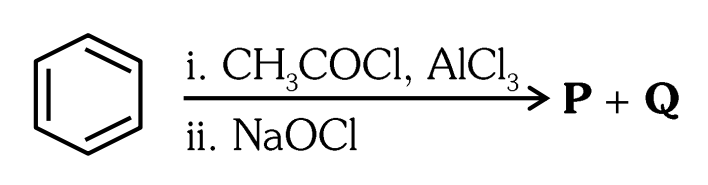
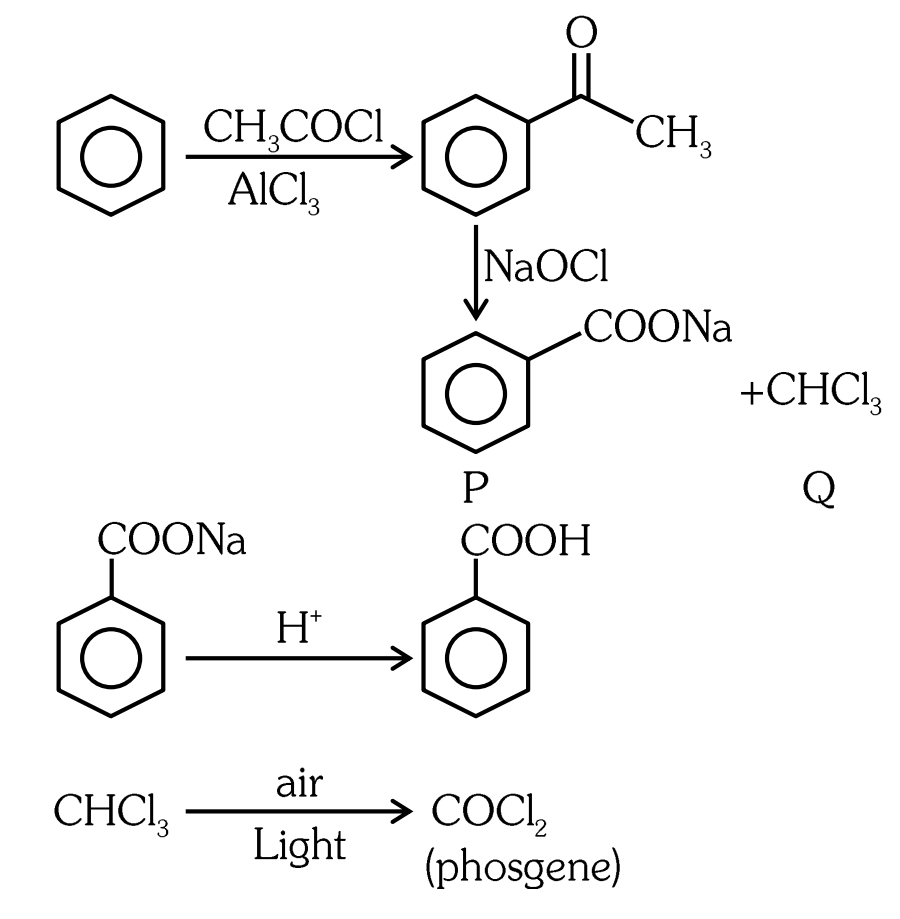 Friedel-Crafts acylation gives acetophenone: $C_6H_6\xrightarrow{CH_3COCl/AlCl_3}C_6H_5COCH_3$. The haloform reaction with NaOCl gives $C_6H_5COONa$ (P) + $CHCl_3$ (Q). On acidification P gives benzoic acid, $C_6H_5COOH$. Chloroform on exposure to air and light forms the poisonous gas phosgene: $CHCl_3\xrightarrow{air,\ light}COCl_2$.
 -
Given below are two statements: Statement-I: $[Fe(ox)_3]^{3-}$ is chiral. Statement-II: trans-$[Cr(H_2O)_2(ox)_2]^-$ is chiral. (Given: $oxH_2$ = HOOC-COOH) In light of the above statements, choose the most appropriate answer from the options given below:S-I: $[Fe(ox)_3]^{3-}$ is of the type $[M(AA)_3]$, has no plane of symmetry and is optically active, so it is chiral - correct. S-II: trans-$[Cr(H_2O)_2(ox)_2]^-$ has a plane of symmetry (the two ox ligands in one plane, water molecules trans), so it is not optically active, i.e. not chiral - incorrect.
-
The following carbocation is stabilized by the interaction of the empty p orbital with
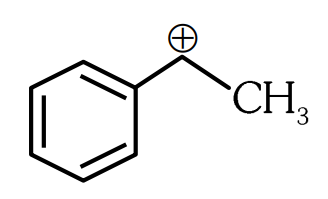 The empty p orbital of the benzylic carbocation $C_6H_5\overset{+}{C}HCH_3$ is stabilised by hyperconjugation with the filled C-H $\sigma$ orbitals of $CH_3$ and by resonance with the filled $\pi$ orbitals of the benzene ring.
 -
In potash alum, the ratio of $K^+$ and $SO_4^{2-}$ ions isPotash alum is $K_2SO_4\cdot Al_2(SO_4)_3\cdot24H_2O$. $K^+:SO_4^{2-}=2:4=1:2$.
-
The correct statement about peptides and proteins isIn $\beta$-pleated sheet structures, peptide chains are held together by intermolecular hydrogen bonds (NCERT, Biomolecules). The $\alpha$-helix is a right-handed helix, quaternary structure involves two or more subunits, and proteins need not have a quaternary structure to be biologically active.
-
The numbers 17.0145 and 21.0235 were rounded to three figures after the decimal point. The resulting numbers, respectively, are17.0145: the rightmost digit to be removed is 5 and the preceding digit (4) is even, so it remains unchanged: 17.014. 21.0235: the digit to be removed is 5 and the preceding digit (3) is odd, so it is increased by 1: 21.024.
-
The correct order of solubility of the given salts in water at 298 K is AgBr: $K_{sp}=5.0\times10^{-13}$; $Zn(OH)_2$: $K_{sp}=1.0\times10^{-15}$; $Hg_2Cl_2$: $K_{sp}=1.3\times10^{-18}$AgBr: $K_{sp}=s^2 \Rightarrow s_1=\sqrt{5\times10^{-13}}=7.1\times10^{-7}$ M. $Zn(OH)_2$: $K_{sp}=4s^3 \Rightarrow s_2=\left(\frac{1.0\times10^{-15}}{4}\right)^{1/3}=6.3\times10^{-6}$ M. $Hg_2Cl_2\rightarrow Hg_2^{2+}+2Cl^-$: $K_{sp}=4s^3 \Rightarrow s_3=\left(\frac{1.3\times10^{-18}}{4}\right)^{1/3}=6.9\times10^{-7}$ M. Order of solubility: $Zn(OH)_2>AgBr>Hg_2Cl_2$.
-
Among the following options, the correct trend in the electron gain enthalpy isThe electron gain enthalpy order (magnitude) of the halogens is Cl > F > Br > I; fluorine is lower than chlorine because of electron-electron repulsion in its small 2p subshell.
-
For an ideal solution formed by mixing liquids P and Q, $\Delta_{mix}H=0$ and $\Delta_{mix}V=0$Reason: No interactions occur between P and QAn ideal solution forms when the intermolecular attractive forces P-P and Q-Q are nearly equal to those between P-Q. Since the interactions remain nearly the same, $\Delta_{mix}H=0$ and $\Delta_{mix}V=0$. Interactions between P and Q do occur, so the Assertion is correct and the Reason is incorrect.
-
The amino acid that gives a red-blood colour on treating its sodium fusion extract with sodium nitroprusside isMethionine, $CH_3-S-CH_2-CH_2-CH(NH_2)-COOH$, contains both sulphur and nitrogen, so its sodium fusion extract gives the red-blood colour test.
-
The standard electrode potential ($E^\circ$) for the half-cell reaction $Fe^{3+}+e^-\rightarrow Fe^{2+}$ at 298 K is (Given: $E^\circ(Fe^{3+}/Fe)=-0.04$ V and $E^\circ(Fe^{2+}/Fe)=-0.44$ V at 298 K)(1) $Fe^{3+}+3e^-\rightarrow Fe$; (2) $Fe^{2+}+2e^-\rightarrow Fe$; (3) $Fe^{3+}+e^-\rightarrow Fe^{2+}$. Eq. (3) = Eq. (1) - Eq. (2), so $\Delta G_3^\circ=\Delta G_1^\circ-\Delta G_2^\circ \Rightarrow -1\cdot FE_3^\circ=-3FE_1^\circ-(-2FE_2^\circ) \Rightarrow E_3^\circ=3E_1^\circ-2E_2^\circ=3(-0.04)-2(-0.44)=-0.12+0.88=+0.76$ V.
-
In an acidic medium, 10 mL of 0.25 M oxalic acid is titrated with $KMnO_4$ solution. If the volume of $KMnO_4$ solution required to reach end point is 10 mL, the strength of the $KMnO_4$ solution isEquivalents of oxalic acid = equivalents of $KMnO_4$: $M_1\times n_1\times V_1=M_2\times n_2\times V_2 \Rightarrow 0.25\times2\times10=M_2\times5\times10 \Rightarrow M_2=0.10$ M.
-
According to crystal field theory, the correct order of ligands with respect to their decreasing order of field strength isSpectrochemical series (decreasing field strength): $CO>NH_3>H_2O>Cl^-$.
-
Two moles of an ideal gas undergo free expansion from 10 L to 100 L at 300 K. The values of $\Delta S_{system}$ and $\Delta S_{surroundings}$ are (R is universal gas constant)Isothermal free expansion of 2 mol: $\Delta S_{sys}=nR\ln\frac{V_2}{V_1}=2R\ln\frac{100}{10}=2R\times2.303=4.606R$. Since $dT=0$, $\Delta U=0$; $P_{ext}=0$, so $W=0$. By the first law, $Q=0$. As no heat is exchanged with the surroundings, $\Delta S_{surr}=-\frac{Q_{sys}}{T}=0$.
-
$2A\xrightarrow{k}B$ is a zero-order reaction, where k = 1.0 mol L$^{-1}$ min$^{-1}$. If the initial concentration of A is 2 M, then the time taken to complete 75% of the reaction will be$2A\xrightarrow{k}B$, zero order: rate $=\frac{1}{2}\left(-\frac{d[A]}{dt}\right)=k \Rightarrow -\frac{d[A]}{dt}=2k \Rightarrow [A]_0-[A]_t=2kt$. For 75% completion, $[A]_t=0.25\times2=0.5$ M: $2-0.5=2(1)t_{75\%} \Rightarrow t_{75\%}=0.75$ min.
-
Generally, 3d transition metals have high melting points.Reason: Involvement of 3d-electrons in addition to 4s-electrons in the interatomic metallic bonding.In d-block metals, unpaired electrons of the (n-1)d subshell also take part in metallic bonding along with the ns electrons. This makes interatomic metallic bonding comparatively strong, hence their melting points are high. Both A and R are correct and R explains A.
-
For a salt XY, which is a strong electrolyte, the plot of $\Lambda_m$ versus $\sqrt{c}$ has a slope of -90.0 S cm$^2$ mol$^{-3/2}$ L$^{1/2}$ at 298 K. At 0.01 M concentration of XY, the value of $\Lambda_m$ is 145.0 S cm$^2$ mol$^{-1}$. The limiting molar conductivity of $Y^-$ ion ($\lambda^0_{Y^-}$, in S cm$^2$ mol$^{-1}$) at 298 K will be (Given: $\lambda^0_{X^+}=74.0$ S cm$^2$ mol$^{-1}$)Debye-Huckel-Onsager equation: $\Lambda_m=\Lambda_m^0-A\sqrt{c}$. The slope of $\Lambda_m$ vs $\sqrt{c}$ is $-A=-90$, so A = 90. At c = 0.01 M: $145=\Lambda_m^0-90\times\sqrt{10^{-2}}=\Lambda_m^0-9 \Rightarrow \Lambda_m^0=154$ S cm$^2$ mol$^{-1}$. $\Lambda_m^0(XY)=\lambda^0(X^+)+\lambda^0(Y^-) \Rightarrow \lambda^0(Y^-)=154-74=80$ S cm$^2$ mol$^{-1}$.
-
The amount of carbon dioxide evolved upon complete combustion of 116 g of n-butane is (Given: atomic mass in amu H = 1, C = 12 and O = 16)n-butane is $C_4H_{10}$; $n=\frac{116}{58}=2$ mol. $C_4H_{10}+\frac{13}{2}O_2\rightarrow4CO_2+5H_2O$, so 2 mol butane gives 8 mol $CO_2$. Mass $=8\times44=352$ g.
-
For an elementary chemical reaction, the Arrhenius plot is given below.
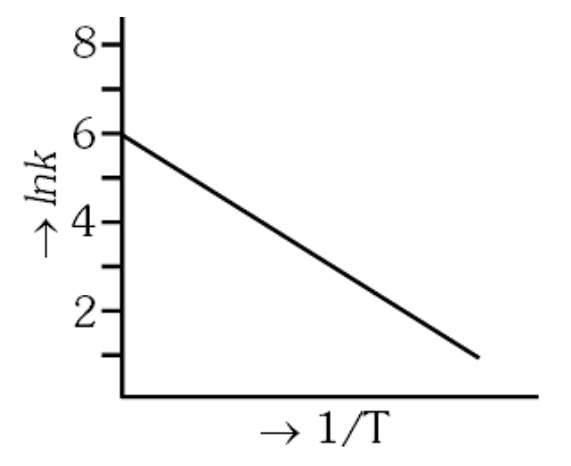 If the energy of activation is 6.64 kJ mol$^{-1}$ and R = 8.3 J K$^{-1}$ mol$^{-1}$, the temperature at which the rate constant becomes $e^2$ min$^{-1}$, is$\ln k=\ln A-\frac{E_a}{RT}$. From the graph, $\ln A=6$ (intercept). For $k=e^2$: $2=6-\frac{6.64\times1000}{8.3\times T} \Rightarrow \frac{6640}{8.3\times T}=4 \Rightarrow T=200$ K.
 -
Given below are two statements: Statement-I: Heating NaCl with concentrated $H_2SO_4$ and $MnO_2$ results in oxidation of Mn. Statement-II: Heating NaI with concentrated $H_2SO_4$ and $MnO_2$ results in reduction of Mn. In light of the above statements, choose the most appropriate answer from the options given below.S-I: $4NaCl+MnO_2+4H_2SO_4\rightarrow MnCl_2+4NaHSO_4+2H_2O+Cl_2$. Mn goes from +4 to +2, i.e. it is reduced, not oxidised - Statement I is wrong. S-II: $2NaI+MnO_2+4H_2SO_4\rightarrow I_2+MnSO_4+Na_2SO_4+2H_2O$. Mn goes from +4 to +2, i.e. it is reduced - Statement II is correct.
-
Among the species given below, the spin-only magnetic moment is highest for (Given: Atomic number of Ti = 22, Mn = 25, Fe = 26 and Co = 27)(1) $[Mn(CN)_6]^{3-}$: $d^2sp^3$, $Mn^{3+}=3d^4$ (low spin) $\Rightarrow$ n = 2. (2) $[Fe(CN)_6]^{3-}$: $Fe^{3+}=3d^5$ (low spin) $\Rightarrow$ n = 1. (3) $[Co(NH_3)_6]^{3+}$: $Co^{3+}=3d^6$ (low spin) $\Rightarrow$ n = 0. (4) $[Ti(H_2O)_6]^{3+}$: $Ti^{3+}=3d^1 \Rightarrow$ n = 1. $[Mn(CN)_6]^{3-}$ has the maximum number of unpaired electrons, so the highest spin-only magnetic moment.
-
The lanthanide ion having four unpaired electrons is (Given: Atomic numbers of Ce = 58, Nd = 60, Tb = 65 and Ho = 67)$Nd^{3+}=4f^3$: n = 3. $Ce^{3+}=4f^1$: n = 1. $Tb^{3+}=4f^8$: n = 6. $Ho^{3+}=4f^{10}$: n = 4. So $Ho^{3+}$ has four unpaired electrons.
-
The formula of tetraammineaquachloridocobalt(III) chloride isTetraammine = $(NH_3)_4$, aqua = $H_2O$, chlorido = Cl as ligands; cobalt(III) needs two chloride counter ions: $[Co(NH_3)_4(H_2O)Cl]Cl_2$.
-
Consider the reversible processes for 1.0 mol of an ideal gas as shown in the figure.
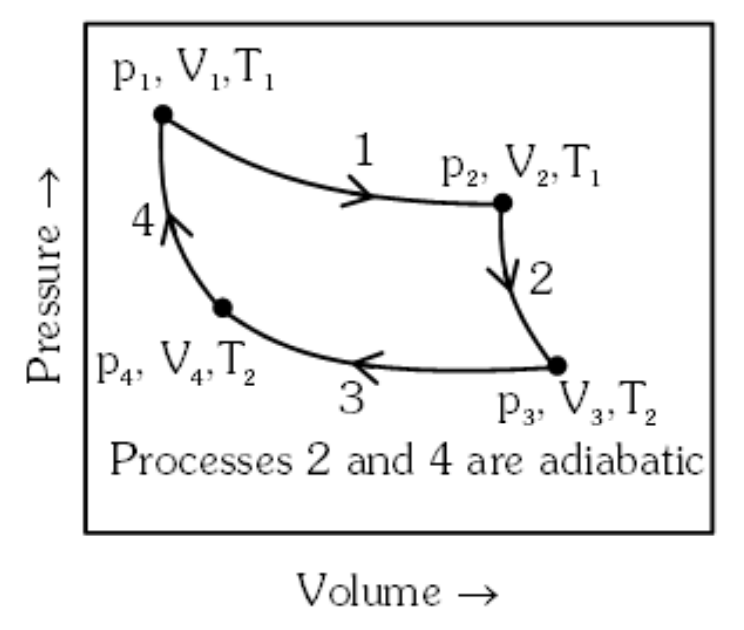 $w_1$, $w_2$, $w_3$ and $w_4$ represent work done (in calories) in the processes 1, 2, 3 and 4, respectively; $\Delta U_2$ and $\Delta U_4$ are changes in the internal energy for the processes 2 and 4, respectively. [use R = 2 cal K$^{-1}$ mol$^{-1}$] The correct option isProcess 1 (isothermal, reversible): $w_1=-nRT_1\ln\frac{V_2}{V_1}=-2T_1\ln\frac{V_2}{V_1}$. Process 3 (isothermal, reversible): $w_3=-2T_2\ln\frac{V_4}{V_3}$. So $w_1+w_3=-2T_1\ln\frac{V_2}{V_1}-2T_2\ln\frac{V_4}{V_3}$. Process 2 (adiabatic expansion): $w_2=\Delta U_2=C_V(T_2-T_1)$. Process 4 (adiabatic compression): $w_4=\Delta U_4=C_V(T_1-T_2)$, so $w_2+w_4=\Delta U_2+\Delta U_4=0$.
 -
The first ionization enthalpy of O is lower than that of N and F.Reason: The loss of an electron from O leads to stable half-filled p orbitalFirst ionisation enthalpy order: O < N < F, so the first IE of O is lower than both N and F. After removal of one electron, O becomes $2p^3$ (stable half-filled), which explains its lower IE. Both A and R are correct and R explains A.