Looking for classes? Ksquare Career Institute, Bengaluru →

Conversion of galvanometer into ammeter
Appears in
Concepts tested here
- Shunt resistance 2
All Questions
2014 AIPMT 1 question
-
In an ammeter 0.2% of main current passes through the galvanometer. If resistance of galvanometer is G, the resistance of ammeter will be:
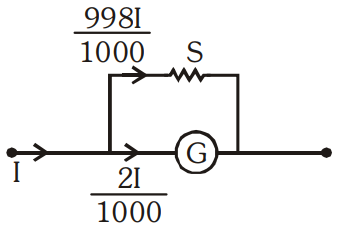
Current through the galvanometer $= \frac{2I}{1000}$; through the shunt $= \frac{998I}{1000}$
$\left(\frac{2I}{1000}\right)G = \left(\frac{998I}{1000}\right)S \Rightarrow S = \frac{G}{499}$
Resistance of ammeter $R = \frac{SG}{S + G} = \frac{\frac{G}{499}\cdot G}{\frac{G}{499} + G} = \frac{G}{500}$
2012 AIPMT-PRE 1 question
-
A millivoltmeter of 25 millivolt range is to be converted into an ammeter of 25 ampere range. The value (in ohm) of necessary shunt will beFull-scale voltage across the meter: $i_gR_g = 25\times10^{-3}$ V
The shunt is in parallel, so $S(i - i_g) = i_gR_g$
$S = \frac{i_gR_g}{i - i_g} \approx \frac{25\times10^{-3}}{25}$ (since $i_g \ll i$)
$S = 10^{-3}\ \Omega = 0.001\ \Omega$