Looking for classes? Ksquare Career Institute, Bengaluru →

Physics
Oscillations
63 questions from 34 papers, each with its answer.
- 63 questions
- 34 papers
- 3.57% of Physics
Combination of springs
-
Two springs of spring constants $k_1$ and $k_2$ are joined in series. The effective spring constant of the combination is given by -When springs are joined in series, the same force F acts in each spring, and the total extension is the sum of the individual extensions.
$x = x_1 + x_2 \Rightarrow \dfrac{F}{k_{eff}} = \dfrac{F}{k_1} + \dfrac{F}{k_2}$
So in series: $\dfrac{1}{k_{eff}} = \dfrac{1}{k_1} + \dfrac{1}{k_2} + \dots$
For two springs: $\dfrac{1}{k_{eff}} = \dfrac{k_1 + k_2}{k_1 k_2}$
$\Rightarrow k_{eff} = \dfrac{k_1 k_2}{k_1 + k_2}$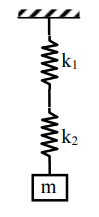
(For springs in parallel the constants would simply add: $k_{eff} = k_1 + k_2$.)
Velocity and Acceleration in SHM
-
Which one of the following statements is true for the speed 'v' and the acceleration 'a' of a particle executing simple harmonic motionFor SHM $x = A\sin\omega t$:
Velocity: $v = \omega\sqrt{A^2 - x^2}$
Acceleration: $a = -\omega^2 x$
At the mean position ($x = 0$): $v = v_{max} = A\omega$ and $a = 0$.
At the extreme positions ($x = \pm A$): $v = 0$ and $a = a_{max} = \omega^2 A$.
So in SHM, if $v = v_{max}$ then $a = 0$, and if $v = 0$ then $a = a_{max}$.
The true statement is: when 'v' is maximum, a is zero.
That is every question in Oscillations for this filter.
Want a score?
Answers here are not saved. Practise as a test to be marked and see your progress.
Practise as a test