Looking for classes? Ksquare Career Institute, Bengaluru →

Physics
System of Particles and Rotational Motion
100 questions from 38 papers, each with its answer.
- 100 questions
- 38 papers
- 5.67% of Physics
Equilibrium of a Rigid Body – Moments
-
A uniform rod of length 200 cm and mass 500 g is balanced on a wedge placed at 40 cm mark. A mass of 2 kg is suspended from the rod at 20 cm and another unknown mass $m$ is suspended from the rod at 160 cm mark as shown in the figure. Find the value of $m$ such that the rod is in equilibrium. ($g=10\ m/s^2$)
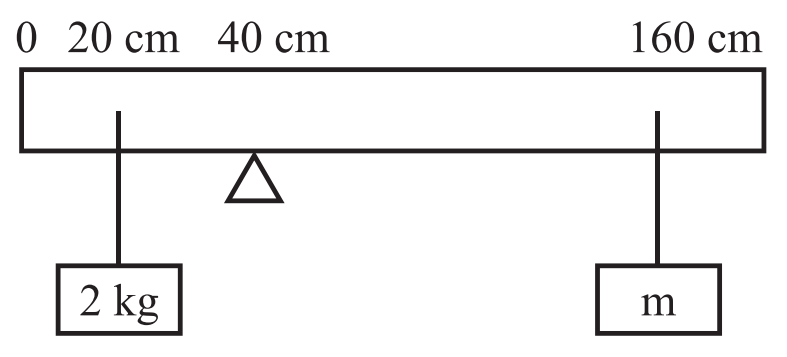
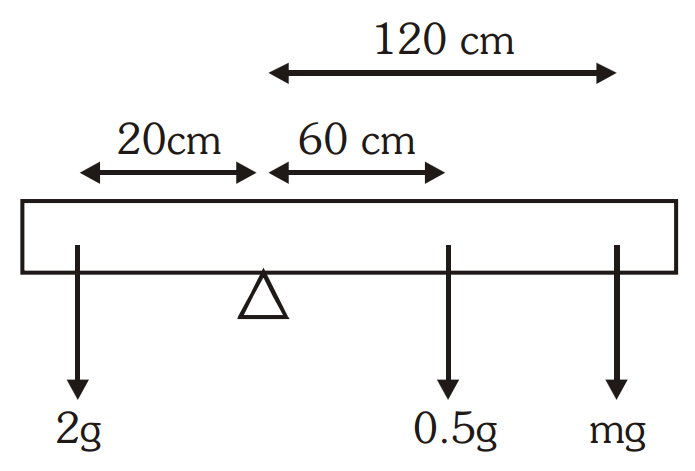
Weight of the rod (0.5 kg) acts at its centre (100 cm), i.e. 60 cm from the wedge. The 2 kg mass is 20 cm from the wedge and m is 120 cm from it.
Balancing torques about the wedge: $2g \times 20 = 0.5g \times 60 + mg \times 120$ $40 = 30 + 120m \Rightarrow m = \frac{1}{12}$ kg
Moment of Inertia
-
From a circular ring of mass $M$ and radius $R$ an arc corresponding to a $90^\circ$ sector is removed. The moment of inertia of the remaining part of the ring about an axis passing through the centre of the ring and perpendicular to the plane of the ring is $K$ times $MR^2$. Then the value of $K$ is:Removing a $90^\circ$ arc leaves $\frac{3}{4}$ of the ring: $M_{remain} = \frac{3}{4}M$ All of the remaining mass is at distance R from the axis: $I = M_{remain}R^2 = \frac{3}{4}MR^2 \Rightarrow K = \frac{3}{4}$
That is every question in System of Particles and Rotational Motion for this filter.
Want a score?
Answers here are not saved. Practise as a test to be marked and see your progress.
Practise as a test