Looking for classes? Ksquare Career Institute, Bengaluru →

Physics
Thermodynamics
54 questions, each with its answer.
-
Figure below shows two paths that may be taken by a gas to go from a state A to a state C.
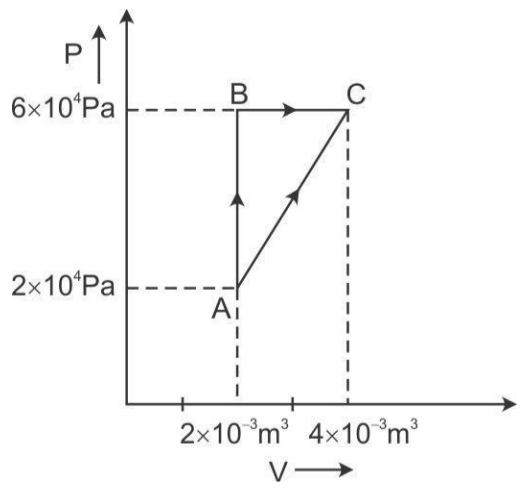
In process AB, 400 J of heat is added to the system and in process BC, 100 J of heat is added to the system. The heat absorbed by the system in the process AC will beFrom the graph: A $(2\times10^{-3}\ m^3,\ 2\times10^4$ Pa$)$, B $(2\times10^{-3}\ m^3,\ 6\times10^4$ Pa$)$, C $(4\times10^{-3}\ m^3,\ 6\times10^4$ Pa$)$.
For the cyclic process ABCA, $\Delta U = 0$, so net heat = net work = area enclosed.
$Q_{AB} + Q_{BC} + Q_{CA} = \frac{1}{2}\times(4\times10^{-3} - 2\times10^{-3})\times(6\times10^4 - 2\times10^4)$
$400 + 100 + Q_{CA} = \frac{1}{2}\times(2\times10^{-3})\times(4\times10^4) = 40$ J
$Q_{CA} = -460$ J, so $Q_{AC} = 460$ J -
A Carnot engine having an efficiency of $\eta = \frac{1}{10}$ as heat engine is used as a refrigerator. If the work done on the system is 10 J, the amount of energy absorbed from the reservoir at lower temperature isCoefficient of performance $\beta = \frac{Q_2}{W}$, and $\beta = \frac{1-\eta}{\eta}$
$\beta = \frac{1 - \frac{1}{10}}{\frac{1}{10}} = 9$
$Q_2 = \beta W = 9\times 10 = 90$ J -
One mole of an ideal diatomic gas undergoes a transition from A to B along a path AB as shown in the figure.
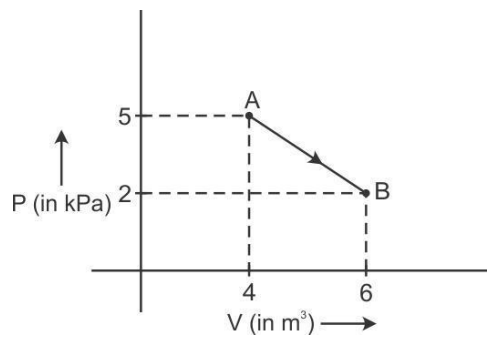
The change in internal energy of the gas during the transition isFrom the graph: A (4 $m^3$, 5 kPa) and B (6 $m^3$, 2 kPa).
$\Delta U = nC_v\Delta T$ with $C_v = \frac{R}{\gamma - 1}$ and $n\Delta T = \frac{P_2V_2 - P_1V_1}{R}$
$\Delta U = \frac{P_2V_2 - P_1V_1}{\gamma - 1}$
For a diatomic gas, $\gamma - 1 = \frac{2}{5}$:
$\Delta U = \frac{(2\times10^3\times 6) - (5\times10^3\times 4)}{2/5} = \frac{-8\times10^3}{2/5}$
$\Delta U = -20$ kJ -
The coefficient of performance of a refrigerator is 5. If the temperature inside freezer is $-20^\circ C$, the temperature of the surroundings to which it rejects heat is:$COP = \frac{T_L}{T_H - T_L}$, with $T_L = 253$ K
$5 = \frac{253}{T_H - 253} \Rightarrow T_H = \frac{6}{5}\times 253 = 303.6$ K
$T_H \approx 31^\circ C$ -
An ideal gas is compressed to half its initial volume by means of several processes. Which of the process results in the maximum work done on the gas?
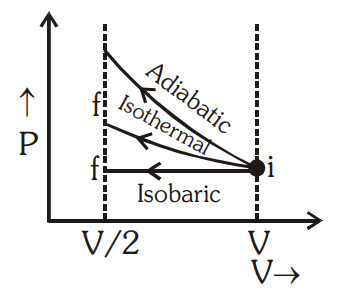
Work done on the gas equals the area under the P–V curve; the adiabatic curve is the steepest, so it encloses the largest area.
$W_{isochoric} = 0$ and $W_{adiabatic} > W_{isothermal} > W_{isobaric}$ -
A monoatomic gas at a pressure P, having a volume V expands isothermally to a volume 2V and then adiabatically to a volume 16V. The final pressure of the gas is: (take $\gamma = \frac{5}{3}$)Isothermal: $P_1V_1 = P_2V_2 \Rightarrow PV = P_2(2V) \Rightarrow P_2 = \frac{P}{2}$
Adiabatic: $P_2V_2^\gamma = P_3V_3^\gamma \Rightarrow \frac{P}{2}(2V)^\gamma = P_3(16V)^\gamma$
$P_3 = \frac{P}{2}\left(\frac{1}{8}\right)^{5/3} = \frac{P}{64}$ -
A thermodynamic system undergoes cyclic process ABCDA as shown in fig. The work done by the system in the cycle is:
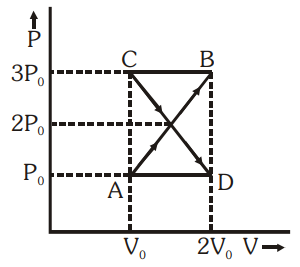 Work done in the cycle = area enclosed by the P–V loops; the two triangular loops are traversed in opposite senses.
$W = \frac{1}{2}(2P_0 - P_0)(2V_0 - V_0) + \left[-\frac{1}{2}(3P_0 - 2P_0)(2V_0 - V_0)\right]$
$W = \frac{P_0V_0}{2} - \frac{P_0V_0}{2} = 0$ -
During an adiabatic process, the pressure of a gas is found to be proportional to the cube of its temperature. The ratio of $\frac{C_p}{C_v}$ for the gas is:$P \propto T^3$ and $PV = nRT$ give $PV^{3/2}$ = constant.
Comparing with $PV^\gamma$ = constant: $\gamma = \frac{C_p}{C_v} = \frac{3}{2}$ -
A gas is taken through the cycle A → B → C → A, as shown. What is the net work done by the gas?
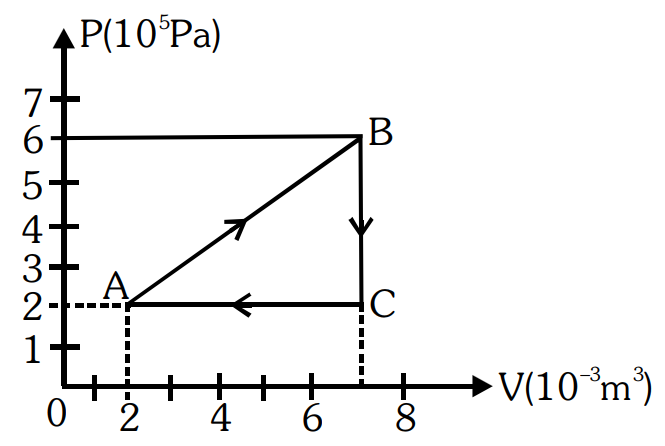 Net work done = area of triangle ABC
$= \frac{1}{2}\times[(7 - 2)\times10^{-3}][(6 - 2)\times10^5] = 1000$ J -
One mole of an ideal gas goes from an initial state A to final state B via two processes: It first undergoes isothermal expansion from volume V to 3V and then its volume is reduced from 3V to V at constant pressure. The correct P-V diagram representing the two processes is:Isothermal expansion: PV = constant, so as the volume goes from V to 3V the pressure falls along a rectangular hyperbola.
Then the volume is reduced from 3V back to V at constant pressure: a horizontal straight line directed towards smaller volume.
So the diagram shows a falling hyperbola from A (at V) to 3V, followed by a horizontal line back to V ending at B, which lies below A. -
A thermodynamic system is taken through the cycle ABCD as shown in figure. Heat rejected by the gas during the cycle is
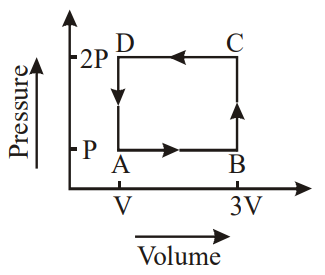 The cycle is a rectangle with pressures P and 2P and volumes V and 3V.
Area enclosed $= (2P - P)(3V - V) = 2PV$
The cycle is traversed anticlockwise, so the work done by the gas is negative: $W = -2PV$
For a complete cycle $\Delta E = 0$, so $Q = W + \Delta E = -2PV$
So the heat rejected by the gas is 2PV. -
An ideal gas goes from state A to state B via three different processes as indicated in the P-V diagram. If $Q_1$, $Q_2$, $Q_3$ indicate the heat absorbed by the gas along the three processes and $\Delta U_1$, $\Delta U_2$, $\Delta U_3$ indicate the change in internal energy along the three processes respectively, then
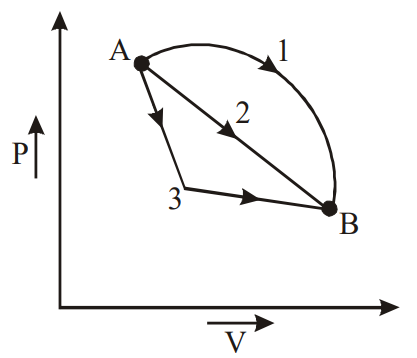 Internal energy is a state function. All three processes have the same initial state A and final state B, so $\Delta U_1 = \Delta U_2 = \Delta U_3$.
Work done = area under the P–V curve. Path 1 lies highest and path 3 lowest, so $W_1 > W_2 > W_3$.
First law: $Q = \Delta U + W$; with equal $\Delta U$, $Q_1 > Q_2 > Q_3$. -
A mass of diatomic gas ($\gamma = 1.4$) at a pressure of 2 atmospheres is compressed adiabatically so that its temperature rises from $27^\circ C$ to $927^\circ C$. The pressure of the gas in the final state is$T_1 = 27 + 273 = 300$ K; $T_2 = 927 + 273 = 1200$ K; $P_1 = 2$ atm.
For an adiabatic process $P^{1-\gamma}T^\gamma$ = constant, so $\frac{P_2}{P_1} = \left(\frac{T_2}{T_1}\right)^{\frac{\gamma}{\gamma - 1}}$
$\frac{\gamma}{\gamma - 1} = \frac{1.4}{0.4} = \frac{7}{2}$
$P_2 = 2\times\left(\frac{1200}{300}\right)^{7/2} = 2\times(4)^{7/2}$
$(4)^{7/2} = 2^7 = 128$
$P_2 = 2\times128 = 256$ atm -
When 1 kg of ice at $0^\circ C$ melts to water at $0^\circ C$, the resulting change in its entropy, taking latent heat of ice to be 80 cal/g, isHeat absorbed in melting: $Q = mL = 1000\ g\times80\ cal/g = 8\times10^4$ cal
Melting takes place at the constant temperature T = $0^\circ C$ = 273 K.
Change in entropy $\Delta S = \frac{Q}{T}$
$\Delta S = \frac{8\times10^4}{273}$
$\Delta S \approx 293$ cal/K
Note: the source prints the latent heat as '80 cal/°C'; the correct unit, cal/g, is used here. -
During an isothermal expansion, a confined ideal gas does −150 J of work against its surroundings. This implies thatFirst law of thermodynamics: $Q = \Delta U + W$, where W is the work done by the gas.
For an ideal gas the internal energy depends only on temperature; in an isothermal process $\Delta T = 0$, so $\Delta U = 0$.
Given W = −150 J.
$Q = 0 + (-150) = -150$ J
The negative sign means heat has left the gas.
Hence 150 J of heat has been removed from the gas. -
A monoatomic gas at pressure $P_1$ and volume $V_1$ is compressed adiabatically to $\frac{1}{8}$th its original volume. What is the final pressure of the gas?For an adiabatic process: $PV^\gamma$ = constant; for a monoatomic gas $\gamma = \frac{5}{3}$
$P_1V_1^{5/3} = P_2\left(\frac{V_1}{8}\right)^{5/3}$
$P_2 = P_1(8)^{5/3}$
$(8)^{5/3} = (2^3)^{5/3} = 2^5 = 32$
$P_2 = 32P_1$ -
If $\Delta U$ and $\Delta W$ represent the increase in internal energy and work done by the system respectively in a thermodynamical process, which of the following is true?First law of thermodynamics: $\Delta Q = \Delta U + \Delta W$
In an adiabatic process no heat is exchanged: $\Delta Q = 0$
$0 = \Delta U + \Delta W$, so $\Delta U = -\Delta W$
In an isothermal process of an ideal gas the temperature is constant, so $\Delta U = 0$ and $\Delta Q = \Delta W$; neither isothermal relation given is true.
Hence $\Delta U = -\Delta W$ in an adiabatic process. -
In thermodynamic processes which of the following statements is not true?Adiabatic process: no heat is exchanged, so the system is insulated from the surroundings, and for an ideal gas $PV^\gamma$ = constant. Both statements are true.
Isothermal process: the temperature remains constant (true).
Isochoric process: it is the volume that remains constant; the pressure changes with temperature ($P \propto T$).
The process in which pressure remains constant is the isobaric process.
Hence the statement that is not true is 'In an isochoric process pressure remains constant'. -
The internal energy change in a system that has absorbed 2 kcal of heat and done 500 J of work isHeat absorbed: $Q = 2$ kcal $= 2\times1000\times4.2$ J $= 8400$ J
Work done by the system: W = 500 J
First law of thermodynamics: $Q = \Delta U + W$
$\Delta U = Q - W = 8400 - 500$
$\Delta U = 7900$ J -
If $Q$, $E$ and $W$ denote respectively the heat added, change in internal energy and the work done in a closed cycle process, then :In a cyclic process the system returns to its initial state, so the initial and final states are the same.
Internal energy is a state function; it depends only on the state of the system.
Therefore the initial and final internal energies are equal and the change in internal energy is zero: $E = 0$.
From the first law, $Q = E + W$, so for a cycle $Q = W$.
$Q$ and $W$ are not zero in general (the work equals the area enclosed by the cycle on the P-V diagram); they are only equal to each other.
Hence the correct relation is $E = 0$. -
An engine has an efficiency of $\dfrac{1}{6}$. When the temperature of sink is reduced by $62^\circ C$, its efficiency is doubled. Temperature of the source isEfficiency of the engine: $\eta = 1 - \dfrac{T_2}{T_1}$, where $T_1$ is the temperature of the source and $T_2$ that of the sink (in kelvin).
According to the problem, $\dfrac{1}{6} = 1 - \dfrac{T_2}{T_1}$ ...(1)
From (1): $\dfrac{T_2}{T_1} = \dfrac{5}{6}$
When the temperature of the sink is reduced by $62^\circ C$ (a fall of 62 K), the efficiency is doubled: $2\left(\dfrac{1}{6}\right) = 1 - \dfrac{T_2 - 62}{T_1}$ ...(2)
$\dfrac{1}{3} = 1 - \dfrac{T_2}{T_1} + \dfrac{62}{T_1} = \dfrac{1}{6} + \dfrac{62}{T_1}$
$\dfrac{62}{T_1} = \dfrac{1}{3} - \dfrac{1}{6} = \dfrac{1}{6}$
$T_1 = 62 \times 6 = 372$ K
$T_1 = 372 - 273 = 99^\circ C$ = temperature of the source.
(The sink is at $T_2 = \dfrac{5}{6} \times 372 = 310$ K $= 37^\circ C$.) -
A Carnot engine whose sink is at 300 K has an efficiency of 40%. By how much should the temperature of source be increased so as to increase its efficiency by 50% of original efficiency :-Efficiency of a Carnot engine: $\eta = 1 - \dfrac{T_2}{T_1}$, where $T_1$ is the source temperature and $T_2$ the sink temperature.
$1 - \dfrac{300}{T_1} = 0.4 \Rightarrow \dfrac{300}{T_1} = 0.6 \Rightarrow T_1 = 500$ K
The efficiency is to be increased by 50 percent of the original efficiency: $\eta' = 0.4 + 0.4 \times \dfrac{50}{100} = 0.6$
Let the source temperature be increased by $\Delta T$, the sink remaining at 300 K.
$0.6 = 1 - \dfrac{300}{500 + \Delta T}$
$\dfrac{300}{500 + \Delta T} = 0.4 \Rightarrow 500 + \Delta T = 750$
$\Rightarrow \Delta T = 250$ K -
Which of the following processes is reversibleA reversible process is one that can be retraced in the opposite direction, so that the system and the surroundings pass through exactly the same states in reverse order.
It must be carried out very slowly (quasi-statically), with the system always in equilibrium, and without dissipative effects such as friction, resistance or heat flow across a finite temperature difference.
A slow isothermal compression of a gas, in contact with a heat reservoir at the same temperature, satisfies these conditions; it can be reversed by an equally slow isothermal expansion. So it is a reversible process.
Transfer of heat by conduction or radiation takes place from a hotter to a colder body across a finite temperature difference; heat never flows back by itself, so these are irreversible.
Electrical (Joule) heating of a nichrome wire is a dissipative process; the heat produced cannot be converted back into electrical energy in the same way, so it is irreversible.
So the reversible process is isothermal compression. -
An ideal gas heat engine operates in Carnot cycle between $227^\circ C$ and $127^\circ C$. It absorbs $6 \times 10^{4}$ cals of heat at higher temperature. Amount of heat converted to work is :-$T_1 = 227 + 273 = 500$ K (source) and $T_2 = 127 + 273 = 400$ K (sink)
Efficiency: $\eta = \dfrac{W}{Q_1} = 1 - \dfrac{T_2}{T_1}$
$\eta = 1 - \dfrac{400}{500} = 0.2$
$W = Q_1\left(1 - \dfrac{T_2}{T_1}\right) = 6 \times 10^{4} \times 0.2$
$W = 1.2 \times 10^{4}$ cals -
One mole of an ideal gas at an initial temperature of T K does 6 R joules of work adiabatically. If the ratio of specific heats of this gas at constant pressure and at constant volume is $\dfrac{5}{3}$, the final temperature of gas will be :-In an adiabatic process no heat is exchanged: $Q = 0$, so by the first law $0 = \Delta U + W \Rightarrow \Delta U = -W$.
The gas does work $W = 6R$, so $\Delta U = -6R$.
For an ideal gas, $\Delta U = \mu C_V \Delta T$, with $C_V = \dfrac{R}{\gamma - 1}$.
Here $\gamma = \dfrac{5}{3}$, so $C_V = \dfrac{R}{\frac{5}{3} - 1} = \dfrac{3}{2}R$
Therefore $-6R = 1 \times \dfrac{3}{2}R\,\Delta T$
$\Rightarrow \Delta T = -4$ K
$T_{final} = (T - 4)$ K (the gas cools as it does work at the cost of its internal energy).
Want a score?
Answers here are not saved. Practise as a test to be marked and see your progress.
Practise as a test