Looking for classes? Ksquare Career Institute, Bengaluru →

Helical Motion in Magnetic Field
Concepts tested here
- Radius from perpendicular velocity
All Questions
2000 AIPMT 1 question
-
A charge having $\dfrac{q}{m}$ equal to $10^8$ C/kg and with velocity $3 \times 10^5$ m/s enters into a uniform magnetic field B = 0.3 tesla at an angle $30^\circ$ with direction of field. Then radius of curvature will be :Only the velocity component perpendicular to the field causes circular motion: $v_\perp = v\sin 30^\circ$.
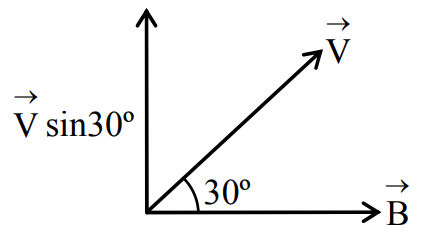
$r = \dfrac{mv_\perp}{qB} = \dfrac{m}{q} \cdot \dfrac{v\sin 30^\circ}{B}$
$r = \dfrac{3 \times 10^5 \times 0.5}{10^8 \times 0.3} = \dfrac{3 \times 10^5}{10^8 \times 0.3 \times 2}$
$r = 0.5 \times 10^{-2}$ m $= 0.5$ cm
(The particle moves along a helix of this radius.)