Looking for classes? Ksquare Career Institute, Bengaluru →

Principles of Inheritance and Variation
Test Cross
8 questions from 8 papers, each with its answer.
- questions
- 8
- papers
- 8
- years asked, 2017–2026
- 1 of 10
- of Principles of Inheritance and Variation
- 4.04%
Appears in
Concepts tested
- Test cross 4
- Back cross and test cross
- Definition of test cross
- Dihybrid test cross
- Using a test cross to determine unknown genotype
All Questions
2024 1 question
-
In a plant, black seed color (BB/Bb) is dominant over white seed color (bb). In order to find out the genotype of the black seed plant, with which of the following genotype will you cross it?To find whether a black-seeded plant is BB or Bb, a test cross is performed with the homozygous recessive (bb) plant. If all offspring are black, the plant is BB; if half are black and half white, it is Bb.
2012 AIPMT-MAINS 1 question
-
A test cross is carried out toIn a test cross, an organism showing the dominant phenotype (whose genotype is unknown) is crossed with the homozygous recessive parent.
If the unknown plant is homozygous dominant (TT), then $TT \times tt$ gives all dominant (tall) progeny.
If the unknown plant is heterozygous (Tt), then $Tt \times tt$ gives dominant and recessive progeny in a 1 : 1 ratio.
So the progeny ratio directly reveals the genotype of the dominant plant taken from the $F_2$ generation.
It is not used to check whether two species can interbreed, nor to count the number of alleles of a gene.
Hence a test cross is carried out to determine the genotype of a plant at $F_2$.
Note: the coaching key in the source PDF marks 'predict whether two traits are linked'; the NCERT purpose of a test cross (and the official answer) is determination of the genotype, so that is taken as correct here.
2011 AIPMT-MAINS 1 question
-
Test cross in plants or in $Drosophila$ involves crossingIn a test cross, an organism showing the dominant phenotype (whose genotype is to be found, e.g., the $F_1$ hybrid) is crossed with the homozygous recessive parent.
For one gene: $Tt \times tt$ gives tall and dwarf in a 1 : 1 ratio.
For two genes: $TtRr \times ttrr$ (double recessive) gives four phenotypes in a 1 : 1 : 1 : 1 ratio.
The ratio of the progeny reveals the genotype of the hybrid and the types of gametes it forms.
A cross between two $F_1$ hybrids is selfing, which gives the $F_2$ generation, not a test cross.
Hence a test cross involves crossing the $F_1$ hybrid with a double recessive genotype.
2010 AIPMT-MAINS 1 question
-
A cross in which an organism showing a dominant phenotype is crossed with the recessive parent in order to know its genotype is calledAn organism with the dominant phenotype may be homozygous dominant or heterozygous.
To find out which, it is crossed with the homozygous recessive parent; this is a test cross.
If all the progeny show the dominant trait the organism is homozygous ($TT \times tt$); if dominant and recessive appear in a 1 : 1 ratio it is heterozygous ($Tt \times tt$).
A back cross is the cross of an $F_1$ individual with either of its parents (dominant or recessive); the test cross is the particular back cross with the recessive parent, done to know the genotype.
Hence the cross is called a test cross.
2010 AIPMT-PRE 1 question
-
The genotype of a plant showing the dominant phenotype can be determined byA plant with the dominant phenotype may be homozygous (TT) or heterozygous (Tt); the two cannot be told apart by appearance.
In a test cross the plant is crossed with the homozygous recessive (tt) parent.
If all the progeny show the dominant character, the plant is homozygous: $TT \times tt \rightarrow$ all Tt.
If the progeny show dominant and recessive characters in a 1 : 1 ratio, the plant is heterozygous: $Tt \times tt \rightarrow$ 1 Tt : 1 tt.
A back cross is a cross of the $F_1$ with either parent; only the cross with the recessive parent (the test cross) reveals the genotype.
Hence the genotype is determined by a test cross.
2007 AIPMT-PRE 1 question
-
A common test to find the genotype of a hybrid is by
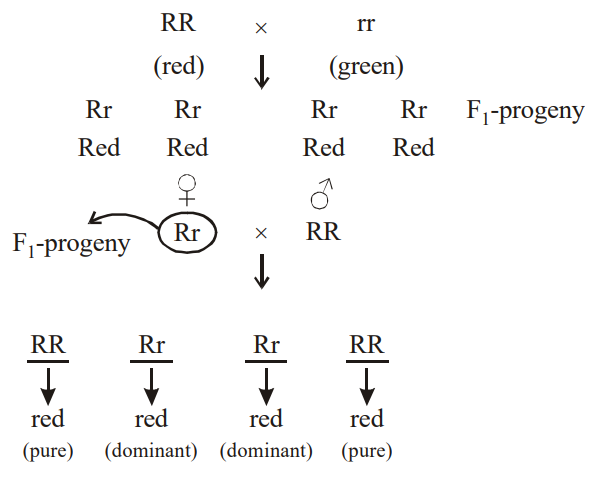
An individual showing the dominant phenotype may be homozygous dominant or heterozygous, and this cannot be told from its appearance.
To find the genotype, the hybrid (F1 progeny) is crossed back with one of its parents. Such a cross is called a back cross.
When the F1 hybrid is crossed with the recessive parent, the cross is called a test cross; here the male parent is taken as the recessive parent.
If the hybrid is heterozygous (Rr), the cross Rr x rr gives dominant and recessive offspring in the ratio 1 : 1.
If the individual tested is homozygous dominant (RR), the cross RR x rr gives all dominant offspring.
So from the ratio of the offspring the genotype of the hybrid is known.
Hence the common test is the crossing of one F1 progeny with the male parent, as given in the answer key.
2006 AIPMT-PRE 1 question
-
Test cross involves -A test cross is used to find out whether an individual showing the dominant phenotype is homozygous or heterozygous.
In a test cross, the organism with the dominant phenotype (such as the F1 hybrid) is crossed with the homozygous recessive parent instead of being self-crossed.
For a dihybrid, the F1 hybrid (for example RrYy) is crossed with the double recessive genotype (rryy).
Since the recessive parent contributes only recessive alleles, the phenotypes of the offspring directly show the kinds of gametes formed by the hybrid.
A monohybrid test cross gives a 1 : 1 ratio and a dihybrid test cross gives a 1 : 1 : 1 : 1 ratio.
A cross between two F1 hybrids is selfing, which gives the F2 generation.
So a test cross involves crossing the F1 hybrid with a double recessive genotype.
2005 AIPMT 1 question
-
In order to find out the different types of gametes produced by a pea plant having the genotype AaBb, it should be crossed to a plant with the genotype -To find out the types of gametes produced by a plant, it is crossed with a plant that is homozygous recessive for both genes. This is a test cross.
The double recessive plant aabb produces only one kind of gamete, ab, which contributes only recessive alleles.
So the phenotype of each offspring shows directly the type of gamete contributed by the AaBb plant.
AaBb x aabb gives AaBb, Aabb, aaBb and aabb in the ratio 1 : 1 : 1 : 1, showing that AaBb produces four types of gametes (AB, Ab, aB, ab) in equal proportions.
Crossing with AaBb, AABB or aaBB would hide some of the alleles behind dominant ones.
So it should be crossed with aabb.