Looking for classes? Ksquare Career Institute, Bengaluru →

Principles of Inheritance and Variation
Pedigree Analysis
7 questions from 7 papers, each with its answer.
- questions
- 7
- papers
- 7
- years asked, 2017–2026
- 2 of 10
- of Principles of Inheritance and Variation
- 3.54%
Appears in
Concepts tested
- Autosomal recessive inheritance
- Autosomal recessive pedigree
- consanguineous mating symbol
- Pedigree symbols
- Recessive trait
- X-linked recessive inheritance
- X-Linked Recessive Pedigree
All Questions
2025 1 question
-
With the help of given pedigree, find out the probability for the birth of a child having no disease and being a carrier (has the disease mutation in one allele of the gene) in $F_{3}$ generation.
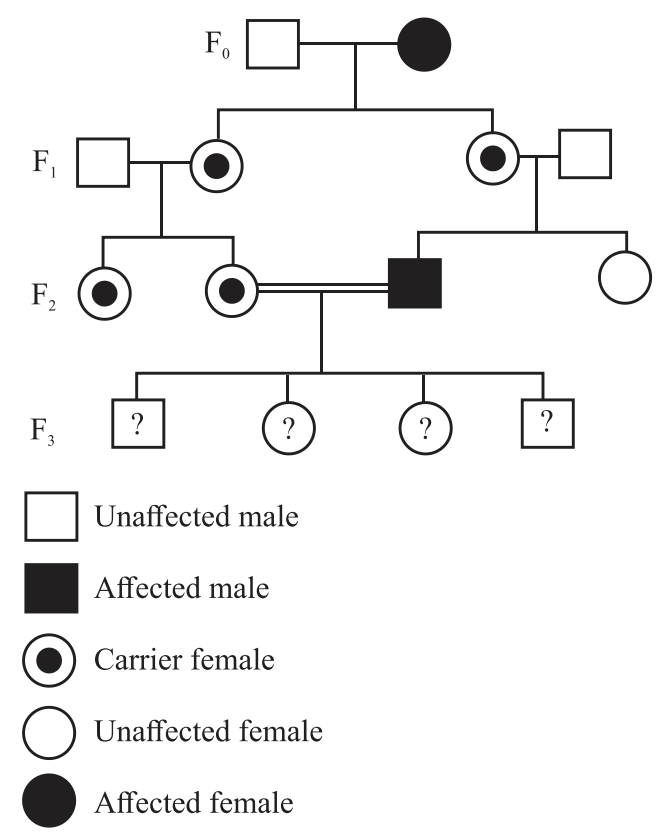
Probability of a carrier female child ($X^C X$) from a carrier mother ($X^C X$) and normal father ($XY$) is 1/4.
The pedigree shows X-linked recessive inheritance. In $F_2$, the mother is a carrier female ($X^C X$) and the father is unaffected ($XY$). The offspring genotypes are: $X^C X$ (carrier female, 1/4), $XX$ (normal female, 1/4), $X^C Y$ (affected male, 1/4), $XY$ (normal male, 1/4). The probability of an unaffected child being a carrier is 1/4.
2023 1 question
-
Which one of the following symbols represents mating between relatives in human pedigree analysis?
Mating between relatives is a consanguineous mating.
Pedigree symbols: affected individuals; mating; mating between relatives (consanguineous mating); parents with male child affected with disease. [add image]
2015 AIPMT-II 1 question
-
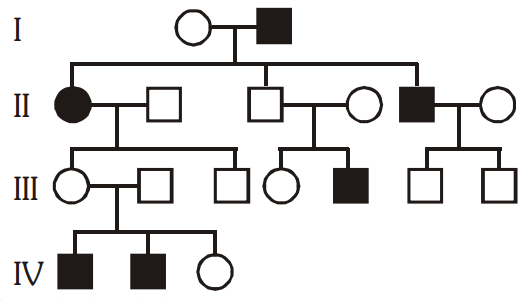
In the following human pedigree, the filled symbols represent the affected individuals. Identify the type of given pedigree.
2010 AIPMT-MAINS 1 question
-
Study the pedigree chart of a certain family given below and select the correct conclusion which can be drawn for the character.
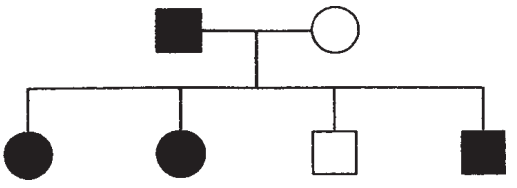 In the chart the father is affected and the mother is unaffected; among the four children, two daughters and one son are affected and one son is unaffected.
Take the trait as recessive: the affected father is homozygous recessive (aa).
Affected children (aa) must receive one recessive allele from each parent, so the unaffected mother must carry the recessive allele: she is heterozygous (Aa).
The cross $aa \times Aa$ gives affected (aa) and unaffected (Aa) children in a 1 : 1 ratio, as seen. So a normal daughter (Aa) was also possible.
The same pattern fits an X-linked recessive trait such as colour-blindness (father $X^cY$, mother $X^CX^c$), so colour-blindness cannot be ruled out; and the father, being affected, cannot be homozygous dominant.
Hence the correct conclusion is that the female parent is heterozygous.
2010 AIPMT-PRE 1 question
-
Which one of the following symbols and its representation, used in human pedigree analysis, is correct?Standard pedigree symbols: a square represents a male and a circle represents a female; an open (unshaded) symbol is an unaffected individual and a filled (shaded) symbol is an affected individual.
A diamond represents an individual whose sex is unspecified, so a filled diamond is not 'male affected'.
An open circle is an unaffected female, not an unaffected male.
An open square is an unaffected male, not an unaffected female.
A single horizontal line joining a square and a circle shows mating; a double line shows mating between relatives (consanguineous mating).
Hence the correct representation is the square and circle joined by a double line = mating between relatives.
2009 AIPMT 1 question
-
Study the pedigree chart given below:
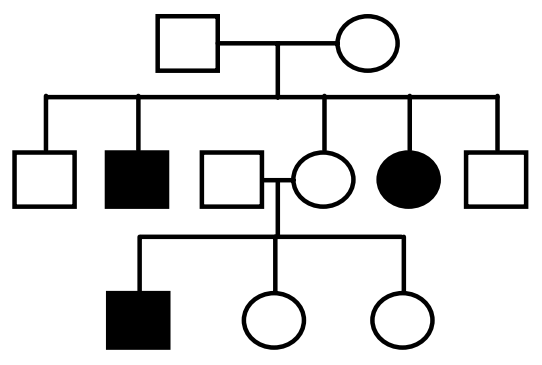
What does it show?In the chart, unaffected parents have affected children; this is possible only if the trait is recessive and both parents are heterozygous carriers.
The affected individuals include a female born to an unaffected father. For an X-linked recessive trait an affected daughter ($X^aX^a$) must have an affected father ($X^aY$), so sex-linked inheritance like haemophilia is ruled out.
The trait is therefore autosomal recessive: carrier parents $Aa \times Aa$ give affected children (aa) of either sex.
Phenylketonuria is an inborn error of metabolism inherited as an autosomal recessive trait (it is not sex-linked).
Hence the chart shows inheritance of a condition like phenylketonuria as an autosomal recessive trait.
2005 AIPMT 1 question
-
A man and a woman, who do not show any apparent signs of a certain inherited disease, have seven children (2 daughters and 5 sons). Three of the sons suffer from the given disease but none of the daughters are affected. Which of the following modes of inheritance do you suggest for this diseaseThe parents are both unaffected, but some children are affected, so the disease is recessive; a dominant disease would appear in at least one parent.
Only sons are affected and the daughters are normal, which points to a sex-linked (X-linked) recessive trait.
The mother must be a carrier ($X^aX$) and the father normal ($XY$).
Each son receives his only X chromosome from the mother, so half the sons are expected to be affected ($X^aY$); here 3 out of 5 sons are affected.
The daughters receive the father's normal X, so none of them is affected (half of them are carriers).
So the suggested mode of inheritance is sex-linked recessive (like haemophilia).