Looking for classes? Ksquare Career Institute, Bengaluru →

Principles of Inheritance and Variation
Sex-linked inheritance
10 questions from 9 papers, each with its answer.
- questions
- 10
- papers
- 9
- years asked, 2017–2026
- 1 of 10
- of Principles of Inheritance and Variation
- 5.05%
Appears in
Concepts tested
- Colour blindness cross 2
- Carrier mother and colour blindness
- Colour blindness is X-linked
- Criss-cross inheritance
- Criss-cross inheritance of colour blindness
- Hemizygous condition in males
- X-linked recessive disorders
- X-linked recessive inheritance
- x-linked-inheritance
All Questions
2018 1 question
-
A woman has an X-linked condition on one of her X chromosomes. This chromosome can be inherited by
Each child receives one of the mother's X chromosomes.
The woman is a carrier. Both sons and daughters inherit an X chromosome from the mother. However, only sons would be diseased.
2015 AIPMT-II 1 question
-
A colour blind man marries a woman with normal sight who has no history of colour blindness in her family. What is the probability of their grandson being colour blind?
2014 AIPMT 1 question
-
A man whose father was colour blind marries a woman who had a colour blind mother and normal father. What percentage of male children of this couple will be colour blind?The man gets his Y chromosome from his father, so his X is normal: $XY$.
The woman's mother was colour blind ($X^cX^c$) and her father normal, so she is a carrier: $XX^c$.
Sons get their X from the mother: half receive $X$ and half receive $X^c$, so 50% of the male children will be colour blind.
2012 AIPMT-MAINS 1 question
-
Represented below is the inheritance pattern of a certain type of traits in humans. Which one of the following conditions could be an example of this pattern?
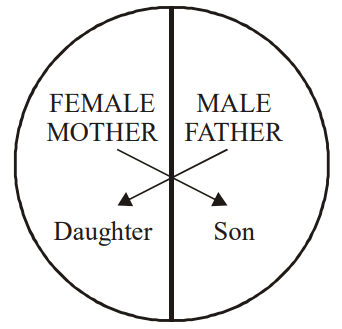 The diagram shows the trait passing from the mother to the son and from the father to the daughter, i.e., a criss-cross pattern of inheritance.
Such a pattern is characteristic of genes located on the X chromosome: a son receives his only X chromosome from his mother, while a father passes his X chromosome only to his daughters.
Haemophilia is a sex-linked (X-linked) recessive disorder and follows this pattern.
Thalassemia, phenylketonuria and sickle cell anaemia are autosomal recessive disorders; they are inherited equally by sons and daughters from both parents and do not show criss-cross inheritance.
Hence the condition that could be an example of this pattern is haemophilia.
2012 AIPMT-PRE 1 question
-
A normal-visioned man whose father was colour-blind, marries a woman whose father was also colour-blind. They have their first child as a daughter. What are the chances that this child would be colour-blind?Colour blindness is X-linked recessive. The man is normal-visioned, so his genotype is $XY$ (he received Y, not X, from his colour-blind father).
The woman received $X^c$ from her colour-blind father, so she is a carrier: $XX^c$.
A daughter gets the normal X from her father and either $X$ or $X^c$ from her mother: $XX$ (normal) or $XX^c$ (carrier).
No daughter can be colour-blind, so the chance is zero percent.
2006 AIPMT-PRE 1 question
-
If a colourblind woman marries a normal visioned man, their sons will be -Colour blindness is a recessive X-linked character. Let $X^c$ be the X chromosome carrying the gene for colour blindness.
A colourblind woman must be homozygous: $X^cX^c$.
A normal visioned man is $XY$.
The mother produces only $X^c$ eggs; the father produces $X$ sperms and $Y$ sperms.
Sons receive the Y chromosome from the father and their only X chromosome from the mother, so all sons are $X^cY$, i.e. colourblind.
Daughters are $X^cX$: normal visioned but carriers.
This passing of the character from mother to sons is called criss-cross inheritance.
So all their sons will be colourblind.
2005 AIPMT 2 questions
-
A woman with normal vision, but whose father was colour blind, marries a colour blind man. Suppose that the fourth child of this couple was a boy. This boy -Colour blindness is an X-linked recessive trait. Let $X^c$ carry the allele for colour blindness.
The woman has normal vision, but her father was colour blind, so she received $X^c$ from him. She is a carrier: $X^cX$.
The colour blind man is $X^cY$.
A son receives the Y chromosome from his father and one X chromosome from his mother.
The mother gives either $X^c$ or $X$ with equal probability, so each son has a 50 percent chance of being $X^cY$ (colour blind) and a 50 percent chance of being $XY$ (normal).
The birth order of the child has no effect on this probability.
A male has only one X chromosome, so he cannot be heterozygous for this trait.
So the boy may be colour blind or may have normal vision. -
Haemophilia is more commonly seen in human males than in human females because -Haemophilia is a sex-linked recessive disease: the gene is located on the X chromosome.
A male has only one X chromosome (XY), so a single recessive allele ($X^hY$) is enough to make him haemophilic; there is no second allele to mask it.
A female has two X chromosomes and becomes haemophilic only if both carry the recessive allele ($X^hX^h$); with one defective allele she is a normal carrier ($X^hX$).
A haemophilic female needs a haemophilic father and a carrier (or affected) mother, which is very rare.
So the disease is far more common in males because it is due to an X-linked recessive mutation.
2004 AIPMT 1 question
-
The recessive genes located on X-chromosomes in humans are always-Human males have one X and one Y chromosome (XY). Most genes on the X chromosome have no corresponding allele on the Y chromosome.
So a male has only one copy of each X-linked gene; he is hemizygous. A recessive allele on his X chromosome has no dominant allele to mask it, and it is always expressed.
Females (XX) express an X-linked recessive trait only if they are homozygous recessive; heterozygous females are carriers.
Examples: colour blindness and haemophilia are much more common in males.
Such genes are not necessarily lethal or sub-lethal.
So recessive genes on the X chromosome are always expressed in males.
2002 AIPMT 1 question
-
Which of the following is the example of sex linked disease : -Sex-linked diseases are caused by genes present on the sex chromosomes, usually the X chromosome.
Colour blindness (red-green) is caused by a recessive gene on the X chromosome, so it is a sex-linked (X-linked recessive) disorder, much more common in males.
AIDS (caused by HIV), syphilis (Treponema) and gonorrhoea (Neisseria) are sexually transmitted infections caused by microbes, not genetic diseases.
So colour blindness is an example of a sex-linked disease.