Looking for classes? Ksquare Career Institute, Bengaluru →

Chemistry
The p-Block Elements
77 questions from 28 papers, each with its answer.
- 77 questions
- 28 papers
- 4.38% of Chemistry
Topics in this chapter
Most asked
Squares are the last ten exam years: filled means it was asked that year.
- Oxoacids of phosphorus 4 questions
- Group 13 elements 3 questions
- Silicates 3 questions
- Oxidising power of halogens 2 questions
- Boron hydrides 2 questions
All topics
In syllabus order. Each goes to its questions below.
No topic matches that.
- 1. Group 15 Elements - Hydrides and Oxides 1 question
- 2. Group 18 Elements - Xenon Compounds 1 question
- 3. Boiling Points of Group 16 Hydrides and Hydrogen Bonding 1 question
- 4. Oxidation States of Group 16 Elements 1 question
- 5. Hydrolysis reactions of p-block compounds 1 question
- 6. Dehydrating property of concentrated sulphuric acid 1 question
- 7. Structures of noble gas (xenon) compounds 1 question
- 8. Nature of oxides of group 14 elements 1 question
- 9. Classification of oxides 1 question
- 10. Types of hydrides 1 question
- 11. Hydrolysis of group 13 trihalides 1 question
- 12. Classification of oxides - neutral, acidic, basic, amphoteric 1 question
- 13. Important compounds of boron 1 question
- 14. Nitric acid - Ostwald's process 1 question
- 15. Borax - action of heat 1 question
- 16. Oxidising power of halogens 2 questions
- 17. Aluminium chloride - hydrated complex 1 question
- 18. Silicones - uses 1 question
- 19. Phosphine - preparation and properties 1 question
- 20. Oxoacids of phosphorus 4 questions
- 21. Oxoacids of sulphur 1 question
- 22. Potash alum 1 question
- 23. Preparation of halogens - redox with MnO2 1 question
- 24. Anomalous behaviour of boron - covalency 1 question
- 25. Acidic strength and properties of hydrogen halides 1 question
- 26. Anomalous properties of nitrogen - bond strength 1 question
- 27. Qualitative analysis of anions 1 question
- 28. Oxides of nitrogen and sulphur 1 question
- 29. Compounds of group 16 and 17 1 question
- 30. Group 13 elements 3 questions
- 31. Hydrogen halides 1 question
- 32. Hydrides of group 16 1 question
- 33. Boron hydrides 2 questions
- 34. Silicates 3 questions
- 35. Boron compounds 1 question
- 36. Silicones 2 questions
- 37. Sulphur dioxide 1 question
- 38. Oxoacids 1 question
- 39. Reactions of chlorine 1 question
- 40. Oxides of sulphur 1 question
- 41. Trends in p-block hydrides and oxides 1 question
- 42. Group 14 elements 1 question
- 43. Compounds of chlorine 1 question
- 44. Oxides of phosphorus 1 question
- 45. Oxides and oxoanions of chlorine 1 question
- 46. Boron halides 1 question
- 47. Group 17 elements 1 question
- 48. Group 17: Trends in Properties 2 questions
- 49. Group 14: Inert Pair Effect 2 questions
- 50. Oxoacids of Halogens 2 questions
- 51. Compounds of Aluminium 1 question
- 52. Nature of Oxides 1 question
- 53. Oxides of Chlorine 1 question
- 54. Group 16: Hydrides and their Salts 1 question
- 55. Silicates and Zeolites 1 question
- 56. Boric Acid 1 question
- 57. Group 17 Elements: Halogens 1 question
- 58. Group 17: Bond Dissociation Enthalpy 1 question
- 59. Borax 1 question
- 60. Oxidising Action of Nitric Acid 1 question
- 61. Group 15: Anomalous Behaviour of Nitrogen 1 question
- 62. Group 13: Electron Deficient Compounds 1 question
- 63. Group 17: Halogens 1 question
- 64. Compounds of Xenon 1 question
Group 15 Elements - Hydrides and Oxides
-
Given below are two statements:
Statement I: Like nitrogen that can form ammonia, arsenic can form arsine.
Statement II: Antimony cannot form antimony pentoxide.
In the light of the above statements, choose the most appropriate answer from the options given below:Statement I is correct (arsenic forms arsine $\text{AsH}_3$). Statement II is incorrect because antimony forms antimony pentoxide $\text{Sb}_2\text{O}_5$.
Group 15 elements form hydrides of formula $\text{EH}_3$ ($\text{NH}_3, \text{PH}_3, \text{AsH}_3$ / arsine, $\text{SbH}_3, \text{BiH}_3$). Therefore, Statement I is correct. All elements of Group 15 form two types of oxides: trioxides ($\text{E}_2\text{O}_3$) and pentoxides ($\text{E}_2\text{O}_5$). Antimony forms antimony pentoxide ($\text{Sb}_2\text{O}_5$), which makes Statement II incorrect.
Group 18 Elements - Xenon Compounds
-
Match List-I with List-II.
Pick the matching item from Column II for each row.
Column I
- A. $\text{XeO}_3$
- B. $\text{XeF}_2$
- C. $\text{XeOF}_4$
- D. $\text{XeF}_6$
Column II
- I. $sp^3d$, linear
- II. $sp^3$, pyramidal
- III. $sp^3d^3$, distorted octahedral
- IV. $sp^3d^2$, square pyramidal
Correct answer: A → II, B → I, C → IV, D → III
$\text{XeO}_3$: $sp^3$ pyramidal; $\text{XeF}_2$: $sp^3d$ linear; $\text{XeOF}_4$: $sp^3d^2$ square pyramidal; $\text{XeF}_6$: $sp^3d^3$ distorted octahedral.
Hybridization and shapes of xenon compounds: 1. $\text{XeO}_3$: 3 $\sigma$ bonds + 1 lone pair = 4 steric number $\implies sp^3$, trigonal pyramidal (II). 2. $\text{XeF}_2$: 2 $\sigma$ bonds + 3 lone pairs = 5 steric number $\implies sp^3d$, linear (I). 3. $\text{XeOF}_4$: 5 $\sigma$ bonds + 1 lone pair = 6 steric number $\implies sp^3d^2$, square pyramidal (IV). 4. $\text{XeF}_6$: 6 $\sigma$ bonds + 1 lone pair = 7 steric number $\implies sp^3d^3$, distorted octahedral (III). Hence, A-II, B-I, C-IV, D-III.
Boiling Points of Group 16 Hydrides and Hydrogen Bonding
-
Given below are two statements: Statement I: The boiling point of hydrides of Group 16 elements follow the order $H_2O > H_2Te > H_2Se > H_2S$. Statement II: On the basis of molecular mass, $H_2O$ is expected to have lower boiling point than the other members of the group but due to the presence of extensive H-bonding in $H_2O$, it has higher boiling point. In the light of the above statements, choose the correct answer from the options given below:For $H_2S$, $H_2Se$ and $H_2Te$, the boiling point increases with molecular mass. On the basis of molecular mass, $H_2O$ should have the lowest boiling point, but due to extensive intermolecular hydrogen bonding in water, $H_2O$ has the highest boiling point. So the order $H_2O > H_2Te > H_2Se > H_2S$ is correct and the explanation is correct: both statements are true.
Oxidation States of Group 16 Elements
-
Among Group 16 elements, which one does NOT show -2 oxidation state?Down group 16, metallic character and electropositivity increase. Po is a highly electropositive (metallic) element, so it does not show the $-2$ oxidation state.
Hydrolysis reactions of p-block compounds
-
Which one of the following reactions does not come under hydrolysis type reaction?Reactions (1), (2) and (3) are all hydrolysis reactions in which water reacts to break bonds of the compound (P-O, Si-Cl, Li-N), forming new O-H/other bonds. Reaction (4), $2F_2+2H_2O\rightarrow4HF+O_2$, is a redox reaction (fluorine displaces oxygen from water; fluorine is reduced and oxygen is oxidised), not a hydrolysis reaction.
Dehydrating property of concentrated sulphuric acid
-
The reaction of concentrated sulphuric acid with carbohydrates ($C_{12}H_{22}O_{11}$) is an example ofConcentrated sulphuric acid removes water from carbohydrates such as sucrose ($C_{12}H_{22}O_{11}$), charring it to carbon — this demonstrates the strong dehydrating property of concentrated $H_2SO_4$.
Structures of noble gas (xenon) compounds
-
Match the compounds of Xe in column I with the molecular structure in column II.
Pick the matching item from Column II for each row.
Column I
- a. XeF2
- b. XeF4
- c. XeO3
- d. XeOF4
Column II
- i. Square planar
- ii. Linear
- iii. Square pyramidal
- iv. Pyramidal
Correct answer: a → ii, b → i, c → iv, d → iii
$XeF_2$ has a linear structure (a-ii); $XeF_4$ has a square planar structure (b-i); $XeO_3$ has a pyramidal structure (c-iv); $XeOF_4$ has a square pyramidal structure (d-iii).
Nature of oxides of group 14 elements
-
Which of the following oxide is amphoteric in nature?$SnO_2$ is amphoteric, reacting with both acids and bases. ($CO_2$ and $SiO_2$ are acidic oxides; $GeO_2$ is predominantly acidic/weakly amphoteric but the standard NCERT-level answer identifies $SnO_2$ as the amphoteric oxide among these.)
Classification of oxides
-
Which of the following is correctly matched?$Mn_2O_7$, $SO_2$, and $TeO_3$ are all acidic oxides, making option (3) the correctly matched pair. (Option 1 wrongly classes $SnO_2$, which is amphoteric, as basic; option 2 wrongly classes $NO_2$, which is acidic, as neutral; option 4 wrongly classes $GeO$ among amphoteric oxides.)
Types of hydrides
-
Match List-I (Hydride) with List-II (Type of Hydride)
Pick the matching item from Column II for each row.
Column I
- A. NaH
- B. PH3
- C. GeH4
- D. LaH2.87
Column II
- I. Electron precise
- II. Saline
- III. Metallic
- IV. Electron rich
Correct answer: A → II, B → IV, C → I, D → III
NaH is a saline (ionic) hydride (A-II); $PH_3$ is an electron-rich hydride (B-IV); $GeH_4$ is an electron-precise hydride (C-I); $LaH_{2.87}$, being non-stoichiometric, is classified as a metallic/interstitial hydride (D-III).
Hydrolysis of group 13 trihalides
-
Select the element (M) whose trihalides cannot be hydrolysed to produce an ion of the form $[M(H_2O)_6]^{3+}$Boron has a maximum covalency of four (due to the absence of d-orbitals in its valence shell), so it cannot expand its coordination number to six to form $[B(H_2O)_6]^{3+}$, unlike Al, Ga, and In, which can form such hexaaqua ions.
Classification of oxides - neutral, acidic, basic, amphoteric
-
The correct sequence given below containing neutral, acidic, basic and amphoteric oxide each, respectively, isNO is a neutral oxide; $CO_2$ is an acidic oxide; CaO is a basic oxide; ZnO is an amphoteric oxide. So the correct sequence (neutral, acidic, basic, amphoteric) is NO, $CO_2$, CaO, ZnO.
Important compounds of boron
-
Match List - I (Compounds) with List - II (Molecular formula). Choose the correct answer.
Pick the matching item from Column II for each row.
Column I
- A. Borax
- B. Kernite
- C. Orthoboric acid
- D. Borax bead
Column II
- I. $NaBO_2$
- II. $Na_2B_4O_7\cdot4H_2O$
- III. $H_3BO_3$
- IV. $Na_2B_4O_7\cdot10H_2O$
Correct answer: A → IV, B → II, C → III, D → I
Borax $\rightarrow Na_2B_4O_7\cdot10H_2O$; Kernite $\rightarrow Na_2B_4O_7\cdot4H_2O$; Orthoboric acid $\rightarrow H_3BO_3$; Borax bead $\rightarrow NaBO_2$ (with $B_2O_3$).
Nitric acid - Ostwald's process
-
Which of the following reactions is a part of the large scale industrial preparation of nitric acid?On a large scale nitric acid is prepared by Ostwald's process: (i) $4NH_3+5O_2\xrightarrow[500\ K,\ 9\ bar]{Pt/Rh\ gauze}4NO+6H_2O$; (ii) $2NO+O_2\rightarrow2NO_2$; (iii) $3NO_2+H_2O\rightarrow2HNO_3+NO$.
Borax - action of heat
-
$Na_2B_4O_7\xrightarrow{heat}X+NaBO_2$. In the above reaction the product 'X' is:On strong heating borax gives boric anhydride and sodium metaborate: $Na_2B_4O_7\xrightarrow{heat}B_2O_3+2NaBO_2$.
Oxidising power of halogens
-
Fluorine is a stronger oxidising agent than chlorine because: (a) F-F bond has a low enthalpy of dissociation. (b) Fluoride ion ($F^-$) has high hydration enthalpy. (c) Electron gain enthalpy of fluorine is less negative than chlorine. (d) Fluorine has a very small size. Choose the most appropriate answer from the options given:$X_2(g)\xrightarrow{\Delta H_{diss}}2X(g)\xrightarrow{\Delta_{eg}H}X^-(g)\xrightarrow{\Delta_{hyd}H}X^-(aq)$. Adding these steps, more energy is released for fluorine due to its low bond dissociation enthalpy and high hydration enthalpy, making it the stronger oxidising agent.
-
Which reaction is not feasible : -The oxidising power of halogens decreases down the group: $F_2 \gt Cl_2 \gt Br_2 \gt I_2$.
A halogen can displace (oxidise) a halide ion of a halogen below it in the group.
$Br_2$ oxidises $I^-$ to $I_2$: feasible. $Cl_2$ oxidises $Br^-$ to $Br_2$: feasible. $F_2$ oxidises water to $O_2$: feasible.
$I_2$ is a weaker oxidising agent than $Br_2$, so it cannot oxidise $Br^-$ to $Br_2$.
So the reaction $2KBr + I_2 \rightarrow 2KI + Br_2$ is not feasible.
Aluminium chloride - hydrated complex
-
Aluminium chloride in acidified aqueous solution forms a complex 'A', in which hybridisation state of Al is 'B'. What are 'A' and 'B', respectively?$AlCl_3$ in acidified aqueous solution forms $[Al(H_2O)_6]^{3+}$. $Al^{3+}$ = [Ne], with no inner d orbitals available, so it uses outer 3d orbitals: $sp^3d^2$.
Silicones - uses
-
Which of the following compounds is used in cosmetic surgery?
Phosphine - preparation and properties
-
A compound 'X' upon reaction with $H_2O$ produces a colorless gas 'Y' with rotten fish smell. Gas 'Y' is absorbed in a solution of $CuSO_4$ to give $Cu_3P_2$ as one of the products. Predict the compound 'X'$Ca_3P_2+6H_2O\rightarrow3Ca(OH)_2+2PH_3$ (colourless gas Y). $3CuSO_4+2PH_3\rightarrow Cu_3P_2+3H_2SO_4$. Hence X is calcium phosphide, $Ca_3P_2$.
Oxoacids of phosphorus
-
Which of the following oxoacids of phosphorus has strongest reducing property?Reducing property $\propto$ number of P-H bonds. $H_3PO_2$ has two P-H bonds, the maximum among these.
-
Strong reducing behaviour of $H_3PO_2$ is due to:Oxoacids of phosphorus that contain P–H bonds act as reducing agents.
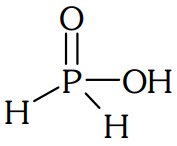
$H_3PO_2$ has one –OH group and two P–H bonds, which make it a strong reducing agent. -
Which of the following statements is not valid for oxoacids of phosphorus?In all oxoacids of phosphorus, P is tetrahedrally surrounded by four groups and has at least one P=O and one P–OH bond.
Orthophosphoric acid is used to make triple superphosphate: $Ca_3(PO_4)_2 + 4H_3PO_4 \rightarrow 3Ca(H_2PO_4)_2$.
Hypophosphorous acid, $H_3PO_2$, has the structure $H_2P(=O)(OH)$ with only one P–OH group. Only the H of P–OH is ionisable, so it is monoprotic.
So the statement that hypophosphorous acid is diprotic is not valid. -
Oxidation states of P in $H_4P_2O_5$, $H_4P_2O_6$, $H_4P_2O_7$ are respectivelyTake H = +1, O = −2 and let the oxidation state of P be x.
$H_4P_2O_5$: $4(+1) + 2x + 5(-2) = 0$, so $2x = 6$, x = +3
$H_4P_2O_6$: $4(+1) + 2x + 6(-2) = 0$, so $2x = 8$, x = +4
$H_4P_2O_7$: $4(+1) + 2x + 7(-2) = 0$, so $2x = 10$, x = +5
The oxidation states are +3, +4, +5 respectively.
Oxoacids of sulphur
-
Identify the correct formula of oleum from the followingOleum is pyrosulphuric acid, $H_2S_2O_7$.
Potash alum
-
In potash alum, the ratio of $K^+$ and $SO_4^{2-}$ ions isPotash alum is $K_2SO_4\cdot Al_2(SO_4)_3\cdot24H_2O$. $K^+:SO_4^{2-}=2:4=1:2$.
Preparation of halogens - redox with MnO2
-
Given below are two statements: Statement-I: Heating NaCl with concentrated $H_2SO_4$ and $MnO_2$ results in oxidation of Mn. Statement-II: Heating NaI with concentrated $H_2SO_4$ and $MnO_2$ results in reduction of Mn. In light of the above statements, choose the most appropriate answer from the options given below.S-I: $4NaCl+MnO_2+4H_2SO_4\rightarrow MnCl_2+4NaHSO_4+2H_2O+Cl_2$. Mn goes from +4 to +2, i.e. it is reduced, not oxidised - Statement I is wrong. S-II: $2NaI+MnO_2+4H_2SO_4\rightarrow I_2+MnSO_4+Na_2SO_4+2H_2O$. Mn goes from +4 to +2, i.e. it is reduced - Statement II is correct.
Anomalous behaviour of boron - covalency
-
The correct statement isB = [He] $2s^22p^1$. In the first excited state ($2s^12p^2$) boron has one 2s and three 2p orbitals, i.e. 4 valence orbitals that can participate in bonding, so its maximum covalency is four (e.g. $BF_4^-$).
Acidic strength and properties of hydrogen halides
-
Identify the incorrect statement from the following:The correct order of acidic strength of hydrohalic acids is $HI>HBr>HCl>HF$ (bond dissociation enthalpy decreases down the group, making H–I easiest to ionise), so the statement given in option (a), $HF>HCl>HBr>HI$, is incorrect.
Anomalous properties of nitrogen - bond strength
-
Identify the incorrect statement.The N–N single bond is actually weaker than the P–P single bond, because of high inter-electronic repulsion between the non-bonding (lone pair) electrons on the small nitrogen atoms — so the statement that they are equally strong is incorrect.
Qualitative analysis of anions
-
Match List-I (Solid salt treated with dil. $H_2SO_4$) with List-II (Anion detected) and choose the correct answer from the options given below:
Pick the matching item from Column II for each row.
Column I
- A. Effervescence of colourless gas
- B. Gas with smell of rotten egg
- C. Gas with pungent smell
- D. Brown fumes
Column II
- I. NO2-
- II. CO3^2-
- III. S2-
- IV. SO3^2-
Correct answer: A → II, B → III, C → IV, D → I
Effervescence of colourless gas indicates $CO_3^{2-}$ (A-II); gas with smell of rotten egg indicates $S^{2-}$ (B-III); gas with pungent smell indicates $SO_3^{2-}$ (C-IV); brown fumes indicate $NO_2^-$ / $NO_3^-$ (D-I).
Oxides of nitrogen and sulphur
-
Nitrogen dioxide and sulphur dioxide have some properties in common. Which property is shown by one of these compounds, but not by the other?Both oxides form acid rain, act as reducing agents and dissolve in water.
Only sulphur dioxide is used as a food preservative.
Compounds of group 16 and 17
-
Which of the statements given below is incorrect?ONF and $NO_2^-$ both have 24 electrons, so they are isoelectronic.
$OF_2$ is a fluoride of oxygen (oxygen difluoride), not an oxide of fluorine, because fluorine is more electronegative than oxygen — this statement is incorrect.
$2HClO_4 \xrightarrow[-H_2O]{\Delta} Cl_2O_7$, so $Cl_2O_7$ is the anhydride of perchloric acid.
$O_3$ has a lone pair on the central O, so it is bent.
Group 13 elements
-
The stability of +1 oxidation state among Al, Ga, In and Tl increases in the sequence:Due to the inert pair effect, the stability of the +1 oxidation state increases down group 13: Al < Ga < In < Tl.
-
Which of the following statements is incorrect?Aluminium is amphoteric. With excess aqueous NaOH it dissolves to form soluble sodium tetrahydroxoaluminate(III) and hydrogen: $2Al + 2NaOH + 6H_2O \rightarrow 2Na[Al(OH)_4] + 3H_2$
$Al(OH)_3$ is not the product, because it is itself soluble in excess NaOH. So this statement is incorrect.
$2NaHCO_3 \xrightarrow{\Delta} Na_2CO_3 + H_2O + CO_2$ (true).
Sodium dissolves in liquid ammonia to give a deep blue solution due to ammoniated electrons: $Na + (x + y)NH_3 \rightarrow [Na(NH_3)_x]^+ + [e(NH_3)_y]^-$ (true).
NaOH attacks the silica of glass: $2NaOH + SiO_2 \rightarrow Na_2SiO_3 + H_2O$ (true).
Hence the incorrect statement is that aluminium reacts with excess NaOH to give $Al(OH)_3$. -
The stability of +1 oxidation state increases in the sequenceGroup 13 elements have the configuration $ns^2np^1$ and can show +1 and +3 oxidation states.
Down the group the $ns^2$ electrons become increasingly reluctant to take part in bonding, because the intervening d and f electrons shield the nuclear charge poorly. This is the inert pair effect.
As a result the +1 state becomes more and more stable on going down the group, while the +3 state becomes less stable.
Stability of the +1 state: Al < Ga < In < Tl (for thallium, +1 is the predominant state).
Hydrogen halides
-
The variation of the boiling points of the hydrogen halides is in the order HF > HI > HBr > HCl. What explains the higher boiling point of hydrogen fluoride?HF molecules are associated through strong hydrogen bonding, so HF has the highest boiling point: HF > HI > HBr > HCl.
Hydrides of group 16
-
Acidity of diprotic acids in aqueous solutions increases in the order:On moving down the group the bond length increases, so the H–E bond breaks more easily and the tendency to release $H^+$ increases.
So acidity: $H_2S < H_2Se < H_2Te$
Boron hydrides
-
Which of the following is electron-deficient?$(BH_3)_2$ is $B_2H_6$, which has 3-centre-2-electron (B–H–B) bridge bonds.
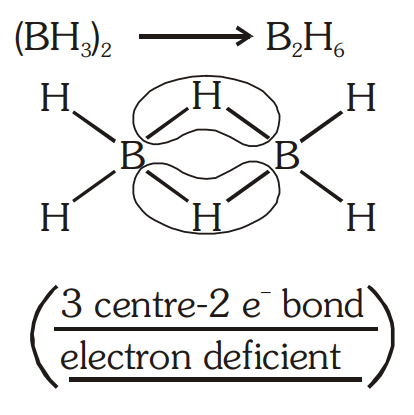
So it is electron deficient. -
Which of the following is the electron deficient molecule -An electron deficient molecule does not have enough valence electrons to form normal two-centre two-electron bonds between all its bonded atoms.
Diborane, $B_2H_6$, has only 12 valence electrons (3 from each B and 1 from each H), but it would need 14 electrons to form seven normal B-H and B-B bonds.
Its structure has four terminal B-H bonds (normal two-electron bonds) and two bridging B-H-B bonds, each of which is a three-centre two-electron (banana) bond.
So diborane is an electron deficient molecule and acts as a Lewis acid.
$C_2H_6$, $SiH_4$ and $PH_3$ have normal electron-precise bonds (and $PH_3$ is electron rich, with a lone pair).
So the electron deficient molecule is $B_2H_6$.
Silicates
-
The basic structural unit of silicates is:Silicates are salts of silicic acid, $H_4SiO_4$.
$Si(OH)_4 \xrightarrow{-4H^+} SiO_4^{4-}$ (silicate ion, tetrahedral) -
Name the type of the structure of silicate in which one oxygen atom of $[SiO_4]^{4-}$ is shared?The basic unit of all silicates is the $[SiO_4]^{4-}$ tetrahedron; silicates are classified by the number of oxygen atoms shared per tetrahedron.
No oxygen shared: orthosilicates, $SiO_4^{4-}$.
One oxygen shared between two tetrahedra: pyrosilicates, $Si_2O_7^{6-}$.
Two oxygens shared: chain or cyclic silicates, $(SiO_3)_n^{2n-}$.
Three oxygens shared: sheet silicates, $(Si_2O_5)_n^{2n-}$; all four shared: three-dimensional silicates, $SiO_2$.
Hence sharing of one oxygen atom gives a pyrosilicate. -
Which of the following anions is present in the chain structure of silicates?The basic unit of all silicates is the $SiO_4^{4-}$ tetrahedron; different silicates arise from the number of oxygen atoms shared between tetrahedra.
In chain silicates (pyroxenes), two oxygen atoms per $SiO_4$ tetrahedron are shared, giving polymeric anion chains of formula $(SiO_3^{2-})_n$.
Examples: spodumene $LiAl(SiO_3)_2$ and diopside $CaMg(SiO_3)_2$.
$SiO_4^{4-}$ is the discrete anion of orthosilicates (no oxygen shared).
$Si_2O_7^{6-}$ is the anion of pyrosilicates (one oxygen shared between two tetrahedra).
$(Si_2O_5^{2-})_n$ is the anion of sheet silicates (three oxygen atoms shared per tetrahedron).
So the anion present in the chain structure is $(SiO_3^{2-})_n$.
Boron compounds
-
Which of the following structure is similar to graphite?Boron nitride (BN) has a layered structure of hexagonal rings like graphite, and is called inorganic graphite.
Silicones
-
Which of these is not a monomer for a high molecular mass silicone polymer?Silicones are organosilicon polymers containing $-(R_2Si-O-SiR_2)-$ linkages.
$Me_3SiCl$ has only one Cl, so it cannot form a high molecular mass silicone polymer; it acts as a chain-terminating organosilane. -
The straight chain polymer is formed bySilicones are made by hydrolysis of alkyl-substituted chlorosilanes followed by condensation polymerisation; the number of Cl atoms decides how many Si–O–Si links each unit can form.
$(CH_3)_2SiCl_2$ has two Cl atoms: hydrolysis gives $(CH_3)_2Si(OH)_2$ with two –OH groups, which can condense at both ends to give a long straight chain: $n(CH_3)_2Si(OH)_2 \rightarrow -[Si(CH_3)_2-O]_n- + nH_2O$
$(CH_3)_3SiCl$ gives $(CH_3)_3SiOH$ with only one –OH group; it can only form a dimer and acts as a chain-terminating (end-blocking) unit.
$CH_3SiCl_3$ gives $CH_3Si(OH)_3$ with three –OH groups; it forms a cross-linked, three-dimensional polymer.
$(CH_3)_4Si$ has no Cl and cannot be hydrolysed.
Hence the straight chain polymer is formed from $(CH_3)_2SiCl_2$.
Sulphur dioxide
-
Roasting of sulphides gives the gas X as a by-product. This is a colourless gas with choking smell of burnt sulphur and causes great damage to respiratory organs as a result of acid rain. Its aqueous solution is acidic, acts as a reducing agent and its acid has never been isolated. The gas X is:Roasting of sulphide ores gives $SO_2$, a colourless gas with a choking smell that causes acid rain.
Its aqueous solution, sulphurous acid ($H_2SO_3$), is a reducing agent and has never been isolated.
Oxoacids
-
Which is the strongest acid in the following?Acid strength increases with the oxidation state and electronegativity of the central atom.
In $HClO_4$ chlorine is in the +7 state and $ClO_4^-$ is the most stabilised conjugate base, so it is the strongest acid.
Reactions of chlorine
-
When $Cl_2$ gas reacts with hot and concentrated sodium hydroxide solution, the oxidation number of chlorine changes from$3Cl_2 + 6NaOH$ (hot, conc.) $\rightarrow 5NaCl + NaClO_3 + 3H_2O$
In $Cl_2$ the oxidation number of Cl is 0.
In NaCl it is −1, and in $ClO_3^-$ it is +5.
So chlorine changes from zero to −1 and from zero to +5 (disproportionation).
Oxides of sulphur
-
Sulphur trioxide can be obtained by which of the following reaction:$Fe_2(SO_4)_3 \xrightarrow{\Delta} Fe_2O_3 + 3SO_3$
$H_2SO_4 + PCl_5$ gives sulphuryl chloride/chlorosulphonic acid, $CaSO_4 + C$ gives $SO_2$ (or CaS), and $S + 2H_2SO_4 \rightarrow 3SO_2 + 2H_2O$.
So $SO_3$ is obtained by heating ferric sulphate.
Trends in p-block hydrides and oxides
-
In which of the following arrangements the given sequence is not strictly according to the property indicated against it?Down group 16 the H–E bond becomes weaker, so acid strength increases: $H_2O < H_2S < H_2Se < H_2Te$.
A stronger acid has a larger $K_a$ and therefore a smaller $pK_a$.
So $pK_a$ decreases in the order $H_2O > H_2S > H_2Se > H_2Te$; the sequence given as increasing $pK_a$ is not correct.
The other three sequences are correct.
Group 14 elements
-
Which of the following oxides is amphoteric?An amphoteric oxide reacts with both acids and bases.
Among the dioxides of group 14, $CO_2$, $SiO_2$ and $GeO_2$ are acidic, whereas $SnO_2$ and $PbO_2$ are amphoteric.
$SnO_2$ reacts with a base: $SnO_2 + 2NaOH \rightarrow Na_2SnO_3 + H_2O$
$SnO_2$ reacts with an acid: $SnO_2 + 4HCl \rightarrow SnCl_4 + 2H_2O$
CaO is the oxide of an alkaline earth metal and is basic.
Hence the amphoteric oxide is $SnO_2$.
Compounds of chlorine
-
Which one of the following is present as an active ingredient in bleaching powder for bleaching action?Bleaching powder is made by passing chlorine over dry slaked lime: $2Ca(OH)_2 + 2Cl_2 \rightarrow Ca(OCl)_2 + CaCl_2 + 2H_2O$
Its composition is $Ca(OCl)_2\cdot CaCl_2\cdot Ca(OH)_2\cdot2H_2O$.
The bleaching action is due to the hypochlorite ion, $OCl^-$, which is an oxidising agent and releases available chlorine.
$CaCl_2$ has no bleaching action.
Hence the active ingredient is calcium hypochlorite, $Ca(OCl)_2$.
Oxides of phosphorus
-
How many bridging oxygen atoms are present in $P_4O_{10}$?In $P_4O_{10}$ the four phosphorus atoms lie at the corners of a tetrahedron.
A tetrahedron has six edges; along each edge there is one oxygen atom bridging two phosphorus atoms (a P–O–P linkage). This gives 6 bridging oxygen atoms.
Each phosphorus atom also carries one terminal oxygen atom (P=O), giving 4 terminal oxygen atoms.
Total oxygen atoms = 6 + 4 = 10, in agreement with the formula.
Number of bridging oxygen atoms = 6
Oxides and oxoanions of chlorine
-
The correct order of increasing bond angles in the following species is$ClO_2^-$: the central Cl has two bond pairs and two lone pairs ($sp^3$); strong lone pair–lone pair repulsion compresses the angle to about $110^\circ$ (smallest).
$Cl_2O$: the central O has two bond pairs and two lone pairs ($sp^3$), but the two bulky Cl atoms repel each other and open the angle slightly, to about $110.9^\circ$.
$ClO_2$: the central Cl has two bond pairs, one lone pair and one odd (unpaired) electron; a single electron repels much less than a lone pair, so the angle opens up to about $118^\circ$ (largest).
Increasing order of bond angle: $ClO_2^- < Cl_2O < ClO_2$
Boron halides
-
The tendency of $BF_3$, $BCl_3$ and $BBr_3$ to behave as Lewis acid decreases in the sequenceBoron trihalides are Lewis acids because boron has an empty 2p orbital and only six valence electrons.
The halogen can donate a lone pair from its filled p orbital into this empty 2p orbital of boron ($p\pi$–$p\pi$ back bonding), which reduces the electron deficiency of boron.
Back bonding is most effective in $BF_3$, because the 2p orbital of F matches the 2p orbital of B in size and energy; overlap is poorer with the 3p of Cl and poorest with the 4p of Br.
Extent of back bonding: $BF_3 > BCl_3 > BBr_3$, so the electron deficiency and Lewis acidity follow the reverse order.
Lewis acid strength: $BBr_3 > BCl_3 > BF_3$
Group 17 elements
-
Among the following which is the strongest oxidizing agent?An oxidising agent accepts electrons; the higher its standard reduction potential, the stronger it is.
$E^\circ(X_2/X^-)$: $F_2$ = +2.87 V, $Cl_2$ = +1.36 V, $Br_2$ = +1.09 V, $I_2$ = +0.54 V
Fluorine has the highest value because of its low F–F bond dissociation enthalpy and the very high hydration enthalpy of the small $F^-$ ion, even though its electron gain enthalpy is less negative than that of chlorine.
Oxidising power: $F_2 > Cl_2 > Br_2 > I_2$
Hence the strongest oxidising agent is $F_2$.
Group 17: Trends in Properties
-
Which one of the following arrangements does not give the correct picture of the trends indicated against it ?In the case of the diatomic molecules ($X_2$) of the halogens, the bond dissociation energy decreases in the order: $Cl_2 \gt Br_2 \gt F_2 \gt I_2$
Approximate values: $Cl_2$ = 242.6, $Br_2$ = 192.8, $F_2$ = 158.8 and $I_2$ = 151.1 kJ mol$^{-1}$.
The F-F bond is unexpectedly weak because the F atom is very small, so the lone pairs on the two F atoms repel each other strongly.
So the arrangement $F_2 \gt Cl_2 \gt Br_2 \gt I_2$ for bond dissociation energy is not correct.
The oxidizing power, electronegativity and reactivity decrease in the order: $F_2 \gt Cl_2 \gt Br_2 \gt I_2$, so those two arrangements are correct.
The electron gain enthalpy of the halogens follows the order $Cl \gt F \gt Br \gt I$; the low value for fluorine is again due to the small size of the fluorine atom. Strictly, that arrangement is also not exact, but the answer intended by the paper is the bond dissociation energy arrangement. -
Which one of the following orders is not in accordance with the property stated against it ?Bond dissociation energy of the halogens: $Cl_2$ (242.6) > $Br_2$ (192.8) > $F_2$ (158.8) > $I_2$ (151.1) kJ mol$^{-1}$.
The F-F bond is unexpectedly weak because the fluorine atom is very small, so the lone pairs on the two fluorine atoms repel each other strongly.
So the order $F_2 \gt Cl_2 \gt Br_2 \gt I_2$ is not correct for bond dissociation energy.
Oxidising power decreases down the group: $F_2 \gt Cl_2 \gt Br_2 \gt I_2$; correct.
Electronegativity decreases down the group: F > Cl > Br > I; correct.
Acidic strength of the hydrogen halides in water increases as the H-X bond becomes weaker: $HI \gt HBr \gt HCl \gt HF$; correct.
So the order not in accordance with its property is the one for bond dissociation energy.
Group 14: Inert Pair Effect
-
Which of the following oxidation states are the most characteristic for lead and tin respectively?All the group 14 elements show tetravalency, which can be explained by the shifting of one electron from $ns$ to the vacant $np$ orbital; the four orbitals then give four $sp^3$ hybrid orbitals.
When the $ns^2$ electrons of the outermost shell do not participate in bonding, they are called an inert pair, and the effect is called the inert pair effect.
The last three elements of the group, Ge, Sn and Pb, have a tendency to form divalent as well as tetravalent ions.
The inert pair effect increases from Ge to Pb, so the stability of the tetravalent state decreases and that of the divalent state increases down the group.
That is why $Pb^{2+}$ is more stable than $Pb^{4+}$ (Pb(IV) compounds are strong oxidising agents), while $Sn^{4+}$ is more stable than $Sn^{2+}$ (Sn(II) compounds are reducing agents).
So the most characteristic oxidation states are +2 for lead and +4 for tin. -
$PbO_2 \rightarrow PbO$, $\Delta G_{298} \lt 0$; $SnO_2 \rightarrow SnO$, $\Delta G_{298} \gt 0$. Most probable oxidation states of Pb and Sn will be :$PbO_2 \rightarrow PbO$ has $\Delta G \lt 0$, so the change from +4 to +2 is spontaneous for lead. So +2 is the more stable state of Pb.
$SnO_2 \rightarrow SnO$ has $\Delta G \gt 0$, so the change from +4 to +2 is not spontaneous for tin. So +4 is the more stable state of Sn.
This is due to the inert pair effect, which increases down group 14: the $6s^2$ pair of Pb is reluctant to take part in bonding.
So the most probable oxidation states are $Pb^{2+}$ and $Sn^{4+}$.
Oxoacids of Halogens
-
Which one of the following orders correctly represents the increasing acid strengths of the given acids?Oxidation numbers of chlorine: $HOCl$ (+1), $HOClO$ (+3), $HOClO_2$ (+5), $HOClO_3$ (+7).
As the oxidation number of the central atom increases, the strength of the oxoacid also increases.
More oxygen atoms on chlorine pull electron density away from the O-H bond, so the proton is released more easily.
Also, the negative charge of the conjugate base is delocalised over more oxygen atoms: $ClO^- \lt ClO_2^- \lt ClO_3^- \lt ClO_4^-$ in stability.
A more stable conjugate base means a stronger acid.
Increasing acid strength: $HOCl \lt HOClO \lt HOClO_2 \lt HOClO_3$ -
The correct order of acid strength is -Oxidation numbers of chlorine: HClO (+1), $HClO_2$ (+3), $HClO_3$ (+5), $HClO_4$ (+7).
As the oxidation number of the central atom increases, the number of oxygen atoms attached to it increases, and the O-H bond becomes more polar.
The conjugate bases are also stabilised more by the delocalisation of the negative charge over more oxygen atoms: $ClO^- \lt ClO_2^- \lt ClO_3^- \lt ClO_4^-$ in stability.
The more stable the conjugate base, the stronger the acid.
So the correct order of acid strength is $HClO \lt HClO_2 \lt HClO_3 \lt HClO_4$.
Compounds of Aluminium
-
$Al_2O_3$ can be converted to anhydrous $AlCl_3$ by heating :-$Al_2O_3$ is a very stable oxide because aluminium has a strong affinity for oxygen.
Chlorine alone cannot displace the oxygen, and heating with HCl gas or solid NaCl does not give the anhydrous chloride.
When a mixture of alumina and carbon is heated in a current of dry chlorine, the carbon removes the oxygen as CO and the chlorine combines with the aluminium:
$Al_2O_3 + 3C + 3Cl_2 \xrightarrow{\Delta} 2AlCl_3 + 3CO$
The anhydrous $AlCl_3$ formed sublimes and is collected.
The chlorine must be dry, because $AlCl_3$ is readily hydrolysed by moisture.
So anhydrous $AlCl_3$ is obtained by heating a mixture of $Al_2O_3$ and carbon in dry $Cl_2$ gas.
Nature of Oxides
-
Which of the following is the most basic oxide :-The basic character of oxides increases with the metallic character of the element, which increases down a group.
$SeO_2$ is the oxide of a non-metal and is acidic.
$Al_2O_3$ is amphoteric.
$Sb_2O_3$ is amphoteric (antimony is a metalloid).
$Bi_2O_3$ is the oxide of bismuth, the most metallic element of group 15, and it is basic.
In group 15 the oxides of the type $E_2O_3$ change from acidic (N, P) through amphoteric (As, Sb) to basic (Bi).
So the most basic oxide is $Bi_2O_3$.
Oxides of Chlorine
-
Which one of the following oxides is expected to exhibit paramagnetic behaviour -A substance is paramagnetic if it has one or more unpaired electrons.
Count the valence electrons. $ClO_2$: Cl has 7 and each O has 6, so total $= 7 + 2 \times 6 = 19$, an odd number.
A molecule with an odd number of electrons must have at least one unpaired electron, so $ClO_2$ is an odd electron molecule and is paramagnetic.
$CO_2$ (16 valence electrons), $SO_2$ (18) and $SiO_2$ (a network solid with all electrons paired) have no unpaired electrons, so they are diamagnetic.
So the paramagnetic oxide is $ClO_2$.
Group 16: Hydrides and their Salts
-
What is the correct relationship between the pHs of isomolar solutions of sodium oxide ($pH_1$), sodium sulphide ($pH_2$), sodium selenide ($pH_3$) and sodium telluride ($pH_4$) ?These are salts of the strong base NaOH with the very weak acids $H_2O$, $H_2S$, $H_2Se$ and $H_2Te$. In water the anions are hydrolysed and give $OH^-$ ions, making the solutions basic.
The acid strength of the hydrides increases down the group: $H_2O \lt H_2S \lt H_2Se \lt H_2Te$, because the H-E bond becomes longer and weaker.
The weaker the acid, the stronger its conjugate base, so the basic strength of the anions decreases: $O^{2-} \gt S^{2-} \gt Se^{2-} \gt Te^{2-}$.
$Na_2O$ reacts completely with water to give NaOH ($O^{2-} + H_2O \rightarrow 2OH^-$), so its solution is the most basic.
A more strongly basic solution has a higher pH.
So $pH_1 \gt pH_2 \gt pH_3 \gt pH_4$.
Silicates and Zeolites
-
Which one of the following statements about the zeolites is false :-Zeolites are three-dimensional aluminosilicates. They are built from $SiO_4$ tetrahedra in which some silicon atoms are replaced by aluminium atoms, i.e. some $SiO_4^{4-}$ tetrahedra are replaced by $AlO_4^{5-}$ tetrahedra. So they are aluminosilicates with a three-dimensional network; this statement is true.
The extra negative charge produced by each Al is balanced by cations such as $Na^+$, $K^+$ or $Ca^{2+}$. These cations can be exchanged (e.g. for $Ca^{2+}$ and $Mg^{2+}$ in hard water), so zeolites are used as cation exchangers; true.
Their framework has open cavities and channels of molecular size, so they can take up small molecules (molecular sieves, shape-selective catalysts such as ZSM-5); true.
Aluminium in zeolites is present only in tetrahedral $AlO_4$ units. There are no octahedral $AlO_6^{9-}$ units in the framework.
So the false statement is the one claiming that $SiO_4^{4-}$ units are replaced by $AlO_4^{5-}$ and $AlO_6^{9-}$ ions.
Boric Acid
-
Which one of the following compounds is not a protonic acid :A protonic (Brønsted) acid releases a proton ($H^+$) from its own –OH group.
$PO(OH)_3$ (phosphoric acid), $SO(OH)_2$ (sulphurous acid) and $SO_2(OH)_2$ (sulphuric acid) all ionise by releasing $H^+$ from their –OH groups.
Boric acid, $B(OH)_3$, does not release its own proton. Boron has an incomplete octet, so it accepts an $OH^-$ ion from water, which releases $H^+$ from the water:
$B(OH)_3 + H_2O \rightarrow [B(OH)_4]^- + H^+$
So boric acid is a weak monobasic Lewis acid, not a protonic acid.
So the compound that is not a protonic acid is $B(OH)_3$.
Group 17 Elements: Halogens
-
Which of the following statements is not true :Iodide is the most powerful reducing halide ion, since $I^-$ is the largest and loses its electron most easily (and $I_2$ is the weakest oxidant); true.
Fluorine, the most electronegative element with no d orbitals, shows only the –1 state; true.
In the hypohalous acids HOX, a more electronegative X pulls electron density from the O–H bond, so HOCl ($K_a \approx 3 \times 10^{-8}$) is stronger than HOBr; true.
Among hydrogen halides, acid strength increases HF $\lt$ HCl $\lt$ HBr $\lt$ HI, because the H–X bond becomes weaker. The H–F bond is very strong and HF is a weak acid in water, while HCl is a strong acid.
So the statement that is not true is: HF is a stronger acid than HCl.
Group 17: Bond Dissociation Enthalpy
-
Which of the following statement is true : -Bond dissociation enthalpies: $F_2$ about 158 kJ/mol and $Cl_2$ about 242 kJ/mol. So the bond energy of $F_2$ is less than that of $Cl_2$; this is true.
The F–F bond is weak because the F atoms are very small, so the lone pairs on the two atoms are close together and repel each other strongly.
Silicon can show coordination number 6 as well (e.g. $[SiF_6]^{2-}$), because of its vacant d orbitals, so it does not always show 4.
$Mn^{2+}$ ($3d^5$, half-filled) is more stable than $Mn^{3+}$ in water; $Mn^{3+}$ disproportionates.
Group 15 elements show oxidation states from –3 to +5, not only +3 and +5.
So the true statement is that the bond energy of $F_2$ is less than that of $Cl_2$.
Borax
-
In borax bead test which compound is formedOn heating, borax loses water and swells, then melts into a transparent glassy bead of sodium metaborate and boric anhydride:
$Na_2B_4O_7 \cdot 10H_2O \xrightarrow{\Delta} Na_2B_4O_7 \rightarrow 2NaBO_2 + B_2O_3$
When this bead is heated with a coloured metal salt, the metal oxide combines with $B_2O_3$ to form a coloured metaborate, e.g. $CuO + B_2O_3 \rightarrow Cu(BO_2)_2$ (blue), $CoO + B_2O_3 \rightarrow Co(BO_2)_2$ (blue).
So in the borax bead test, a metaborate is formed.
Oxidising Action of Nitric Acid
-
Zn gives $H_2$ gas with $H_2SO_4$ and HCl but not with $HNO_3$ because :-With dilute $H_2SO_4$ or HCl, zinc reduces $H^+$ (hydronium) ions to hydrogen gas: $Zn + 2H^+ \rightarrow Zn^{2+} + H_2$.
Nitric acid is a strong oxidising agent. The nitrate ion is reduced more easily than $H^+$ (it has a higher reduction potential).
So zinc reduces $NO_3^-$ to oxides of nitrogen, $N_2O$, or $NH_4^+$ instead of releasing hydrogen; any hydrogen formed is also oxidised to water.
Example: $4Zn + 10HNO_3(dil) \rightarrow 4Zn(NO_3)_2 + N_2O + 5H_2O$
$HNO_3$ is a strong acid, and Zn acts as a reducing agent, not an oxidising agent.
So $NO_3^-$ is reduced in preference to the hydronium ion.
Group 15: Anomalous Behaviour of Nitrogen
-
Nitrogen forms $N_2$, but phosphorus forms $P_4$ instead of $P_2$; the reason is : -Nitrogen is small, so its 2p orbitals overlap well sideways and form strong $p\pi - p\pi$ bonds. It exists as $N\equiv N$.
Phosphorus atoms are larger, so the sideways overlap of their 3p orbitals is poor and $p\pi - p\pi$ bonds are weak.
So instead of forming a triple bond ($P\equiv P$), each phosphorus forms three single P–P bonds, giving the tetrahedral $P_4$ molecule.
So the reason is that $p\pi - p\pi$ bonding is weak in phosphorus.
Group 13: Electron Deficient Compounds
-
Which of the following compound is electron deficient :In $BCl_3$, boron has only 6 electrons in its valence shell (3 bond pairs), two less than an octet. So it is electron deficient and acts as a Lewis acid (e.g. $BCl_3 + NH_3 \rightarrow Cl_3B \leftarrow NH_3$).
$CCl_4$ has a complete octet, and $PCl_5$ has an expanded octet (10 electrons).
$BeCl_2$ (4 electrons around Be in the monomer) is also electron deficient, but the standard example and the key's answer is $BCl_3$.
So, as per the answer key, $BCl_3$ is the electron deficient compound.
Group 17: Halogens
-
Which statement is wrong :The bond dissociation energy of $F_2$ (about 158 kJ/mol) is less than that of $Cl_2$ (about 242 kJ/mol), because the small F atoms bring their lone pairs close and these repel strongly. So 'bond energy of $F_2 \gt Cl_2$' is wrong.
F is the most electronegative element, more than Cl; true.
$F_2$ is the strongest oxidising agent, stronger than $Cl_2$; true.
The electron affinity of Cl (–349 kJ/mol) is greater than that of F (–328 kJ/mol), because the small size of F causes electron repulsion; true.
So the wrong statement is 'bond energy of $F_2 \gt Cl_2$'.
Compounds of Xenon
-
Which compound has planar structure :$XeF_4$: Xe has 4 bond pairs and 2 lone pairs ($sp^3d^2$). The lone pairs occupy opposite (axial) positions, giving a square planar shape.
$XeO_4$ is tetrahedral, $XeO_2F_2$ is see-saw, and $XeOF_2$ is T-shaped; these are not planar in the same way.
So $XeF_4$ has a planar structure.
That is every question in The p-Block Elements.
Want a score?
Answers here are not saved. Practise as a test to be marked and see your progress.
Practise as a testQuestions per paper
Asked in 8 of the last 16 papers (2017–2026).
- 2026: not asked
- 2026 Re-NEET: 3 questions
- 2025: 2 questions
- 2024: 2 questions
- 2024 Re-NEET: 3 questions
- 2023: not asked
- 2023 Manipur: 4 questions
- 2022: not asked
- 2022 Phase 2: 4 questions
- 2021: not asked
- 2020: not asked
- 2020 Phase-2: 4 questions
- 2019: not asked
- 2019 Odisha: 5 questions
- 2018: not asked
- 2017: not asked
Concepts tested
- Inert pair effect 3
- Acid strength and oxidation number 2
- Anomalous bond energy of fluorine 2
- Oxidising power of halogens 2
- Acid strength and pKa
- Acid strength of hydrogen halides
- Acid strength of oxoacids
- Acid-base character of p-block oxides
- Acidic strength and properties of hydrogen halides
- Acidic strength of hydrides
- Aluminium chloride - hydrated complex
- Amphoteric nature of aluminium
- Anomalous behaviour of boron - covalency
- Anomalous boiling point of water due to hydrogen bonding
- Anomalous properties of fluorine
- Anomalous properties of nitrogen - bond strength
- Anomalously low F-F bond energy
- Back bonding