Looking for classes? Ksquare Career Institute, Bengaluru →

Chemistry
Coordination Compounds
104 questions from 38 papers, each with its answer.
- 104 questions
- 38 papers
- 5.91% of Chemistry
Topics in this chapter
Most asked
Squares are the last ten exam years: filled means it was asked that year.
- Isomerism in Coordination Compounds 12 questions
- Crystal field theory 7 questions
- Magnetic properties of complexes 6 questions
- Valence bond theory 5 questions
- Bonding in metal carbonyls 3 questions
All topics
In syllabus order. Each goes to its questions below.
No topic matches that.
- 1. Magnetic Properties and Hybridisation 1 question
- 2. Crystal Field Theory and Colour of Complexes 1 question
- 3. Werner's Theory and Electrolytic Conductance 1 question
- 4. Crystal Field Theory and Magnetic Behaviour of Complexes 1 question
- 5. Homoleptic and Heteroleptic Complexes 1 question
- 6. Isomerism in Coordination Compounds 12 questions
- 7. Nomenclature and Types of Complexes 1 question
- 8. Stability of Coordination Compounds – Chelate Effect 1 question
- 9. Nomenclature of Coordination Compounds 1 question
- 10. Crystal Field Theory – Colour of Complexes 1 question
- 11. Ligands – Denticity 1 question
- 12. Bonding in Coordination Compounds – Magnetic Moment 1 question
- 13. Coordination Compounds – Tetraamminecopper(II) Complex 1 question
- 14. Crystal Field Theory – Spectrochemical Series 1 question
- 15. Crystal Field Theory – d-orbital Splitting in Octahedral Complexes 1 question
- 16. Spin-only magnetic moment formula, $\mu = \sqrt{n(n+2)}$ BM 1 question
- 17. Geometry/shapes of coordination complexes 1 question
- 18. Types of ligands - ambidentate ligands 1 question
- 19. Types of isomerism in coordination compounds 1 question
- 20. Denticity of ligands 1 question
- 21. Ambidentate ligands 1 question
- 22. Qualitative analysis - identification tests for cations/radicals 1 question
- 23. Structure of metal carbonyls 1 question
- 24. VBT hybridisation and geometry 1 question
- 25. Complex salts vs double salts 1 question
- 26. Solvate (hydrate) isomerism 1 question
- 27. Structural isomerism in coordination compounds 1 question
- 28. Bonding in metal carbonyls 3 questions
- 29. Crystal field splitting - tetrahedral vs octahedral 1 question
- 30. Optical isomerism in complexes 3 questions
- 31. Spectrochemical series 1 question
- 32. Crystal field theory - magnetic moment 1 question
- 33. IUPAC nomenclature of coordination compounds 2 questions
- 34. Geometrical isomerism - fac and mer 1 question
- 35. Werner's theory - ionisation 1 question
- 36. Metal carbonyls 2 questions
- 37. Valence bond theory – hybridisation and magnetism 1 question
- 38. Stability of complexes – formation constants 1 question
- 39. Werner's theory – ionisable chloride 1 question
- 40. Crystal field theory – spectrochemical series and colour 1 question
- 41. Organometallic compounds – sigma and pi bonded 1 question
- 42. Valence bond theory – hybridisation and geometry 1 question
- 43. Metal carbonyls – synergic bonding 1 question
- 44. Trans effect 1 question
- 45. Crystal field theory – Jahn–Teller distortion 1 question
- 46. Werner's theory 2 questions
- 47. Crystal field theory 7 questions
- 48. IUPAC nomenclature of complexes 1 question
- 49. Valence bond theory 5 questions
- 50. Coordination number and oxidation state 1 question
- 51. Applications of coordination compounds 2 questions
- 52. Magnetic properties of complexes 6 questions
- 53. Colour of coordination compounds 2 questions
- 54. Isomerism 1 question
- 55. Organometallic Compounds 2 questions
- 56. Importance and Applications of Coordination Compounds 1 question
- 57. Crystal Field Theory and Spectrochemical Series 1 question
- 58. Valence Bond Theory: Hybridisation 1 question
- 59. Crystal Field Theory: High Spin Complexes 1 question
- 60. Geometrical Isomerism 1 question
- 61. Importance of Coordination Compounds in Biological Systems 1 question
- 62. Writing Formulas from IUPAC Names 1 question
- 63. Applications of Coordination Compounds: Electroplating 1 question
- 64. Complex Formation 1 question
- 65. Coordination Number and Denticity 1 question
- 66. Valence Bond Theory: Magnetic Behaviour 1 question
- 67. Ionisation of Complexes 1 question
- 68. Stability of Complexes in Qualitative Analysis 1 question
Magnetic Properties and Hybridisation
-
Which of the following are paramagnetic?
A. $[\text{NiCl}_4]^{2-}$
B. $\text{Ni(CO)}_4$
C. $[\text{Ni(CN)}_4]^{2-}$
D. $[\text{Ni(H}_2\text{O)}_6]^{2+}$
E. $\text{Ni(PPh}_3)_4$
Choose the correct answer from the options given below:$[\text{NiCl}_4]^{2-}$ (tetrahedral, $sp^3$) and $[\text{Ni(H}_2\text{O)}_6]^{2+}$ (octahedral, $sp^3d^2$) both have two unpaired electrons ($d^8$ high-spin) and are paramagnetic.
$\text{Ni}^{2+}$ has $3d^8$ electronic configuration. With weak field ligands: $[\text{NiCl}_4]^{2-}$ is tetrahedral ($sp^3$) with 2 unpaired electrons (paramagnetic); $[\text{Ni(H}_2\text{O)}_6]^{2+}$ is octahedral ($sp^3d^2$) with 2 unpaired electrons (paramagnetic). With strong field ligand: $[\text{Ni(CN)}_4]^{2-}$ undergoes pairing to form square planar ($dsp^2$) low-spin with 0 unpaired electrons (diamagnetic). For $\text{Ni}(0)$ complexes $\text{Ni(CO)}_4$ and $\text{Ni(PPh}_3)_4$, configuration is $3d^{10}$ (all paired, diamagnetic). Thus only A and D are paramagnetic.
Crystal Field Theory and Colour of Complexes
-
The correct order of the wavelength of light absorbed by the following complexes is:
A. $[\text{Co(NH}_3)_6]^{3+}$
B. $[\text{Co(CN)}_6]^{3-}$
C. $[\text{Cu(H}_2\text{O)}_4]^{2+}$
D. $[\text{Ti(H}_2\text{O)}_6]^{3+}$
Choose the correct answer from the options given below:Crystal field splitting follows $\Delta_o \propto \text{charge on metal} \times \text{ligand strength}$: $\text{CN}^- > \text{NH}_3 > \text{H}_2\text{O}$. Since $\lambda_{\text{abs}} \propto 1/\Delta_o$, the absorbed wavelength order is $\text{B} < \text{A} < \text{D} < \text{C}$.
According to spectrochemical series, ligand field strength is $\text{CN}^- > \text{NH}_3 > \text{H}_2\text{O}$. Higher oxidation state on metal and stronger ligand increase crystal field splitting: $\Delta_o([\text{Co(CN)}_6]^{3-}) > \Delta_o([\text{Co(NH}_3)_6]^{3-}) > \Delta_o([\text{Ti(H}_2\text{O)}_6]^{3+}) > \Delta_o([\text{Cu(H}_2\text{O)}_4]^{2+})$. Since absorbed photon wavelength is inversely related to splitting ($\lambda = \frac{hc}{\Delta}$), the order of absorbed wavelength is $B < A < D < C$.
Werner's Theory and Electrolytic Conductance
-
Out of the following complex compounds, which of the compound will be having the minimum conductance in solution?
$[\text{Co(NH}_3)_3\text{Cl}_3]$ is a neutral coordination complex that does not ionize in water, giving minimum electrical conductance.
Electrical conductance in aqueous solution is directly proportional to the number of free ions produced per formula unit. $[\text{Co(NH}_3)_6]\text{Cl}_3$ produces 4 ions; $[\text{Co(NH}_3)_5\text{Cl}]\text{Cl}_2$ produces 3 ions; $[\text{Co(NH}_3)_4\text{Cl}_2]\text{Cl}$ produces 2 ions. $[\text{Co(NH}_3)_3\text{Cl}_3]$ is a neutral non-electrolyte complex that does not dissociate into ions in water, exhibiting minimum (near zero) electrical conductance.
Crystal Field Theory and Magnetic Behaviour of Complexes
-
Given below are two statements:
Statement I: Both $[Co(NH_3)_6]^{3+}$ and $[CoF_6]^{3-}$ complexes are octahedral but differ in their magnetic behaviour. Statement II: $[Co(NH_3)_6]^{3+}$ is diamagnetic whereas $[CoF_6]^{3-}$ is paramagnetic. In the light of the above statements,
choose the correct answer from the options given below:$[Co(NH_3)_6]^{3+}$ and $[CoF_6]^{3-}$ are both octahedral. In $[Co(NH_3)_6]^{3+}$ ($NH_3$ is a strong field ligand), all electrons are paired ($t_{2g}^6e_g^0$), so it is diamagnetic. In $[CoF_6]^{3-}$ ($F^-$ is a weak field ligand), there are four unpaired electrons ($t_{2g}^4e_g^2$), so it is paramagnetic. So they differ in magnetic behaviour: both Statement I and Statement II are true.
Homoleptic and Heteroleptic Complexes
-
Given below are two statements: Statement I: $[Co(NH_3)_6]^{3+}$ is a homoleptic complex whereas $[Co(NH_3)_4Cl_2]^{+}$ is a heteroleptic complex. Statement II: Complex $[Co(NH_3)_6]^{3+}$ has only one kind of ligands but $[Co(NH_3)_4Cl_2]^{+}$ has more than one kind of ligands. In the light of the above statements, choose the correct answer from the options given below:$[Co(NH_3)_6]^{3+}$ has only one type of ligand ($NH_3$), so it is a homoleptic complex. $[Co(NH_3)_4Cl_2]^+$ has more than one type of ligand ($NH_3$ and $Cl^-$), so it is a heteroleptic complex. So both Statement I and Statement II are true.
Isomerism in Coordination Compounds
-
Match List-I with List-II regarding the type of isomerism shown by the given coordination complexes.
Pick the matching item from Column II for each row.
Column I
- A. $[Co(NH_3)_5(NO_2)]Cl_2$
- B. $[Co(NH_3)_5(SO_4)]Br$
- C. $[Co(NH_3)_6][Cr(CN)_6]$
- D. $[Co(H_2O)_6]Cl_3$
Column II
- I. Solvate isomerism
- II. Linkage isomerism
- III. Ionization isomerism
- IV. Coordination isomerism
Correct answer: A → II, B → III, C → IV, D → I
$[Co(NH_3)_5(NO_2)]Cl_2$: $NO_2^-$ is ambidentate – linkage isomerism $[Co(NH_3)_5(SO_4)]Br$: exchange of ions inside and outside the coordination sphere – ionization isomerism $[Co(NH_3)_6][Cr(CN)_6]$: interchange of ligands between cationic and anionic complexes – coordination isomerism $[Co(H_2O)_6]Cl_3$: water as ligand vs water of crystallisation – solvate (hydrate) isomerism Correct match: A-II, B-III, C-IV, D-I. -
The type of isomerism shown by the complex $[CoCl_2(en)_2]$ is
$[MA_2(AA)_2]$ octahedral complexes show cis–trans isomerism.
In $[CoCl_2(en)_2]$, the coordination number of Co is 6 and the compound has octahedral geometry. [add image: cis and trans isomers of $[CoCl_2(en)_2]$] Among the given options, the type of isomerism shown is geometrical isomerism. -
Number of possible isomers for the complex $[Co(en)_2Cl_2]Cl$ will be: (en = ethylenediamine)$[Co(en)_2Cl_2]^+$ shows cis and trans geometrical isomers.
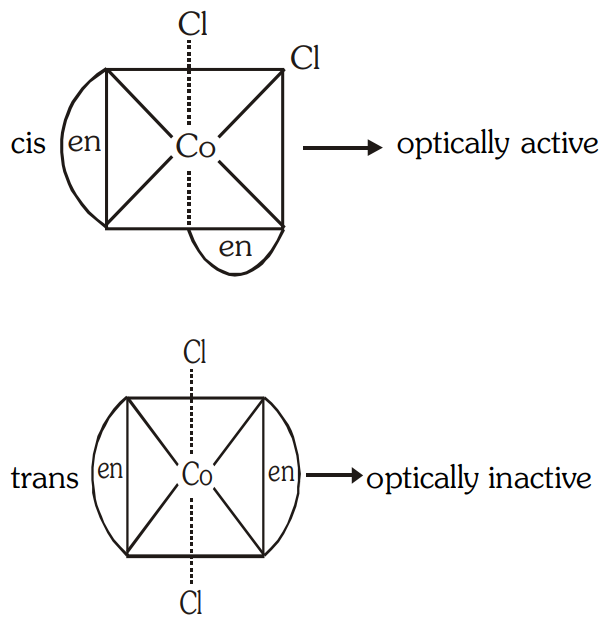
The trans form has a plane of symmetry (optically inactive); the cis form is optically active and exists as a pair of enantiomers.
Total stereoisomers = 2 + 1 = 3 -
The complex, $[Pt(Py)(NH_3)BrCl]$ will have how many geometrical isomers?
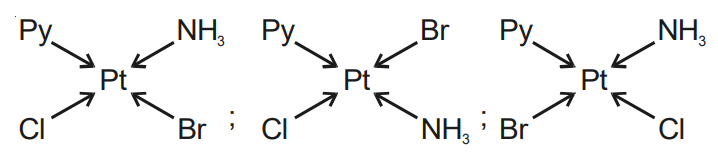
Pt(II) forms square planar complexes; this complex is of the type [Mabcd] with four different monodentate ligands (Py, $NH_3$, Br, Cl).
Fix one ligand, say Py, at one corner. The position trans to it can be occupied by any one of the other three ligands.
Isomer 1: Py trans to $NH_3$ (Br trans to Cl).
Isomer 2: Py trans to Br ($NH_3$ trans to Cl).
Isomer 3: Py trans to Cl ($NH_3$ trans to Br).
So a square planar complex [Mabcd] has 3 geometrical isomers. -
The complexes $[Co(NH_3)_6][Cr(CN)_6]$ and $[Cr(NH_3)_6][Co(CN)_6]$ are the examples of which type of isomerism?In both compounds the cation and the anion are complex ions.
In the first, $NH_3$ ligands are bound to Co and $CN^-$ ligands to Cr; in the second, $NH_3$ ligands are bound to Cr and $CN^-$ ligands to Co.
The ligands have been interchanged between the cationic and anionic coordination entities of the two different metal ions.
This type of isomerism is called coordination isomerism.
Linkage isomerism needs an ambidentate ligand bound through different atoms, and ionisation isomerism involves exchange of a ligand with the counter ion, which is not the case here. -
Which one of the following complexes is not expected to exhibit isomerism?$[Ni(NH_3)_4(H_2O)_2]^{2+}$ is octahedral of the type $[MA_4B_2]$; it shows geometrical (cis–trans) isomerism.
$[Pt(NH_3)_2Cl_2]$ is square planar ($dsp^2$) of the type $[MA_2B_2]$; it shows cis–trans isomerism (cis-platin and trans-platin).
$[Ni(en)_3]^{2+}$ is octahedral with three bidentate ligands; it has no plane of symmetry and shows optical isomerism (d and l forms).
$[Ni(NH_3)_2Cl_2]$: $Ni^{2+}$ with these weak field ligands is $sp^3$ hybridised and tetrahedral. In a tetrahedron all four positions are adjacent to one another, so $[MA_2B_2]$ has only one arrangement; there is no geometrical isomerism, and no optical isomerism either, since it has a plane of symmetry.
Hence $[Ni(NH_3)_2Cl_2]$ is not expected to exhibit isomerism. -
The existence of two different coloured complexes with the composition of $[Co(NH_3)_4Cl_2]^+$ is due to$[Co(NH_3)_4Cl_2]^+$ is an octahedral complex of the type $[MA_4B_2]$.
The two $Cl^-$ ligands can occupy adjacent positions ($90^\circ$ apart, cis isomer) or opposite positions ($180^\circ$ apart, trans isomer).
These are geometrical isomers; the cis form is violet and the trans form is green.
Ionisation isomerism needs exchange of a ligand with a counter ion, linkage isomerism needs an ambidentate ligand, and coordination isomerism needs both cation and anion to be complexes; none applies to this single complex ion.
Hence the two coloured forms are due to geometrical isomerism. -
Which of the following does not show optical isomerism? (en = ethylenediamine)A complex is optically active if it is chiral, i.e., if it has no plane of symmetry and is not superimposable on its mirror image.
$[Co(en)_3]^{3+}$: three bidentate ligands give a propeller-like structure with no plane of symmetry; it shows optical isomerism.
$[Co(en)_2Cl_2]^+$: the cis isomer has no plane of symmetry and is optically active.
$[Co(en)Cl_2(NH_3)_2]^+$: its cis forms can be chiral and show optical isomerism.
$[Co(NH_3)_3Cl_3]$ is of the type $[MA_3B_3]$ with only monodentate ligands; it shows geometrical isomerism (fac and mer forms), but both forms have planes of symmetry, so neither is optically active.
Hence $[Co(NH_3)_3Cl_3]^0$ does not show optical isomerism. -
$[Co(NH_3)_4(NO_2)_2]Cl$ exhibits :-Linkage isomerism: $NO_2^-$ is an ambidentate ligand. It can bind through nitrogen (nitro, $-NO_2$) or through oxygen (nitrito, $-ONO$), so linkage isomers are possible.
Ionization isomerism: the ligand $NO_2^-$ inside the coordination sphere and the counter ion $Cl^-$ outside can exchange places, giving $[Co(NH_3)_4(NO_2)Cl]NO_2$. So ionization isomerism is possible.
Geometrical isomerism: the complex ion $[Co(NH_3)_4(NO_2)_2]^+$ is octahedral of the type $MA_4B_2$, which exists in cis and trans forms.
Optical isomerism: both the cis and the trans forms of an $MA_4B_2$ complex with monodentate ligands have a plane of symmetry, so the complex is not optically active.
So the compound exhibits linkage isomerism, ionization isomerism and geometrical isomerism. -
Which of the following coordination compounds would exhibit optical isomerismA complex shows optical isomerism if it is chiral, i.e. it has no plane or centre of symmetry, so it is not superimposable on its mirror image.
$[Pt(NH_3)_2Cl_2]$ is square planar. A square planar complex has its molecular plane as a plane of symmetry, so it is optically inactive (it shows only geometrical isomerism).
trans-$[Cr(CN)_2(en)_2]Cl$: in the trans form the two $CN^-$ groups are opposite each other and the two en rings lie in one plane, which is a plane of symmetry. So it is optically inactive (only the cis form is chiral).
$[Co(en)_3]Br_3$: three bidentate en ligands wrap around Co like the blades of a propeller. The arrangement has no plane of symmetry and exists as two non-superimposable mirror images (d and l forms). So it shows optical isomerism.
$[Co(NH_3)_5(NO_2)]I_2$ is of the $MA_5B$ type and has planes of symmetry, so it is optically inactive (it shows linkage isomerism).
So tris(ethylenediamine)cobalt(III) bromide exhibits optical isomerism. -
Which of the following will give maximum number of isomers : -$[Co(NH_3)_4Cl_2]$: $MA_4B_2$ type, shows only cis and trans geometrical isomers (2).
$[Ni(en)(NH_3)_4]^{2+}$: the en ligand must span cis positions, so there is only one form.
$[Ni(C_2O_4)(en)_2]^{2-}$: $M(AA)(BB)_2$ type; it exists as a pair of enantiomers (d and l), i.e. 2 isomers.
$[Cr(SCN)_2(NH_3)_4]^+$: $MA_4B_2$ type gives cis and trans forms. In addition, the ambidentate SCN ligand can bind through S (thiocyanato) or N (isothiocyanato), so each SCN can be S- or N-bonded (SCN, SCN; SCN, NCS; NCS, NCS). Combining geometrical and linkage isomerism gives the largest number of isomers.
So $[Cr(SCN)_2(NH_3)_4]^+$ gives the maximum number of isomers. -
Which complex compound will give four isomers :$[Fe(en)_3]^{3+}$: shows only optical isomerism (d and l), 2 isomers.
$[Co(en)_2Cl_2]^+$: cis (which is optically active, d and l) and trans: 3 isomers.
$[Fe(PPh_3)_3(NH_3)ClBr]^+$: an octahedral $[MA_3BCD]$ complex. The three $PPh_3$ groups can be facial (fac) or meridional (mer), and the positions of $NH_3$, Cl and Br relative to them give further arrangements, some of which are chiral. In total it gives four stereoisomers.
$[Co(PPh_3)_3Cl]^{3+}$ is a four-coordinate complex with no comparable isomerism.
So, as per the answer key, $[Fe(PPh_3)_3NH_3ClBr]Cl$ gives four isomers.
Nomenclature and Types of Complexes
-
Homoleptic complex from the following complexes is:
A homoleptic complex has only one kind of ligand.
Homoleptic complexes have all ligands identical. Potassium trioxalatoaluminate (III) is $K_3[Al(C_2O_4)_3]$ which has only oxalate ion as ligand. All others have more than one type of ligands.
Stability of Coordination Compounds – Chelate Effect
-
Which complex compound is most stable?
Ethylene diamine is a bidentate chelating ligand, which increases stability.
Ethylene diamine, en is bidentate, chelating ligand. Chelating ligands increase stability due to higher entropy factor.
Nomenclature of Coordination Compounds
-
The IUPAC name of the complex- $[Ag(H_2O)_2][Ag(CN)_2]$ is:$[Ag(H_2O)_2][Ag(CN)_2]$: coordination number = 2; oxidation state of Ag = +1 in both ions. Cation $[Ag(H_2O)_2]^+$: diaquasilver(I); anion $[Ag(CN)_2]^-$: dicyanidoargentate(I) IUPAC name: diaquasilver(I) dicyanidoargentate(I)
Crystal Field Theory – Colour of Complexes
-
The order of energy absorbed which is responsible for the color of complexes A. $[Ni(H_2O)_2(en)_2]^{2+}$ B. $[Ni(H_2O)_4(en)]^{2+}$ and C. $[Ni(en)_3]^{2+}$ isen (ethylenediamine) is a stronger field ligand than $H_2O$. As the number of en ligands increases, the crystal field splitting $\Delta_o$ increases, so the energy absorbed increases. $[Ni(en)_3]^{2+}$ (3 en) > $[Ni(H_2O)_2(en)_2]^{2+}$ (2 en) > $[Ni(H_2O)_4(en)]^{2+}$ (1 en) So the order is C > A > B.
Ligands – Denticity
-
Ethylene diaminetetraacetate (EDTA) ion is:EDTA ion has two N donor atoms and four $-COO^-$ (O) donor atoms.
So it is a hexadentate ligand with four 'O' and two 'N' donor atoms.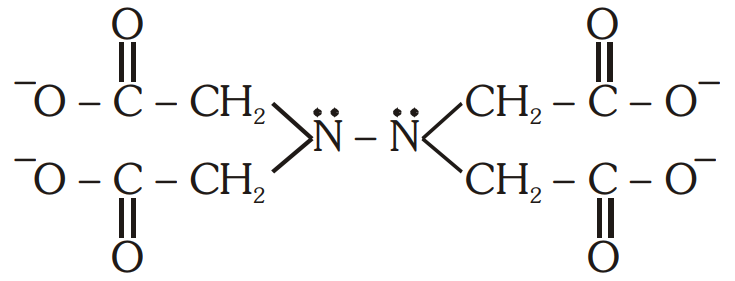
Bonding in Coordination Compounds – Magnetic Moment
-
Match List-I with List-II.
Pick the matching item from Column II for each row.
Column I
- A. $[Fe(CN)_6]^{3-}$
- B. $[Fe(H_2O)_6]^{3+}$
- C. $[Fe(CN)_6]^{4-}$
- D. $[Fe(H_2O)_6]^{2+}$
Column II
- I. 5.92 BM
- II. 0 BM
- III. 4.90 BM
- IV. 1.73 BM
Correct answer: A → IV, B → I, C → II, D → III
$[Fe(CN)_6]^{3-}$: $Fe^{3+}$ ($3d^5$), strong field – 1 unpaired electron, $\mu = 1.73$ BM $[Fe(H_2O)_6]^{3+}$: $Fe^{3+}$ ($3d^5$), weak field – 5 unpaired electrons, $\mu = 5.92$ BM $[Fe(CN)_6]^{4-}$: $Fe^{2+}$ ($3d^6$), strong field – 0 unpaired electrons, $\mu = 0$ BM $[Fe(H_2O)_6]^{2+}$: $Fe^{2+}$ ($3d^6$), weak field – 4 unpaired electrons, $\mu = 4.90$ BM Correct match: A-IV, B-I, C-II, D-III.
Coordination Compounds – Tetraamminecopper(II) Complex
-
Urea reacts with water to form A which will decompose to form B. B when passed through $Cu^{2+}$ (aq), deep blue colour solution C is formed. What is the formula of C from the following?$NH_2CONH_2 + 2H_2O \rightarrow (NH_4)_2CO_3$ (A) $(NH_4)_2CO_3 \xrightarrow{\Delta} 2NH_3(g) + CO_2(g) + H_2O(l)$ (B = $NH_3$) $Cu^{2+}(aq) + 4NH_3 \rightarrow [Cu(NH_3)_4]^{2+}$ (C, deep blue solution)
Crystal Field Theory – Spectrochemical Series
-
Which of the following is the correct order of increasing field strength of ligands to form coordination compounds?Spectrochemical series (NCERT): $I^- < Br^- < SCN^- < Cl^- < S^{2-} < F^- < OH^- < C_2O_4^{2-} < H_2O < NCS^- < edta^{4-} < NH_3 < en < CN^- < CO$ So the increasing order of field strength is $SCN^- < F^- < C_2O_4^{2-} < CN^-$.
Crystal Field Theory – d-orbital Splitting in Octahedral Complexes
-
What is the correct electronic configuration of the central atom in $K_4[Fe(CN)_6]$ based on crystal field theory?In $K_4[Fe(CN)_6]$, Fe is in +2 state. Fe ground state: $[Ar]3d^64s^2$; $Fe^{2+}$: $3d^64s^0$ $CN^-$ is a strong field ligand, so in the octahedral field pairing occurs and all 6 electrons go into $t_{2g}$. Configuration: $t_{2g}^6e_g^0$
Spin-only magnetic moment formula, $\mu = \sqrt{n(n+2)}$ BM
-
The calculated 'spin-only' magnetic moment of $Ti^{2+}(3d^2)$ is:$_{22}Ti \rightarrow [Ar]\,4s^2\,3d^2$ ; $Ti^{2+} \rightarrow [Ar]\,3d^2$ Number of unpaired electrons, n = 2 Spin-only magnetic moment $\mu = \sqrt{n(n+2)} = \sqrt{2(2+2)} = \sqrt{8} = 2.84$ BM
Geometry/shapes of coordination complexes
-
Match List I with List II
Pick the matching item from Column II for each row.
Column I
- i. $[Pt(Cl_2)(NH_3)_2]$
- ii. $[Co(NH_3)_6]Cl_3$
- iii. $[NiCl_4]^{2-}$
- iv. $[Fe(CO)_5]$
Column II
- a. Octahedral
- b. Trigonal bipyramidal
- c. Square planar
- d. Tetrahedral
Correct answer: i → c, ii → a, iii → d, iv → b
$[Pt(Cl_2)(NH_3)_2]$: C.N. = 4, $Pt^{2+}$ – $5d^8$, all ligands considered as SFL, so hybridisation is $dsp^2$ – square planar $[Co(NH_3)_6]Cl_3$: C.N. = 6, hybridisation $d^2sp^3$ – octahedral $[NiCl_4]^{2-}$: C.N. = 4, $Ni^{2+}$, $Cl^-$ acts as WFL, no pairing, hence hybridisation is $sp^3$ – tetrahedral $[Fe(CO)_5]$: C.N. = 5, hybridisation $dsp^3$ – trigonal bipyramidal Correct match: i-c, ii-a, iii-d, iv-b.
Types of ligands - ambidentate ligands
-
Which one of the following is an ambidentate ligand?Ambidentate ligand: has more than one donor atom but at a time only one can form a coordinate bond with the central metal atom. Thiocyanate can bind through S ($SCN^-$) or through N ($NCS^-$), so it is ambidentate.
Types of isomerism in coordination compounds
-
Match List I with List II:
Pick the matching item from Column II for each row.
Column I
- i. $[Pt(NH_3)_2Cl_2]$
- ii. $[Co(en)_3]^{3+}$
- iii. $[Co(NH_3)_5NO_2]Cl_2$
- iv. $[Cr(H_2O)_6]Cl_3$
Column II
- a. Optical
- b. Solvate
- c. Geometrical
- d. Linkage
Correct answer: i → c, ii → a, iii → d, iv → b
$[Pt(NH_3)_2Cl_2]$: square planar $[Ma_2b_2]$, shows geometrical (cis-trans) isomerism $[Co(en)_3]^{3+}$: $[M(AA)_3]$ type, due to presence of bidentate ligand, shows optical isomerism $[Co(NH_3)_5(NO_2)]Cl_2$: $NO_2^-$ is ambidentate ($NO_2$/ONO), so shows linkage isomerism $[Cr(H_2O)_6]Cl_3$: due to presence of $H_2O$ ligand shows hydrate (solvate) isomerism, e.g. $[Cr(H_2O)_5Cl]Cl_2 \cdot H_2O$, $[Cr(H_2O)_4Cl_2]Cl \cdot 2H_2O$ Correct match: i-c, ii-a, iii-d, iv-b.
Denticity of ligands
-
Ethylene diaminetetraacetate ion is a/an:EDTA$^{4-}$ (ethylenediaminetetraacetate) can coordinate to a central metal ion through two nitrogen atoms and four oxygen atoms (from the four carboxylate groups), giving a total of six donor sites — it is a hexadentate ligand.
Ambidentate ligands
-
Which of the following is not an ambidentate ligand?Ambidentate ligands have two different donor atoms, either of which can bind to the metal. $SCN^-$ (S or N), $NO_2^-$ (N or O) and $CN^-$ (C or N) are ambidentate. $C_2O_4^{2-}$ (oxalate) binds only through its oxygen atoms (as a bidentate ligand) and has only one type of donor site, so it is not ambidentate.
Qualitative analysis - identification tests for cations/radicals
-
Match List-I with List-II and choose the correct answer from the options given below:
Pick the matching item from Column II for each row.
Column I
- A. Lake Test
- B. Nessler's Reagent
- C. Potassium sulphocyanide
- D. Brown Ring Test
Column II
- I. NO3-
- II. Fe3+
- III. Al3+
- IV. NH4+
Correct answer: A → III, B → IV, C → II, D → I
Lake Test identifies $Al^{3+}$ (A-III); Nessler's Reagent identifies $NH_4^+$ (B-IV); Potassium sulphocyanide (thiocyanate) identifies $Fe^{3+}$ (C-II); Brown Ring Test identifies $NO_3^-$ (D-I).
Structure of metal carbonyls
-
$[Mn_2(CO)_{10}]$ and $[Co_2(CO)_8]$ structures have A. Metal-Metal linkage B. Terminal CO groups C. Bridging CO groups D. Metal in zero oxidation state. Choose the correct answer from the options given below:Both $[Mn_2(CO)_{10}]$ and $[Co_2(CO)_8]$ have a metal-metal bond (A) and terminal CO groups (B), and in both the metal is in the zero oxidation state (D). $[Mn_2(CO)_{10}]$ has no bridging CO groups (only $[Co_2(CO)_8]$ has bridging CO), so statement C does not hold for both. Hence, only A, B, D.
VBT hybridisation and geometry
-
Match the coordination number and type of hybridisation with distribution of hybrid orbitals in space based on Valence bond theory.
Pick the matching item from Column II for each row.
Column I
- a. 4, sp3
- b. 4, dsp2
- c. 5, sp3d
- d. 6, d2sp3
Column II
- i. trigonal bipyramidal
- ii. octahedral
- iii. tetrahedral
- iv. square planar
Correct answer: a → iii, b → iv, c → i, d → ii
4, $sp^3$ hybridisation gives tetrahedral geometry (a-iii); 4, $dsp^2$ hybridisation gives square planar geometry (b-iv); 5, $sp^3d$ hybridisation gives trigonal bipyramidal geometry (c-i); 6, $d^2sp^3$ hybridisation gives octahedral geometry (d-ii).
Complex salts vs double salts
-
Which of the following forms a set of complex and a double salt, respectively?$K_2PtCl_2\cdot2NH_3$, i.e. $K_2[Pt(NH_3)_2Cl_2]$, is a complex salt (retains a complex ion in solution), while $KAl(SO_4)_2\cdot12H_2O$ (potash alum) is a double salt (dissociates completely into its constituent simple ions in solution).
Solvate (hydrate) isomerism
-
Type of isomerism exhibited by compounds $[Cr(H_2O)_6]Cl_3$, $[Cr(H_2O)_5Cl]Cl_2\cdot H_2O$, $[Cr(H_2O)_4Cl_2]Cl\cdot2H_2O$ and the value of coordination number (CN) of central metal ion in all these compounds, respectively is:These complexes differ in the number of water molecules coordinated directly to the metal versus present as water of crystallisation outside the coordination sphere — this is solvate (hydrate) isomerism. In each case, the coordination number of the central chromium ion is 6.
Structural isomerism in coordination compounds
-
Match List - I (Complexes) with List - II (Types). Choose the correct answer.
Pick the matching item from Column II for each row.
Column I
- A. $[Co(NH_3)_5NO_2]Cl_2$ and $[Co(NH_3)_5ONO]Cl_2$
- B. $[Cr(NH_3)_6][Co(CN)_6]$ and $[Cr(CN)_6][Co(NH_3)_6]$
- C. $[Co(NH_3)_5(SO_4)]Br$ and $[Co(NH_3)_5Br]SO_4$
- D. $[Cr(H_2O)_6]Cl_3$ and $[Cr(H_2O)_5Cl]Cl_2\cdot H_2O$
Column II
- I. ionisation isomerism
- II. coordination isomerism
- III. linkage isomerism
- IV. solvate isomerism
Correct answer: A → III, B → II, C → I, D → IV
(a) $NO_2^-$ vs $ONO^-$ bonding: linkage isomerism (ambidentate ligand). (b) Exchange of ligands between cationic and anionic coordination spheres: coordination isomerism. (c) Different ions formed on ionisation: ionisation isomerism. (d) Water present as ligand vs water of crystallisation: solvate (hydrate) isomerism.
Bonding in metal carbonyls
-
The metal carbon bond in metal carbonyls possesses both $\sigma$ and $\pi$ character.Reason: The ligand to metal bond is a $\pi$ bond and metal to ligand bond is a $\sigma$ bond.The M-C bond in metal carbonyls has both $\sigma$ and $\pi$ character, so the assertion is correct. The ligand-to-metal bond is a $\sigma$ bond (donation of lone pair of CO to metal) and the metal-to-ligand bond is a $\pi$ bond (back donation into $\pi^*$ of CO). The reason states the reverse, so it is incorrect.
-
Which of the following carbonyls will have the strongest C–O bond?In metal carbonyls the metal donates electron density from its filled d orbitals into the empty $\pi^*$ orbital of CO (back bonding).
Electrons entering the antibonding $\pi^*$ orbital of CO weaken the C–O bond; the greater the back donation, the lower the C–O bond order.
Back donation increases with the electron density on the metal: a negative charge on the complex increases it and a positive charge decreases it.
$[V(CO)_6]^-$ has the most electron-rich metal (maximum back bonding, weakest C–O bond); the neutral carbonyls $Cr(CO)_6$ and $Fe(CO)_5$ are intermediate.
$[Mn(CO)_6]^+$ has a positively charged metal centre, so back donation is the least and the C–O bond retains the most triple bond character.
Hence $[Mn(CO)_6]^+$ has the strongest C–O bond. -
Which of following organometallic compound is $\sigma$ and $\pi$ bonded : -In metal carbonyls, the M–CO bond has both $\sigma$ and $\pi$ character (synergic bonding).
CO donates its lone pair on carbon into an empty metal orbital, forming a $\sigma$ bond.
The metal donates electrons from a filled d orbital back into the empty $\pi^*$ orbitals of CO, forming a $\pi$ bond (back bonding).
So $[Co(CO)_5NH_3]^{2+}$ contains both $\sigma$ and $\pi$ bonded metal–carbon bonds.
Ferrocene and Zeise's salt are classed as $\pi$-bonded organometallic compounds, and $Fe(CH_3)_3$ is $\sigma$-bonded only.
So, as per the answer key, the $\sigma$ and $\pi$ bonded compound is $[Co(CO)_5NH_3]^{2+}$.
Crystal field splitting - tetrahedral vs octahedral
-
The Crystal Field Stabilisation Energy (CFSE) for $[CoCl_6]^{4-}$ is 18000 cm$^{-1}$. The CFSE for $[CoCl_4]^{2-}$ will be$\Delta_t=\frac{4}{9}\Delta_o=\frac{4}{9}\times18000=8000$ cm$^{-1}$.
Optical isomerism in complexes
-
Given below are two statements: Statement-I: $[Fe(ox)_3]^{3-}$ is chiral. Statement-II: trans-$[Cr(H_2O)_2(ox)_2]^-$ is chiral. (Given: $oxH_2$ = HOOC-COOH) In light of the above statements, choose the most appropriate answer from the options given below:S-I: $[Fe(ox)_3]^{3-}$ is of the type $[M(AA)_3]$, has no plane of symmetry and is optically active, so it is chiral - correct. S-II: trans-$[Cr(H_2O)_2(ox)_2]^-$ has a plane of symmetry (the two ox ligands in one plane, water molecules trans), so it is not optically active, i.e. not chiral - incorrect.
-
Which of the following will give a pair of enantiomorphs?
(en $= NH_2CH_2CH_2NH_2$)Non-superimposable mirror images are called optical isomers and may be described as chiral. They are also called enantiomers (enantiomorphs) and rotate plane polarised light in opposite directions.
$[Co(en)_2Cl_2]^+$ is an octahedral complex with two bidentate en ligands and two chloride ligands. It exists as cis and trans geometrical isomers.
The trans isomer has a plane of symmetry and is optically inactive.
The cis isomer has no plane of symmetry; its mirror image cannot be superimposed on it, so it exists as a pair of enantiomers (d and l forms).
$[Cr(NH_3)_6][Co(CN)_6]$ and $[Pt(NH_3)_4][PtCl_6]$ show coordination isomerism, not optical isomerism.
$[Co(NH_3)_4Cl_2]NO_2$ shows geometrical and ionisation isomerism; with only monodentate ligands both its forms have planes of symmetry.
So the complex that gives a pair of enantiomorphs is $[Co(en)_2Cl_2]Cl$. -
Which one of the following is expected to exhibit optical isomerism ?
(en = ethylenediamine)A complex shows optical isomerism if it has no plane of symmetry, so that its mirror image cannot be superimposed on it.
cis-$[Co(en)_2Cl_2]^+$ is octahedral with the two chloride ions adjacent to each other; the two en rings are arranged like the blades of a propeller.
It has no plane of symmetry, so it exists as a pair of enantiomers (d and l forms).
trans-$[Co(en)_2Cl_2]^+$ has the two chloride ions opposite each other and has a plane of symmetry, so it is optically inactive.
$[Pt(NH_3)_2Cl_2]$ is square planar; both its cis and trans forms lie in a plane, which is a plane of symmetry, so neither is optically active.
So the complex expected to exhibit optical isomerism is cis-$[Co(en)_2Cl_2]$.
Spectrochemical series
-
According to crystal field theory, the correct order of ligands with respect to their decreasing order of field strength isSpectrochemical series (decreasing field strength): $CO>NH_3>H_2O>Cl^-$.
Crystal field theory - magnetic moment
-
Among the species given below, the spin-only magnetic moment is highest for (Given: Atomic number of Ti = 22, Mn = 25, Fe = 26 and Co = 27)(1) $[Mn(CN)_6]^{3-}$: $d^2sp^3$, $Mn^{3+}=3d^4$ (low spin) $\Rightarrow$ n = 2. (2) $[Fe(CN)_6]^{3-}$: $Fe^{3+}=3d^5$ (low spin) $\Rightarrow$ n = 1. (3) $[Co(NH_3)_6]^{3+}$: $Co^{3+}=3d^6$ (low spin) $\Rightarrow$ n = 0. (4) $[Ti(H_2O)_6]^{3+}$: $Ti^{3+}=3d^1 \Rightarrow$ n = 1. $[Mn(CN)_6]^{3-}$ has the maximum number of unpaired electrons, so the highest spin-only magnetic moment.
IUPAC nomenclature of coordination compounds
-
The formula of tetraammineaquachloridocobalt(III) chloride isTetraammine = $(NH_3)_4$, aqua = $H_2O$, chlorido = Cl as ligands; cobalt(III) needs two chloride counter ions: $[Co(NH_3)_4(H_2O)Cl]Cl_2$.
-
According to IUPAC nomenclature sodium nitroprusside is named as :Sodium nitroprusside is $Na_2[Fe(CN)_5NO]$.
The complex anion has five cyanide ligands ($CN^-$) and one nitrosyl ligand. In nitroprusside the NO ligand is present as $NO^+$ (nitrosonium).
Oxidation state of Fe: $x + 5(-1) + (+1) = -2 \Rightarrow x = +2$
The complex is an anion, so the metal name ends in -ate (ferrate). Ligands are named in alphabetical order: cyano before nitrosyl.
So its name is sodium pentacyanonitrosylferrate(II).
Geometrical isomerism - fac and mer
-
The complex which has facial and meridional isomers is (Given: py = pyridine and en = $H_2N-CH_2-CH_2-NH_2$)$[Cr(py)_3Cl_3]$ is of the type $[Ma_3b_3]$, which shows facial and meridional isomers.
Werner's theory - ionisation
-
A 1 : 3 electrolyte in an aqueous solution is$[Co(NH_3)_6]Cl_3\rightarrow[Co(NH_3)_6]^{3+}+3Cl^-$, a 1 : 3 electrolyte.
Metal carbonyls
-
Iron carbonyl, $Fe(CO)_5$ is
One Fe atom per molecule means mononuclear.
Based on the number of metal atoms present in a complex, they are classified into mononuclear, dinuclear, trinuclear and so on. e.g. $Fe(CO)_5$: mononuclear; $Co_2(CO)_8$: dinuclear; $Fe_3(CO)_{12}$: trinuclear So $Fe(CO)_5$ is mononuclear. -
Shape of $Fe(CO)_5$ is :In $Fe(CO)_5$, Fe is in the zero oxidation state: $[Ar]\,3d^6\,4s^2$. With strong field CO, the electrons pair up to give $3d^8$, leaving one 3d, one 4s and three 4p orbitals for bonding.
These form five $dsp^3$ hybrid orbitals, which accept lone pairs from five CO ligands.
$dsp^3$ hybridisation gives a trigonal bipyramidal shape (3 equatorial and 2 axial CO groups). The complex is diamagnetic.
So the shape of $Fe(CO)_5$ is trigonal bipyramidal.
Valence bond theory – hybridisation and magnetism
-
The geometry and magnetic behaviour of the complex $[Ni(CO)_4]$ are
$Ni(0)$, $3d^{10}$, $sp^3$ → tetrahedral and diamagnetic.
$Ni(28) : [Ar]\,3d^8 4s^2$
$\because$ CO is a strong field ligand, the 4s electrons pair into 3d, giving $3d^{10}$.
For four CO ligands the hybridisation is $sp^3$, and thus the complex is diamagnetic with tetrahedral geometry.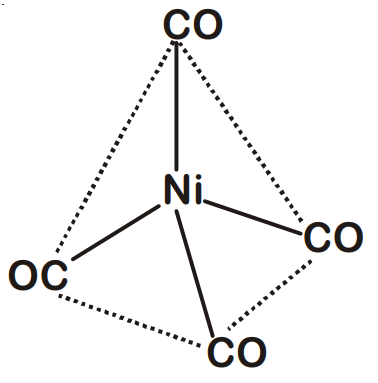
Stability of complexes – formation constants
-
$HgCl_2$ and $I_2$ both when dissolved in water containing $I^-$ ions the pair of species formed is
$I^-$ forms $[HgI_4]^{2-}$ with $HgCl_2$ and $I_3^-$ with $I_2$.
In a solution containing $HgCl_2$, $I_2$ and $I^-$, both $HgCl_2$ and $I_2$ compete for $I^-$. Since the formation constant of $[HgI_4]^{2-}$ is $1.9\times10^{30}$, which is very large compared with $I_3^-$ ($K_f = 700$), $I^-$ will preferentially combine with $HgCl_2$. $HgCl_2 + 2I^- \rightarrow HgI_2\downarrow$ (red ppt) $+ 2Cl^-$ $HgI_2 + 2I^- \rightarrow [HgI_4]^{2-}$ (soluble) With excess $I^-$, $I_2$ also forms $I_3^-$, so the pair formed is $HgI_4^{2-}$ and $I_3^-$.
Werner's theory – ionisable chloride
-
The correct order of the stoichiometries of AgCl formed when $AgNO_3$ in excess is treated with the complexes: $CoCl_3\cdot6NH_3$, $CoCl_3\cdot5NH_3$, $CoCl_3\cdot4NH_3$ respectively is
Only counter-ion chlorides precipitate with $AgNO_3$.
The complexes are respectively $[Co(NH_3)_6]Cl_3$, $[Co(NH_3)_5Cl]Cl_2$ and $[Co(NH_3)_4Cl_2]Cl$. Only ionisable (outside-sphere) $Cl^-$ precipitates as AgCl: 3, 2 and 1 respectively.
Crystal field theory – spectrochemical series and colour
-
Correct increasing order for the wavelengths of absorption in the visible region for the complexes of $Co^{3+}$ is
Stronger field ligand → larger $\Delta_o$ → shorter absorbed wavelength.
The order of the ligands in the spectrochemical series is $H_2O < NH_3 < en$. Hence the wavelength of the light observed will be in the order $[Co(H_2O)_6]^{3+} < [Co(NH_3)_6]^{3+} < [Co(en)_3]^{3+}$. Thus the wavelength absorbed will be in the opposite order, i.e. $[Co(en)_3]^{3+} < [Co(NH_3)_6]^{3+} < [Co(H_2O)_6]^{3+}$.
Organometallic compounds – sigma and pi bonded
-
An example of a sigma bonded organometallic compound is:
RMgX has a Mg–C $\sigma$ bond.
Grignard's reagent, i.e. RMgX, is a $\sigma$-bonded organometallic compound (the others are $\pi$-bonded sandwich compounds).
Valence bond theory – hybridisation and geometry
-
Pick out the correct statement with respect $[Mn(CN)_6]^{3-}$:
Strong-field $CN^-$ pairs electrons leaving two inner d orbitals for $d^2sp^3$.
In $[Mn(CN)_6]^{3-}$, Mn(III) $= [Ar]\,3d^4$
$CN^-$, being a strong field ligand, forces pairing of electrons, giving $t_{2g}^4e_g^0$.
$\because$ Coordination number of Mn = 6, the hybridisation is $d^2sp^3$ and the structure is octahedral.
Metal carbonyls – synergic bonding
-
Which of the following has longest C–O bond length? (Free C–O bond length in CO is 1.128 Å.)
More negative charge on the metal → more back bonding → longer C–O.
The interaction between a filled metal orbital and a vacant orbital of CO is known as back bonding.
When the metal in a metal carbonyl complex carries a negative charge, back bonding increases; the M–C bond length decreases and the C–O bond length increases.
So $[Fe(CO)_4]^{2-}$ has the longest C–O bond: $[Mn(CO)_6]^+ < Ni(CO)_4 < [Co(CO)_4]^- < [Fe(CO)_4]^{2-}$
Trans effect
-
The correct increasing order of trans-effect of the following species is:
Strong π-acceptor/σ-donor ligands like $CN^-$ have the largest trans effect.
Trans effect order: $CN^- > C_6H_5^- > Br^- > NH_3$
Crystal field theory – Jahn–Teller distortion
-
Jahn-Teller effect not observed in high spin complexes of:
Symmetric $e_g^2$ occupancy in $d^8$ gives no distortion.
The Jahn–Teller effect explains axial distortion in octahedral geometry. It is present in $d^4$ high spin, $d^7$ low spin and $d^9$ configurations, which have an odd number of electrons in the $e_g$ set.
A weak Jahn–Teller effect is also present in $d^7$ high spin complexes, which have an odd number of electrons in the $t_{2g}$ set.
High spin $d^8$ ($t_{2g}^6e_g^2$) has symmetric filling, so no Jahn–Teller effect.
Werner's theory
-
Cobalt (III) chloride forms several octahedral complexes with ammonia. Which of the following will not give test for chloride ions with silver nitrate at $25^\circ C$?$CoCl_3\cdot 3NH_3$ is $[Co(NH_3)_3Cl_3]$: all three chlorides are coordinated inside the sphere.
No chloride ion is ionisable, so $[Co(NH_3)_3Cl_3] \xrightarrow{AgNO_3}$ no precipitate. -
An excess of $AgNO_3$ is added to 100 mL of a 0.01 M solution of dichlorotetraaquachromium(III) chloride. The number of moles of AgCl precipitated would be:The complex is $[Cr(H_2O)_4Cl_2]Cl$, which has one ionisable chloride ion per formula unit.
Moles of complex $= 0.1\ L\times0.01\ M = 0.001$ mol
So 0.001 mol of AgCl is precipitated.
Crystal field theory
-
Which of these statements about $[Co(CN)_6]^{3-}$ is true?$Co^{3+}$: $[Ar]3d^6$
$CN^-$ is a strong field ligand, so $\Delta_o$ is large and the electrons pair up in the $t_{2g}$ level.
[add image: $3d^6$ splitting into $t_{2g}^6 e_g^0$ under a strong field]
Configuration $t_{2g}^6e_g^0$: no unpaired electrons, low-spin complex. -
Among the following complexes the one which shows zero crystal field stabilization energy (CFSE):$Fe^{3+}$ is $d^5$ and $H_2O$ is a weak field ligand, so the complex is high spin: $t_{2g}^3e_g^2$.
CFSE $= 3(-0.4\Delta_o) + 2(0.6\Delta_o) = 0$ -
Low spin complex of $d^6$-cation in an octahedral field will have the following energy: ($\Delta_0$ = Crystal Field Splitting Energy in an octahedral field, P = Electron pairing energy)In a low spin $d^6$ octahedral complex all six electrons are paired in the $t_{2g}$ orbitals: $t_{2g}^6e_g^0$.
Each $t_{2g}$ electron is stabilised by $-\frac{2}{5}\Delta_0$ ($= -0.4\Delta_0$) and each $e_g$ electron is destabilised by $+\frac{3}{5}\Delta_0$.
Energy from splitting $= 6\times\left(-\frac{2}{5}\Delta_0\right) + 0 = -\frac{12}{5}\Delta_0$
There are three electron pairs, so the pairing energy is 3P.
Total energy $= -\frac{12}{5}\Delta_0 + 3P$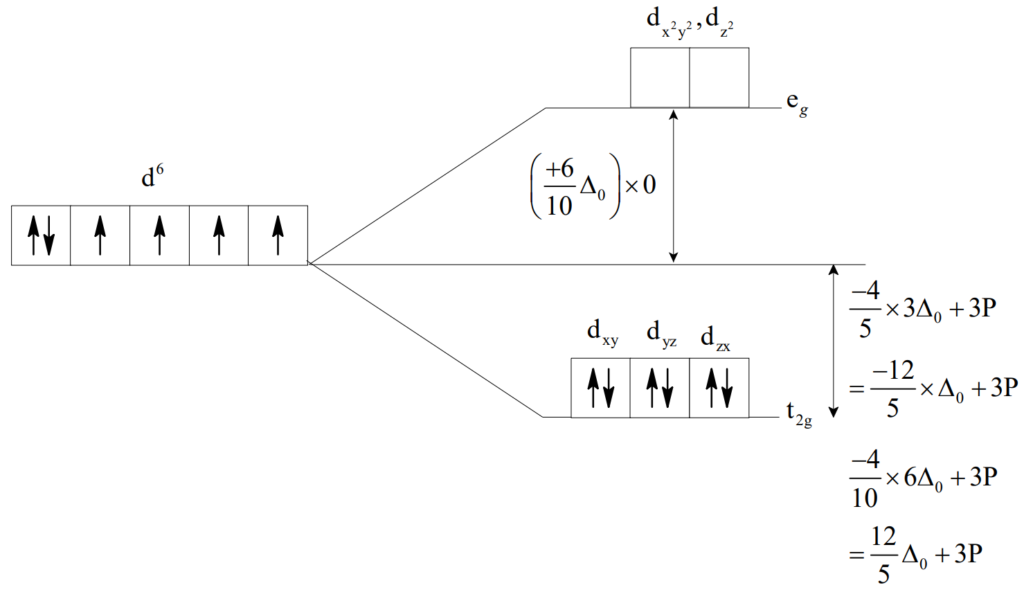
-
Crystal field stabilization energy for high spin $d^4$ octahedral complex isIn an octahedral field the d orbitals split into $t_{2g}$ (each electron stabilised by $-0.4\Delta_0$) and $e_g$ (each electron destabilised by $+0.6\Delta_0$).
High spin $d^4$ means the fourth electron goes to $e_g$ instead of pairing: configuration $t_{2g}^3e_g^1$.
CFSE = $3\times(-0.4\Delta_0) + 1\times(+0.6\Delta_0)$
CFSE = $-1.2\Delta_0 + 0.6\Delta_0$
CFSE = $-0.6\Delta_0$
(No pairing energy term appears, because no electrons are paired.) -
In which of the following co-ordination entities the magnitude of $\Delta_0$ (CFSE in octahedral field) will be maximum ?
(Atomic number of Co = 27)In all four complexes cobalt is in the +3 oxidation state ($3d^6$) in an octahedral field, so the metal ion and the geometry are the same.
The CFSE in an octahedral field then depends only upon the nature of the ligands: stronger the ligand, larger will be the value of $\Delta_{oct}$.
Spectrochemical series (increasing field strength): $I^- \lt Br^- \lt Cl^- \lt F^- \lt OH^- \lt C_2O_4^{2-} \lt H_2O \lt NH_3 \lt en \lt CN^- \lt CO$
Among the given ligands the order of field strength is: $C_2O_4^{2-} \lt H_2O \lt NH_3 \lt CN^-$
$CN^-$ is the strongest field ligand here, so it causes the largest splitting.
Hence $\Delta_0$ is maximum for $[Co(CN)_6]^{3-}$. -
$[Cr(H_2O)_6]Cl_3$ (at. no. of Cr = 24) has a magnetic moment of 3.83 B.M. The correct distribution of 3d electrons in the chromium of the complex is :-In $[Cr(H_2O)_6]Cl_3$ chromium is in the +3 oxidation state. Cr is $[Ar]3d^5 4s^1$, so $Cr^{3+}$ is $3d^3$.
Magnetic moment $\mu = \sqrt{n(n + 2)}$ BM. For $n = 3$: $\mu = \sqrt{15} = 3.87$ BM, which agrees with the observed value of 3.83 BM. So there are three unpaired electrons.
The complex is octahedral. In an octahedral field the five d orbitals split into a lower energy $t_{2g}$ set ($d_{xy}$, $d_{yz}$, $d_{xz}$) and a higher energy $e_g$ set ($d_{x^2-y^2}$, $d_{z^2}$).
The $t_{2g}$ orbitals point between the ligands, so they are lower in energy and are filled first.
The three electrons occupy the three $t_{2g}$ orbitals singly (Hund's rule): $t_{2g}^3\,e_g^0$.
So the distribution is $3d^1_{xy}$, $3d^1_{yz}$, $3d^1_{xz}$. -
Considering $H_2O$ as a weak field ligand, the number of unpaired electrons in $[Mn(H_2O)_6]^{2+}$ will be – (At. no. of Mn = 25)Electronic configuration of Mn (Z = 25): $[Ar]\,3d^5\,4s^2$
In $[Mn(H_2O)_6]^{2+}$, Mn is in the +2 state: $Mn^{2+} = [Ar]\,3d^5$
$H_2O$ is a weak field ligand, so the crystal field splitting $\Delta_o$ is smaller than the pairing energy. Electrons occupy the $t_{2g}$ and $e_g$ orbitals singly before pairing (high spin).
Configuration: $t_{2g}^3\,e_g^2$, with all five electrons unpaired.
So the number of unpaired electrons is five (magnetic moment about 5.92 BM).
IUPAC nomenclature of complexes
-
The name of complex ion, $[Fe(CN)_6]^{3-}$ is:Six cyanide ligands → hexacyanido; anionic complex of iron → ferrate; oxidation state of Fe = +3.
Name: hexacyanidoferrate(III) ion.
Valence bond theory
-
The hybridization involved in complex $[Ni(CN)_4]^{2-}$ is (At. No. Ni = 28)

Oxidation state of Ni: $x - 4 = -2 \Rightarrow x = +2$; $Ni^{2+}$: $[Ar]3d^84s^0$
$CN^-$ is a strong field ligand, so the two unpaired 3d electrons pair up, leaving one 3d orbital empty.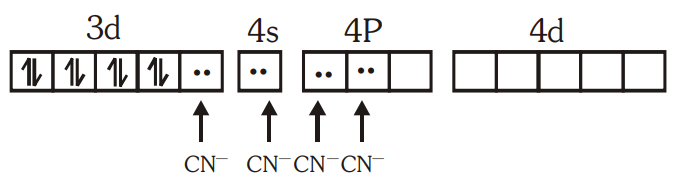
One 3d, one 4s and two 4p orbitals hybridise: $dsp^2$ (square planar). -
Which one of the following is an outer orbital complex and exhibits paramagnetic behaviour?$Ni^{2+}$: $3d^8$. Two vacant 3d orbitals are not available even after pairing, so the 4s, 4p and two 4d orbitals are used: $sp^3d^2$ (outer orbital). It has 2 unpaired electrons, so it is paramagnetic.

$[Co(NH_3)_6]^{3+}$ ($d^6$) is $d^2sp^3$, inner orbital and diamagnetic.
$[Cr(NH_3)_6]^{3+}$ ($d^3$) is $d^2sp^3$, inner orbital.
$[Zn(NH_3)_6]^{2+}$ ($d^{10}$) is outer orbital but diamagnetic.
So $[Ni(NH_3)_6]^{2+}$ is the outer orbital, paramagnetic complex. -
Of the following complex ions, which is diamagnetic in nature?$[Ni(CN)_4]^{2-}$: $Ni^{2+}$ is $3d^8$. $CN^-$ is a strong field ligand and pairs up the 3d electrons, leaving one 3d orbital empty; the hybridisation is $dsp^2$ (square planar) and there are no unpaired electrons, so it is diamagnetic.
$[NiCl_4]^{2-}$: $Ni^{2+}$ is $3d^8$. $Cl^-$ is a weak field ligand, no pairing occurs; hybridisation is $sp^3$ (tetrahedral) with 2 unpaired electrons, so it is paramagnetic.
$[CoF_6]^{3-}$: $Co^{3+}$ is $3d^6$. $F^-$ is a weak field ligand; hybridisation is $sp^3d^2$ with 4 unpaired electrons, so it is paramagnetic.
$[CuCl_4]^{2-}$: $Cu^{2+}$ is $3d^9$ with 1 unpaired electron, so it is paramagnetic.
Hence the diamagnetic ion is $[Ni(CN)_4]^{2-}$. -
Which one of the following is an inner orbital complex as well as diamagnetic in behaviour -An inner orbital complex uses the inner $(n-1)d$ orbitals in hybridisation ($d^2sp^3$); a diamagnetic complex has no unpaired electrons.
$[Co(NH_3)_6]^{3+}$: $Co^{3+}$ is $3d^6$. $NH_3$ pairs up the six electrons in three of the 3d orbitals, leaving two 3d orbitals empty for $d^2sp^3$ hybridisation. So it is an inner orbital, low spin complex with no unpaired electron, i.e. diamagnetic.
$[Zn(NH_3)_6]^{2+}$: $Zn^{2+}$ is $3d^{10}$; no inner d orbital is free, so it would use $sp^3d^2$ (outer orbital), although it is diamagnetic.
$[Ni(NH_3)_6]^{2+}$: $Ni^{2+}$ is $3d^8$; it uses $sp^3d^2$ (outer orbital) hybridisation and has two unpaired electrons, so it is paramagnetic.
$[Cr(NH_3)_6]^{3+}$: $Cr^{3+}$ is $3d^3$; it is an inner orbital ($d^2sp^3$) complex but has three unpaired electrons, so it is paramagnetic.
So the complex that is both inner orbital and diamagnetic is $[Co(NH_3)_6]^{3+}$. -
In an octahedral structure, the pair of d orbitals involved in $d^2sp^3$ hybridization is :-In an octahedral complex the six ligands approach the metal along the $\pm x$, $\pm y$ and $\pm z$ axes.
The hybrid orbitals must point along these axes. Among the d orbitals, only $d_{x^2-y^2}$ (lobes along x and y axes) and $d_{z^2}$ (lobes along the z axis) point along the axes.
$d_{xy}$, $d_{yz}$ and $d_{xz}$ have their lobes between the axes, so they are not used.
So in $d^2sp^3$ hybridization the two d orbitals are $d_{x^2-y^2}$ and $d_{z^2}$ (together with one s and three p orbitals).
Coordination number and oxidation state
-
The sum of coordination number and oxidation number of the metal M in the complex $[M(en)_2(C_2O_4)]Cl$ (where en is ethylenediamine) is:Oxidation state: $x + 0 - 2 = +1 \Rightarrow x = +3$
Coordination number: two en (bidentate) + one oxalate (bidentate) = 6
Sum = 3 + 6 = 9
Applications of coordination compounds
-
Which of the following complexes is used to be as an anticancer agent?$cis\text{-}[PtCl_2(NH_3)_2]$ (cisplatin) is used as an anticancer agent.
-
Red precipitate is obtained when ethanol solution of dimethylglyoxime is added to ammoniacal Ni(II). Which of the following statements is not true?The red precipitate is bis(dimethylglyoximato)nickel(II).
Each dimethylglyoximate ion binds through its two nitrogen atoms (bidentate), and the two ligands are held together by symmetrical O–H···O hydrogen bonds.
$Ni^{2+}$ ($d^8$) is $dsp^2$ hybridised here, so the complex is square planar and diamagnetic.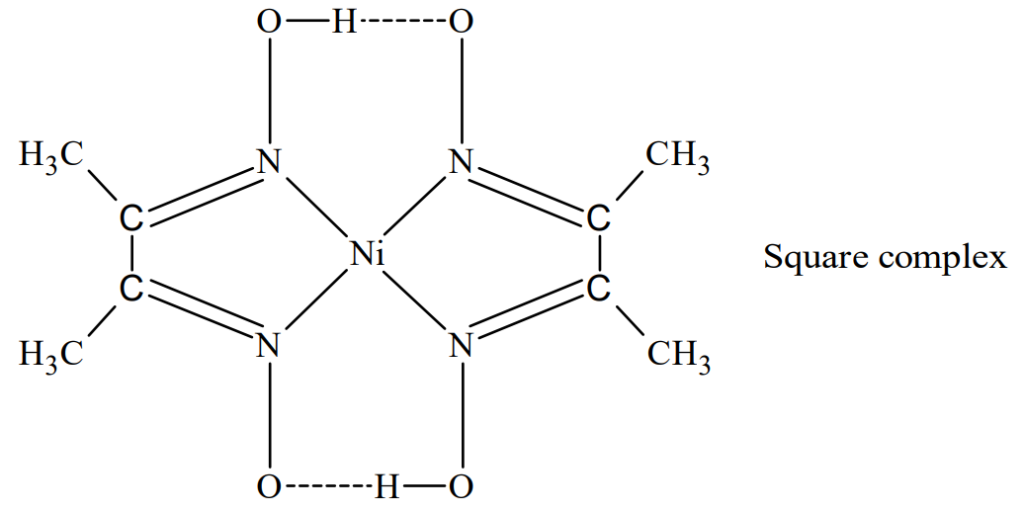
So the statement that it has a tetrahedral geometry is not true.
Magnetic properties of complexes
-
A magnetic moment of 1.73 BM will be shown by one among the following:$\mu = \sqrt{n(n+2)}$ BM = 1.73 gives n = 1 unpaired electron.
$[CoCl_6]^{4-}$: $Co^{2+}$, $d^7$, $Cl^-$ is a weak field ligand, $t_{2g}^5e_g^2$ — 3 unpaired electrons.
$[Cu(NH_3)_4]^{2+}$: $Cu^{2+}$, $d^9$, $dsp^2$ hybridisation — 1 unpaired electron.
$[Ni(CN)_4]^{2-}$: $Ni^{2+}$, $d^8$, $CN^-$ is a strong field ligand, $dsp^2$ — 0 unpaired electrons.
$TiCl_4$: $Ti^{4+}$, $d^0$ — 0 unpaired electrons. -
Which of the following complex compounds will exhibit highest paramagnetic behaviour? (At. No. Ti = 22, Cr = 24, Co = 27, Zn = 30)Paramagnetism increases with the number of unpaired electrons: $\mu = \sqrt{n(n + 2)}$ BM.
$[Co(NH_3)_6]^{3+}$: $Co^{3+}$ is $3d^6$; $NH_3$ causes pairing here ($t_{2g}^6$, inner orbital $d^2sp^3$ complex), so there are 0 unpaired electrons (diamagnetic).
$[Zn(NH_3)_6]^{2+}$: $Zn^{2+}$ is $3d^{10}$, 0 unpaired electrons (diamagnetic).
$[Ti(NH_3)_6]^{3+}$: $Ti^{3+}$ is $3d^1$, 1 unpaired electron.
$[Cr(NH_3)_6]^{3+}$: $Cr^{3+}$ is $3d^3$ ($t_{2g}^3$), 3 unpaired electrons.
Hence $[Cr(NH_3)_6]^{3+}$ shows the highest paramagnetic behaviour. -
The d-electron configurations of $Cr^{2+}$, $Mn^{2+}$, $Fe^{2+}$ and $Co^{2+}$ are $d^4$, $d^5$, $d^6$ and $d^7$ respectively. Which one of the following will exhibit minimum paramagnetic behaviour? (At. nos. Cr = 24, Mn = 25, Fe = 26, Co = 27)$H_2O$ is a weak field ligand, so all these octahedral complexes are high spin and the electrons are not forced to pair.
$Cr^{2+}$ ($d^4$): $t_{2g}^3e_g^1$, 4 unpaired electrons.
$Mn^{2+}$ ($d^5$): $t_{2g}^3e_g^2$, 5 unpaired electrons.
$Fe^{2+}$ ($d^6$): $t_{2g}^4e_g^2$, 4 unpaired electrons.
$Co^{2+}$ ($d^7$): $t_{2g}^5e_g^2$, 3 unpaired electrons.
Paramagnetism increases with the number of unpaired electrons ($\mu = \sqrt{n(n+2)}$ BM).
$[Co(H_2O)_6]^{2+}$ has the fewest unpaired electrons and shows minimum paramagnetic behaviour. -
Which of the following complexes exhibits the highest paramagnetic behaviour ?
Where gly = glycine, en = ethylenediamine and bpy = bipyridyl moieties
(Atomic number Ti = 22, V = 23, Fe = 26, Co = 27)Paramagnetic character depends on the number of unpaired electrons: $\mu = \sqrt{n(n + 2)}$ BM. More the number of unpaired electrons, more will be the paramagnetic character.
$[Co(ox)_2(OH)_2]^-$: oxalate is $-2$ and hydroxide is $-1$, so $x + 2(-2) + 2(-1) = -1 \Rightarrow x = +5$. $Co^{5+}$ is $3d^4$, which has 4 unpaired electrons (the source remarks that this unusually high oxidation state is not really feasible).
$[Ti(NH_3)_6]^{3+}$: the oxidation state of Ti is +3. $Ti^{3+}$ is $3d^1$ and has just one unpaired electron.
$[V(gly)_2(OH)_2(NH_3)_2]^+$: glycinate is $-1$ and hydroxide is $-1$, so $x + 2(-1) + 2(-1) = +1 \Rightarrow x = +3$. $V^{3+}$ is $3d^2$, so the number of unpaired electrons is 2.
$[Fe(en)(bpy)(NH_3)_2]^{2+}$: all ligands are neutral, so the oxidation state of Fe is +2 ($3d^6$). With the strong field ligands en, bpy and $NH_3$ the electrons pair up ($t_{2g}^6$), leaving no unpaired electron in the low spin state.
Number of unpaired electrons: Co complex = 4, Ti complex = 1, V complex = 2.
So the complex taken to show the highest paramagnetic behaviour is $[Co(ox)_2(OH)_2]^-$. -
The d electron configurations of $Cr^{2+}$, $Mn^{2+}$, $Fe^{2+}$ and $Ni^{2+}$ are $3d^4$, $3d^5$, $3d^6$ and $3d^8$ respectively. Which one of the following aqua complexes will exhibit the minimum paramagnetic behaviour?
(At. No. Cr = 24, Mn = 25, Fe = 26, Ni = 28)Lesser the number of unpaired electrons, smaller will be the paramagnetic behaviour ($\mu = \sqrt{n(n + 2)}$ BM).
$H_2O$ is a weak field ligand, so no pairing of electrons takes place and the complexes are high spin; the number of unpaired electrons is the same as in the free ion.
$Cr^{2+}$ ($3d^4$) = 4 unpaired electrons
$Mn^{2+}$ ($3d^5$) = 5 unpaired electrons
$Fe^{2+}$ ($3d^6$) = 4 unpaired electrons
$Ni^{2+}$ ($3d^8$) = 2 unpaired electrons
As $Ni^{2+}$ has the minimum number of unpaired electrons, $[Ni(H_2O)_6]^{2+}$ is the least paramagnetic. -
Atomic number of Cr and Fe are respectively 24 and 26, which of the following is paramagnetic with the spin of electron : -$[Cr(CO)_6]$: Cr(0), $3d^6$ with strong field CO; all electrons pair up ($t_{2g}^6$), diamagnetic.
$[Fe(CO)_5]$: Fe(0), $3d^8$ with CO; all paired, diamagnetic.
$[Fe(CN)_6]^{4-}$: $Fe^{2+}$, $3d^6$ with strong field $CN^-$; low spin $t_{2g}^6$, diamagnetic.
$[Cr(NH_3)_6]^{3+}$: $Cr^{3+}$, $3d^3$. Three electrons occupy the three $t_{2g}$ orbitals singly ($t_{2g}^3$), whatever the ligand strength. So it has 3 unpaired electrons and is paramagnetic ($\mu \approx 3.87$ BM).
So $[Cr(NH_3)_6]^{3+}$ is paramagnetic.
Colour of coordination compounds
-
Which of the following complex ions is not expected to absorb visible light?A complex absorbs visible light (and so appears coloured) when it has unpaired d electrons that can undergo d–d transitions of suitable energy.
$[Ni(CN)_4]^{2-}$: $Ni^{2+}$ is $3d^8$; the strong field ligand $CN^-$ pairs all the electrons ($dsp^2$, square planar), leaving no unpaired electron. With the large splitting it does not absorb in the visible region.
$[Ni(H_2O)_6]^{2+}$: $Ni^{2+}$ ($3d^8$) with a weak field ligand has 2 unpaired electrons; it is green.
$[Cr(NH_3)_6]^{3+}$: $Cr^{3+}$ ($3d^3$) has 3 unpaired electrons; it is coloured.
$[Fe(H_2O)_6]^{2+}$: $Fe^{2+}$ ($3d^6$, high spin) has 4 unpaired electrons; it is pale green.
Hence $[Ni(CN)_4]^{2-}$ is not expected to absorb visible light. -
Which of the following complex ions is expected to absorb visible light? (At. no. Zn = 30, Sc = 21, Ti = 22, Cr = 24)A complex absorbs visible light when the metal ion has a partly filled d subshell, so that d–d transitions are possible.
$Zn^{2+}$: $3d^{10}$, completely filled; no d–d transition, colourless.
$Sc^{3+}$: $3d^0$; no d electrons, colourless.
$Ti^{4+}$: $3d^0$; no d electrons, colourless.
$Cr^{3+}$: $3d^3$, with three unpaired electrons in $t_{2g}$; $t_{2g} \rightarrow e_g$ transitions absorb visible light.
Hence $[Cr(NH_3)_6]^{3+}$ is expected to absorb visible light.
Isomerism
-
Which one of the following pairs represents stereoisomerism :-Isomerism is broadly of two kinds: structural isomerism and stereoisomerism.
Structural isomers differ in the way the atoms are connected; chain isomerism, linkage isomerism, ionisation isomerism and so on are types of structural isomerism.
Stereoisomers have the same connectivity of atoms but differ in the spatial arrangement of the atoms or groups.
The two types of stereoisomerism are geometrical isomerism (cis-trans) and optical isomerism (non-superimposable mirror images).
So the pair that represents stereoisomerism is optical isomerism and geometrical isomerism.
Organometallic Compounds
-
Which of the following does not have a metal-carbon bond :-An organometallic compound contains at least one direct metal-carbon bond.
$C_2H_5MgBr$ (Grignard reagent): the ethyl group is attached directly to Mg, so there is a Mg–C bond.
$K[Pt(C_2H_4)Cl_3]$ (Zeise's salt): ethylene is bonded to Pt through its $\pi$ electrons, so Pt–C bonding is present.
$Ni(CO)_4$ (nickel tetracarbonyl): each CO is bonded to Ni through carbon, so there are Ni–C bonds.
$Al(OC_2H_5)_3$ (aluminium ethoxide): each ethyl group is attached to oxygen, and oxygen is attached to Al. The linkage is Al–O–C, so there is no direct Al–C bond.
So aluminium ethoxide, $Al(OC_2H_5)_3$, does not have a metal-carbon bond. -
Among the following which is not the $\pi$-bonded organometallic compound :In $\pi$-bonded organometallic compounds, the metal is bonded to the $\pi$ electrons of an unsaturated organic molecule. The symbol $\eta^n$ (hapticity) shows how many carbon atoms are bonded to the metal.
$K[PtCl_3(\eta^2-C_2H_4)]$ (Zeise's salt): Pt is bonded to both carbons of ethylene through its $\pi$ electrons; $\pi$-bonded.
$Fe(\eta^5-C_5H_5)_2$ (ferrocene): Fe is sandwiched between two cyclopentadienyl rings, using their $\pi$ electrons; $\pi$-bonded.
$Cr(\eta^6-C_6H_6)_2$ (dibenzene chromium): Cr is sandwiched between two benzene rings; $\pi$-bonded.
$(CH_3)_4Sn$ (tetramethyltin): each methyl group is attached to Sn by an ordinary Sn–C $\sigma$ bond; it is a $\sigma$-bonded organometallic compound.
So $(CH_3)_4Sn$ is not a $\pi$-bonded organometallic compound.
Importance and Applications of Coordination Compounds
-
Which of the following is considered to be an anticancer species :-The anticancer drug cisplatin is cis-diamminedichloridoplatinum(II), cis-$[Pt(NH_3)_2Cl_2]$.
It is a square planar complex in which the two $NH_3$ ligands are adjacent (cis) and the two $Cl^-$ ligands are adjacent.
Inside the cell the Cl ligands are replaced by water, and the platinum binds to two neighbouring guanine bases of DNA. This cross-linking distorts the DNA and stops replication of the rapidly dividing cancer cells.
The trans isomer cannot bind to two neighbouring bases in this way and is not an effective anticancer drug.
$[PtCl_4]^{2-}$ and Zeise's salt anion $[PtCl_3(C_2H_4)]^-$ are not used as anticancer drugs.
So the anticancer species is the cis isomer of $[Pt(NH_3)_2Cl_2]$ (cisplatin).
Crystal Field Theory and Spectrochemical Series
-
$CN^-$ is a strong field ligand. This is due to the fact that :-A strong field ligand produces a large crystal field splitting ($\Delta_o$).
$CN^-$ donates a lone pair from carbon to the metal (a $\sigma$ bond). In addition, it has empty $\pi^*$ antibonding orbitals that can accept electron density back from the filled metal $t_{2g}$ d orbitals (back bonding, $\pi$-acceptor behaviour).
This metal-to-ligand $\pi$ back donation lowers the energy of the $t_{2g}$ orbitals and increases $\Delta_o$. That is why $CN^-$ (like CO) is at the strong end of the spectrochemical series.
Being a pseudohalide or carrying a negative charge does not make a ligand strong field ($Cl^-$ and $F^-$ are negative but weak field). Strong field ligands form low spin complexes, not high spin ones.
So $CN^-$ is a strong field ligand because it can accept electrons from the metal species ($\pi$-acceptor).
Valence Bond Theory: Hybridisation
-
Among $[Ni(CO)_4]$, $[Ni(CN)_4]^{2-}$, $[NiCl_4]^{2-}$ species, the hybridization states at the Ni atom are, respectively :- (At. No. of Ni = 28)Ni (Z = 28): $[Ar]\,3d^8\,4s^2$
$[Ni(CO)_4]$: Ni is in the 0 state. CO is a strong field ligand, so the two 4s electrons are paired into 3d, giving $3d^{10}$. The empty 4s and three 4p orbitals give $sp^3$ hybridisation; tetrahedral and diamagnetic.
$[Ni(CN)_4]^{2-}$: $Ni^{2+} = 3d^8$. $CN^-$ is a strong field ligand, so the eight d electrons pair up into four d orbitals, leaving one 3d orbital empty. One 3d, one 4s and two 4p orbitals give $dsp^2$ hybridisation; square planar and diamagnetic.
$[NiCl_4]^{2-}$: $Ni^{2+} = 3d^8$. $Cl^-$ is a weak field ligand, so no pairing occurs and two electrons stay unpaired. The 4s and three 4p orbitals give $sp^3$ hybridisation; tetrahedral and paramagnetic.
So the hybridisation states are $sp^3$, $dsp^2$ and $sp^3$ respectively.
Crystal Field Theory: High Spin Complexes
-
The number of unpaired electrons in the complex ion $[CoF_6]^{3-}$ is : (At. No. of Co = 27)Co (Z = 27): $[Ar]\,3d^7\,4s^2$
In $[CoF_6]^{3-}$: $x + 6(-1) = -3 \Rightarrow x = +3$. $Co^{3+} = [Ar]\,3d^6$.
$F^-$ is a weak field ligand, so $\Delta_o$ is less than the pairing energy. The electrons occupy the orbitals singly first (high spin): $t_{2g}^4\,e_g^2$.
In $t_{2g}^4$ one orbital is doubly filled and two are singly filled; both $e_g$ orbitals are singly filled. Unpaired electrons $= 2 + 2 = 4$.
($[CoF_6]^{3-}$ is an outer orbital $sp^3d^2$ complex and is paramagnetic.)
So the number of unpaired electrons is 4.
Geometrical Isomerism
-
Which one of the following octahedral complexes will not show geometric isomerism ? (A and B are monodentate ligands)$[MA_4B_2]$ and $[MA_2B_4]$: the two identical minority ligands can be adjacent (cis) or opposite (trans), so they show cis–trans isomerism.
$[MA_3B_3]$: the three A ligands can lie on one face of the octahedron (facial, fac) or along a meridian (mer), so it shows fac–mer isomerism.
$[MA_5B]$: there is only one B ligand. Whichever of the six positions it occupies, all arrangements are identical, so there is only one form.
So $[MA_5B]$ will not show geometric isomerism.
Importance of Coordination Compounds in Biological Systems
-
Vitamin $B_{12}$ contains :Vitamin $B_{12}$ (cyanocobalamin) is a coordination compound of cobalt.
The cobalt is held in a corrin ring (similar to a porphyrin ring) by four nitrogen atoms, with a cyanide group and a nitrogen base as the other two ligands.
Cobalt is in the +3 oxidation state, Co(III).
Iron is present in haemoglobin, magnesium in chlorophyll, zinc in carbonic anhydrase.
So vitamin $B_{12}$ contains Co(III).
Writing Formulas from IUPAC Names
-
The hypothetical complex chlorodiaquatriamminecobalt (III) chloride can be represented as : -Ligands in the name: chloro (one $Cl^-$), diaqua (two $H_2O$), triammine (three $NH_3$). Total coordination number $= 1 + 2 + 3 = 6$.
Co is in the +3 state. Charge on the complex ion $= +3 + (-1) + 0 + 0 = +2$.
So two $Cl^-$ ions are needed outside the coordination sphere to balance the charge (the word 'chloride' at the end).
Formula: $[CoCl(NH_3)_3(H_2O)_2]Cl_2$
Applications of Coordination Compounds: Electroplating
-
In the silver plating of copper, $K[Ag(CN)_2]$ is used instead of $AgNO_3$. The reason is : -Copper is more reactive than silver. With $AgNO_3$ solution, copper would directly displace silver: $Cu + 2Ag^+ \rightarrow Cu^{2+} + 2Ag$. This gives a loose, uneven deposit instead of a smooth plating.
In $K[Ag(CN)_2]$, silver is held in the stable complex ion $[Ag(CN)_2]^-$, so the concentration of free $Ag^+$ ions is very low.
Copper cannot displace silver from this complex, and $Ag^+$ is supplied slowly during electrolysis. This gives a smooth, even and firmly adhering coating.
So $K[Ag(CN)_2]$ is used because of less availability of $Ag^+$ ions, as Cu cannot displace Ag from the $[Ag(CN)_2]^-$ ion.
Complex Formation
-
$CuSO_4$ when reacts with KCN forms CuCN, which is insoluble in water. It is soluble in excess of KCN, due to formation of the following complex : -$Cu^{2+}$ first forms $Cu(CN)_2$, which decomposes to insoluble cuprous cyanide and cyanogen:
$2CuSO_4 + 4KCN \rightarrow 2CuCN + (CN)_2 + 2K_2SO_4$
With excess KCN, CuCN dissolves by forming a soluble complex of Cu(I):
$CuCN + 3KCN \rightarrow K_3[Cu(CN)_4]$
In $[Cu(CN)_4]^{3-}$, Cu is +1 and the charge is $+1 + 4(-1) = -3$, balanced by three $K^+$.
So the complex formed is $K_3[Cu(CN)_4]$.
Coordination Number and Denticity
-
Coordination number of Ni in $[Ni(C_2O_4)_3]^{4-}$ isThe oxalate ion, $C_2O_4^{2-}$, is a bidentate ligand: it binds to the metal through two oxygen atoms.
There are three oxalate ligands, each forming two bonds with Ni.
Coordination number $= 3 \times 2 = 6$
(Charge check: $x + 3(-2) = -4 \Rightarrow x = +2$, so Ni is $Ni^{2+}$.)
Valence Bond Theory: Magnetic Behaviour
-
Which statement is incorrect : -$Ni(CO)_4$: Ni(0) is $3d^8\,4s^2$. CO is a strong field ligand, so the 4s electrons pair into 3d ($3d^{10}$). $sp^3$ hybridisation gives a tetrahedral, diamagnetic complex.
So '$Ni(CO)_4$ – tetrahedral, paramagnetic' is incorrect, and '$Ni(CO)_4$ – tetrahedral, diamagnetic' is correct.
$[Ni(CN)_4]^{2-}$: $Ni^{2+}$, $3d^8$ with strong field $CN^-$; all electrons pair, $dsp^2$, square planar and diamagnetic; correct.
$[NiCl_4]^{2-}$: $Ni^{2+}$, $3d^8$ with weak field $Cl^-$; two unpaired electrons, $sp^3$, tetrahedral and paramagnetic; correct.
So the incorrect statement is '$Ni(CO)_4$ – tetrahedral, paramagnetic'.
Ionisation of Complexes
-
Which of the following will exhibit maximum ionic conductivity : -Ionic conductivity increases with the number of ions (and charges) produced in solution.
$K_4[Fe(CN)_6] \rightarrow 4K^+ + [Fe(CN)_6]^{4-}$: 5 ions
$[Co(NH_3)_6]Cl_3 \rightarrow [Co(NH_3)_6]^{3+} + 3Cl^-$: 4 ions
$[Cu(NH_3)_4]Cl_2 \rightarrow [Cu(NH_3)_4]^{2+} + 2Cl^-$: 3 ions
$[Ni(CO)_4]$ is a neutral complex and gives no ions.
So $K_4[Fe(CN)_6]$ exhibits the maximum ionic conductivity.
Stability of Complexes in Qualitative Analysis
-
In qualitative analysis of second group in lab, $H_2S$ gas is passed in acidic medium for ppt. When $Cu^{2+}$ and $Cd^{2+}$ react with KCN, then in which of the following conditions, ppt will not be formed (for Cu) due to relative stability :In group II analysis, $Cu^{2+}$ and $Cd^{2+}$ are separated using KCN.
With excess KCN, copper forms the Cu(I) complex $K_3[Cu(CN)_4]$ (Cu is reduced from +2 to +1), and cadmium forms $K_2[Cd(CN)_4]$.
$[Cu(CN)_4]^{3-}$ is very stable, so the concentration of free $Cu^+$ is too low and no CuS (or $Cu_2S$) precipitates when $H_2S$ is passed.
$[Cd(CN)_4]^{2-}$ is less stable, so it gives enough $Cd^{2+}$ to form the yellow CdS precipitate.
So the condition is: $K_3[Cu(CN)_4]$ – more stable and $K_2[Cd(CN)_4]$ – less stable.
That is every question in Coordination Compounds.
Want a score?
Answers here are not saved. Practise as a test to be marked and see your progress.
Practise as a testQuestions per paper
Asked in 16 of the last 16 papers (2017–2026).
- 2026: 4 questions
- 2026 Re-NEET: 6 questions
- 2025: 3 questions
- 2024: 3 questions
- 2024 Re-NEET: 4 questions
- 2023: 2 questions
- 2023 Manipur: 2 questions
- 2022: 2 questions
- 2022 Phase 2: 2 questions
- 2021: 2 questions
- 2020: 2 questions
- 2020 Phase-2: 1 question
- 2019: 1 question
- 2019 Odisha: 1 question
- 2018: 3 questions
- 2017: 5 questions
Concepts tested
- Ionisable chloride 2
- Spectrochemical series 2
- Ambidentate ligands
- back-bonding-co-bond-length
- Bidentate ligands
- Bidentate oxalate ligand
- Bonding in metal carbonyls
- CFSE
- CFSE of high-spin d5
- CFSE of low-spin d6
- chelating ligands increase stability
- Chirality of cis bis-chelate complexes
- Cis-trans isomerism
- Cisplatin
- Cisplatin as anticancer drug
- Classification of isomerism
- Cobalt in cyanocobalamin
- Combining geometrical and linkage isomerism