Looking for classes? Ksquare Career Institute, Bengaluru →

Biology
Principles of Inheritance and Variation
198 questions from 38 papers, each with its answer.
- 198 questions
- 38 papers
- 5.62% of Biology
Topics in this chapter
Most asked
Squares are the last ten exam years: filled means it was asked that year.
- Sex-linked inheritance 10 questions
- Chromosomal disorders 9 questions
- Test Cross 8 questions
- Pedigree Analysis 7 questions
- Mendelian Disorders 6 questions
All topics
In syllabus order. Each goes to its questions below.
No topic matches that.
- 1. Polygenic Inheritance 4 questions
- 2. Dihybrid Cross and Law of Independent Assortment 1 question
- 3. Pedigree Analysis 7 questions
- 4. Test Cross 8 questions
- 5. Incomplete Dominance in Snapdragon 1 question
- 6. Genetics Terminology (Allele, Test Cross, Back Cross, Ploidy) 1 question
- 7. Mendel's Law of Dominance 2 questions
- 8. Chromosomal Basis of Genetic Disorders 1 question
- 9. ABO Blood Group Genetics (Multiple Alleles) 1 question
- 10. Inheritance of One Gene – Pleiotropy 1 question
- 11. Linkage and Recombination – Genetic Mapping 1 question
- 12. Chromosomal Disorders – Klinefelter's Syndrome 2 questions
- 13. Chromosomal Disorders – Down's Syndrome 3 questions
- 14. Mendel's Laws of Inheritance 2 questions
- 15. Sex Determination 5 questions
- 16. Mendelian Disorders 6 questions
- 17. Linkage and Recombination 6 questions
- 18. Sex-linked Inheritance – Colour Blindness 3 questions
- 19. Linkage and Recombination – Gene Mapping 2 questions
- 20. Mendelian Disorders – Sickle-cell Anaemia 3 questions
- 21. Inheritance of One Gene – Multiple Alleles and Codominance 1 question
- 22. Chromosomal Theory of Inheritance 4 questions
- 23. Mendel's Experiments 3 questions
- 24. Linkage and Recombination – Genetic Maps 2 questions
- 25. Inheritance of One Gene – Incomplete Dominance 1 question
- 26. Sickle-cell anaemia - point mutation 1 question
- 27. Types of gene interaction/inheritance patterns 1 question
- 28. Haplodiploidy - sex determination in honeybees 1 question
- 29. Sickle-cell anaemia - molecular basis (point mutation) 1 question
- 30. ABO blood group inheritance 2 questions
- 31. Chromosomal sex determination (XO type) 1 question
- 32. Haplodiploidy - gamete formation in male honeybees 1 question
- 33. Patterns of inheritance and their examples 1 question
- 34. Aneuploidy and polyploidy 1 question
- 35. Monohybrid/dihybrid cross - genotype determination 1 question
- 36. Chromosomal aberrations - aneuploidy 1 question
- 37. Mendel's experiments on garden pea 1 question
- 38. Pleiotropy 3 questions
- 39. Phenotypic ratios for different cross types 1 question
- 40. Induction of polyploidy 1 question
- 41. Test cross - expected phenotypic ratio 1 question
- 42. Sickle cell anemia - point mutation 1 question
- 43. Dihybrid cross with one gene showing incomplete dominance 1 question
- 44. Molecular basis of sickle cell anaemia 1 question
- 45. XO type of sex determination in grasshopper 1 question
- 46. Dihybrid cross 2 questions
- 47. Pedigree analysis symbols 1 question
- 48. Sex-linked inheritance - haemophilia 1 question
- 49. Multiple alleles - ABO blood groups 4 questions
- 50. Chromosomal disorders 9 questions
- 51. Punnett square 1 question
- 52. Law of dominance 1 question
- 53. Pleiotropy, co-dominance and sex determination 1 question
- 54. History of genetics – scientists and contributions 1 question
- 55. Sex-linked inheritance 10 questions
- 56. ABO blood groups – multiple alleles and co-dominance 1 question
- 57. Mendel's experiments – seven characters 1 question
- 58. Mendel's experiments – history 1 question
- 59. Mendelian disorders – thalassemia and sickle-cell anaemia 1 question
- 60. Monohybrid cross – genotypic ratio 1 question
- 61. Genetic disorders 3 questions
- 62. Dominance, co-dominance, pleiotropy and polygenic inheritance 1 question
- 63. Sex-linked disorders – haemophilia 2 questions
- 64. Chromosomal aberrations – translocation 1 question
- 65. True-breeding lines 1 question
- 66. Genetic variation 1 question
- 67. Chromosomal aberrations 1 question
- 68. Multiple allelism 1 question
- 69. Mendelian terminology 1 question
- 70. Multiple alleles and codominance 1 question
- 71. Linkage 3 questions
- 72. Codominance 3 questions
- 73. Gene interaction 1 question
- 74. Incomplete dominance 2 questions
- 75. Mutation 4 questions
- 76. Sex determination in humans 2 questions
- 77. Multiple alleles and co-dominance 2 questions
- 78. Mendel's laws 1 question
- 79. Sex-influenced and sex-limited traits 1 question
- 80. Biostatistics and Variation 1 question
- 81. Monohybrid Cross and Test Cross 1 question
- 82. Law of Independent Assortment 1 question
- 83. Drosophila as Experimental Material 1 question
- 84. Genotype and Phenotype 1 question
- 85. Extranuclear Inheritance 2 questions
- 86. Gamete Formation 1 question
- 87. Special Chromosomes: Polytene Chromosomes 1 question
- 88. Cytoplasmic (Extranuclear) Inheritance 1 question
- 89. Gamete Formation and Independent Assortment 1 question
- 90. Inheritance of Three Genes 1 question
- 91. Dihybrid Cross and Test Cross 2 questions
- 92. Cytoplasmic (Maternal) Inheritance 1 question
- 93. Mutation: Induced Mutations 1 question
- 94. Cytoplasmic Inheritance 2 questions
- 95. Mendel's Experiments: Types of Crosses 1 question
- 96. Mendel's Laws: Independent Assortment 1 question
- 97. Mendel's Seven Characters 2 questions
- 98. Sex-limited and Sex-influenced Traits 1 question
- 99. Sex Determination: Genic Balance 1 question
- 100. Linkage Maps 2 questions
- 101. Monohybrid Cross 1 question
- 102. X-linked Dominant Inheritance 1 question
- 103. Molecular Basis of Mendel's Traits 1 question
- 104. Gene Interaction: Complementary Genes 2 questions
- 105. Co-dominance 1 question
- 106. Linkage: Test Cross 1 question
- 107. Sex Determination: Probability 1 question
- 108. Dosage Compensation: Barr Body 1 question
- 109. Rh Factor and Erythroblastosis Foetalis 1 question
Polygenic Inheritance
-
What is the pattern of inheritance for polygenic trait?
Polygenic inheritance shows continuous phenotypic variation and follows a non-Mendelian inheritance pattern.
Polygenic traits are controlled by three or more genes with cumulative additive effects showing continuous bell-shaped phenotypic variation (e.g. human skin colour, height), deviating from typical Mendelian monogenic ratios, hence following a non-Mendelian inheritance pattern. -
Given below are two statements: Statement I: When many alleles of a single gene govern a character, it is called polygenic inheritance. Statement II: In Polygenic inheritance, the effect of each allele is additive. In the light of the above statements, choose the correct answer from the options given below.Statement I incorrectly describes multiple alleles (many alleles of a single gene); polygenic inheritance actually refers to a character governed by more than one gene (multiple genes), so Statement I is false. In polygenic inheritance, the contribution of each gene/allele is additive, producing a continuous range of phenotypes, so Statement II is true.
-
Inheritance of skin colour in humans is an example ofHuman skin colour is not controlled by a single gene; it is controlled by three (or more) genes, say A, B and C.
Such traits, which are controlled by several genes, are called polygenic traits.
The dominant alleles A, B and C add to the amount of melanin, and the effect of each allele is additive.
The genotype with all dominant alleles (AABBCC) has the darkest skin colour and the one with all recessive alleles (aabbcc) has the lightest; the genotype with three dominant and three recessive alleles has an intermediate colour.
The phenotype therefore shows continuous gradation instead of sharp classes. Human height is another example.
It is not due to a point mutation, codominance or a chromosomal aberration.
So the inheritance of skin colour in humans is an example of polygenic inheritance. -
Which one of the following is an example of polygenic inheritance ?In polygenic inheritance a character is controlled by three or more genes, each allele having a small additive effect, so the phenotype shows a continuous range.
Human skin colour is controlled by at least three genes (A, B and C). The more dominant alleles a person has, the more melanin is produced and the darker the skin; this is the classic example of polygenic inheritance.
Flower colour in Mirabilis jalapa (four o'clock plant) is an example of incomplete dominance, with red, pink and white flowers in a 1 : 2 : 1 ratio.
The production of male honey bees (drones) from unfertilised eggs is haplo-diploid sex determination (parthenogenesis).
Pod shape in garden pea is controlled by a single gene and shows simple Mendelian inheritance.
So the example of polygenic inheritance is skin colour in humans.
Dihybrid Cross and Law of Independent Assortment
-
Genes R and Y follow independent assortment. If RRYY produce round yellow seeds and rryy produce wrinkled green seeds, what will be the phenotypic ratio of the F2 generation?
A standard Mendelian dihybrid cross with independent assortment yields a 9:3:3:1 phenotypic ratio in F2.
Crossing homozygous parents $RRYY \times rryy$ gives dihybrid $RrYy$ in $F_1$. Self-fertilization of $F_1$ yields 16 combinations in $F_2$ with the classic 9:3:3:1 ratio (9 Round Yellow, 3 Round Green, 3 Wrinkled Yellow, 1 Wrinkled Green).
Pedigree Analysis
-
With the help of given pedigree, find out the probability for the birth of a child having no disease and being a carrier (has the disease mutation in one allele of the gene) in $F_{3}$ generation.
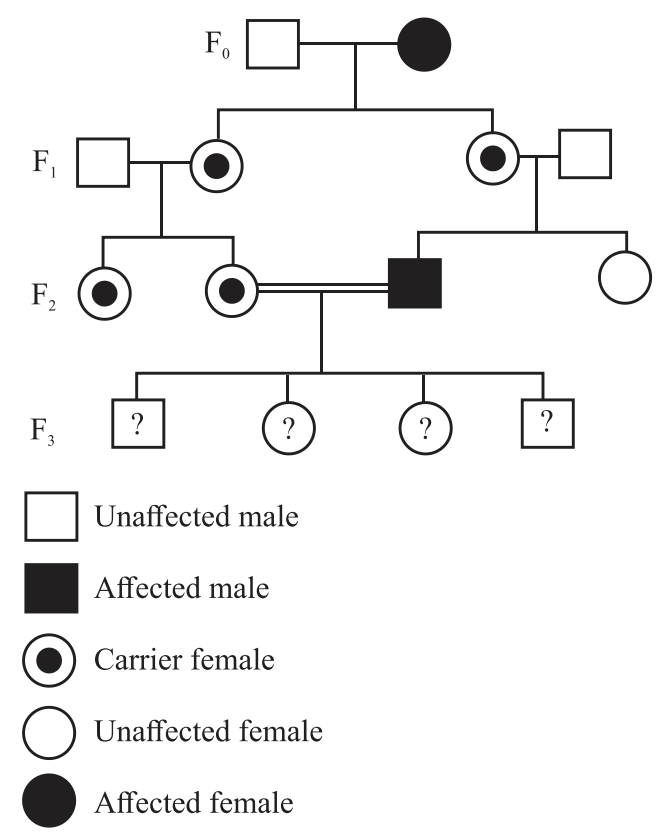
Probability of a carrier female child ($X^C X$) from a carrier mother ($X^C X$) and normal father ($XY$) is 1/4.
The pedigree shows X-linked recessive inheritance. In $F_2$, the mother is a carrier female ($X^C X$) and the father is unaffected ($XY$). The offspring genotypes are: $X^C X$ (carrier female, 1/4), $XX$ (normal female, 1/4), $X^C Y$ (affected male, 1/4), $XY$ (normal male, 1/4). The probability of an unaffected child being a carrier is 1/4. -
Which one of the following symbols represents mating between relatives in human pedigree analysis?
Mating between relatives is a consanguineous mating.
Pedigree symbols: affected individuals; mating; mating between relatives (consanguineous mating); parents with male child affected with disease. [add image] -
In the following human pedigree, the filled symbols represent the affected individuals. Identify the type of given pedigree.
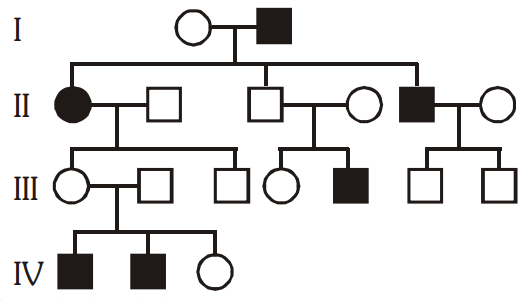
-
Study the pedigree chart of a certain family given below and select the correct conclusion which can be drawn for the character.
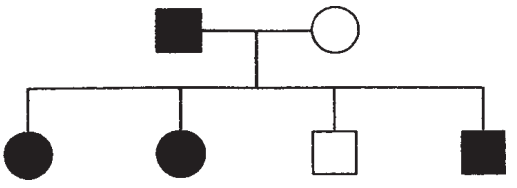 In the chart the father is affected and the mother is unaffected; among the four children, two daughters and one son are affected and one son is unaffected.
Take the trait as recessive: the affected father is homozygous recessive (aa).
Affected children (aa) must receive one recessive allele from each parent, so the unaffected mother must carry the recessive allele: she is heterozygous (Aa).
The cross $aa \times Aa$ gives affected (aa) and unaffected (Aa) children in a 1 : 1 ratio, as seen. So a normal daughter (Aa) was also possible.
The same pattern fits an X-linked recessive trait such as colour-blindness (father $X^cY$, mother $X^CX^c$), so colour-blindness cannot be ruled out; and the father, being affected, cannot be homozygous dominant.
Hence the correct conclusion is that the female parent is heterozygous. -
Which one of the following symbols and its representation, used in human pedigree analysis, is correct?Standard pedigree symbols: a square represents a male and a circle represents a female; an open (unshaded) symbol is an unaffected individual and a filled (shaded) symbol is an affected individual.
A diamond represents an individual whose sex is unspecified, so a filled diamond is not 'male affected'.
An open circle is an unaffected female, not an unaffected male.
An open square is an unaffected male, not an unaffected female.
A single horizontal line joining a square and a circle shows mating; a double line shows mating between relatives (consanguineous mating).
Hence the correct representation is the square and circle joined by a double line = mating between relatives. -
Study the pedigree chart given below:
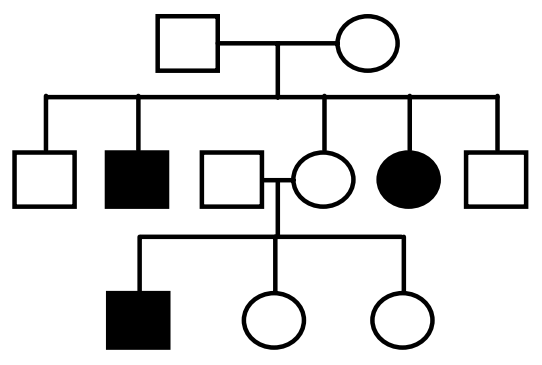
What does it show?In the chart, unaffected parents have affected children; this is possible only if the trait is recessive and both parents are heterozygous carriers.
The affected individuals include a female born to an unaffected father. For an X-linked recessive trait an affected daughter ($X^aX^a$) must have an affected father ($X^aY$), so sex-linked inheritance like haemophilia is ruled out.
The trait is therefore autosomal recessive: carrier parents $Aa \times Aa$ give affected children (aa) of either sex.
Phenylketonuria is an inborn error of metabolism inherited as an autosomal recessive trait (it is not sex-linked).
Hence the chart shows inheritance of a condition like phenylketonuria as an autosomal recessive trait. -
A man and a woman, who do not show any apparent signs of a certain inherited disease, have seven children (2 daughters and 5 sons). Three of the sons suffer from the given disease but none of the daughters are affected. Which of the following modes of inheritance do you suggest for this diseaseThe parents are both unaffected, but some children are affected, so the disease is recessive; a dominant disease would appear in at least one parent.
Only sons are affected and the daughters are normal, which points to a sex-linked (X-linked) recessive trait.
The mother must be a carrier ($X^aX$) and the father normal ($XY$).
Each son receives his only X chromosome from the mother, so half the sons are expected to be affected ($X^aY$); here 3 out of 5 sons are affected.
The daughters receive the father's normal X, so none of them is affected (half of them are carriers).
So the suggested mode of inheritance is sex-linked recessive (like haemophilia).
Test Cross
-
In a plant, black seed color (BB/Bb) is dominant over white seed color (bb). In order to find out the genotype of the black seed plant, with which of the following genotype will you cross it?To find whether a black-seeded plant is BB or Bb, a test cross is performed with the homozygous recessive (bb) plant. If all offspring are black, the plant is BB; if half are black and half white, it is Bb.
-
A test cross is carried out toIn a test cross, an organism showing the dominant phenotype (whose genotype is unknown) is crossed with the homozygous recessive parent.
If the unknown plant is homozygous dominant (TT), then $TT \times tt$ gives all dominant (tall) progeny.
If the unknown plant is heterozygous (Tt), then $Tt \times tt$ gives dominant and recessive progeny in a 1 : 1 ratio.
So the progeny ratio directly reveals the genotype of the dominant plant taken from the $F_2$ generation.
It is not used to check whether two species can interbreed, nor to count the number of alleles of a gene.
Hence a test cross is carried out to determine the genotype of a plant at $F_2$.
Note: the coaching key in the source PDF marks 'predict whether two traits are linked'; the NCERT purpose of a test cross (and the official answer) is determination of the genotype, so that is taken as correct here. -
Test cross in plants or in $Drosophila$ involves crossingIn a test cross, an organism showing the dominant phenotype (whose genotype is to be found, e.g., the $F_1$ hybrid) is crossed with the homozygous recessive parent.
For one gene: $Tt \times tt$ gives tall and dwarf in a 1 : 1 ratio.
For two genes: $TtRr \times ttrr$ (double recessive) gives four phenotypes in a 1 : 1 : 1 : 1 ratio.
The ratio of the progeny reveals the genotype of the hybrid and the types of gametes it forms.
A cross between two $F_1$ hybrids is selfing, which gives the $F_2$ generation, not a test cross.
Hence a test cross involves crossing the $F_1$ hybrid with a double recessive genotype. -
A cross in which an organism showing a dominant phenotype is crossed with the recessive parent in order to know its genotype is calledAn organism with the dominant phenotype may be homozygous dominant or heterozygous.
To find out which, it is crossed with the homozygous recessive parent; this is a test cross.
If all the progeny show the dominant trait the organism is homozygous ($TT \times tt$); if dominant and recessive appear in a 1 : 1 ratio it is heterozygous ($Tt \times tt$).
A back cross is the cross of an $F_1$ individual with either of its parents (dominant or recessive); the test cross is the particular back cross with the recessive parent, done to know the genotype.
Hence the cross is called a test cross. -
The genotype of a plant showing the dominant phenotype can be determined byA plant with the dominant phenotype may be homozygous (TT) or heterozygous (Tt); the two cannot be told apart by appearance.
In a test cross the plant is crossed with the homozygous recessive (tt) parent.
If all the progeny show the dominant character, the plant is homozygous: $TT \times tt \rightarrow$ all Tt.
If the progeny show dominant and recessive characters in a 1 : 1 ratio, the plant is heterozygous: $Tt \times tt \rightarrow$ 1 Tt : 1 tt.
A back cross is a cross of the $F_1$ with either parent; only the cross with the recessive parent (the test cross) reveals the genotype.
Hence the genotype is determined by a test cross. -
A common test to find the genotype of a hybrid is by
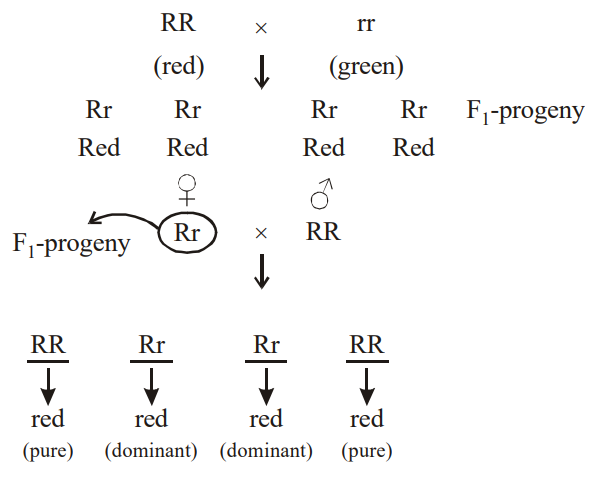
An individual showing the dominant phenotype may be homozygous dominant or heterozygous, and this cannot be told from its appearance.
To find the genotype, the hybrid (F1 progeny) is crossed back with one of its parents. Such a cross is called a back cross.
When the F1 hybrid is crossed with the recessive parent, the cross is called a test cross; here the male parent is taken as the recessive parent.
If the hybrid is heterozygous (Rr), the cross Rr x rr gives dominant and recessive offspring in the ratio 1 : 1.
If the individual tested is homozygous dominant (RR), the cross RR x rr gives all dominant offspring.
So from the ratio of the offspring the genotype of the hybrid is known.
Hence the common test is the crossing of one F1 progeny with the male parent, as given in the answer key. -
Test cross involves -A test cross is used to find out whether an individual showing the dominant phenotype is homozygous or heterozygous.
In a test cross, the organism with the dominant phenotype (such as the F1 hybrid) is crossed with the homozygous recessive parent instead of being self-crossed.
For a dihybrid, the F1 hybrid (for example RrYy) is crossed with the double recessive genotype (rryy).
Since the recessive parent contributes only recessive alleles, the phenotypes of the offspring directly show the kinds of gametes formed by the hybrid.
A monohybrid test cross gives a 1 : 1 ratio and a dihybrid test cross gives a 1 : 1 : 1 : 1 ratio.
A cross between two F1 hybrids is selfing, which gives the F2 generation.
So a test cross involves crossing the F1 hybrid with a double recessive genotype. -
In order to find out the different types of gametes produced by a pea plant having the genotype AaBb, it should be crossed to a plant with the genotype -To find out the types of gametes produced by a plant, it is crossed with a plant that is homozygous recessive for both genes. This is a test cross.
The double recessive plant aabb produces only one kind of gamete, ab, which contributes only recessive alleles.
So the phenotype of each offspring shows directly the type of gamete contributed by the AaBb plant.
AaBb x aabb gives AaBb, Aabb, aaBb and aabb in the ratio 1 : 1 : 1 : 1, showing that AaBb produces four types of gametes (AB, Ab, aB, ab) in equal proportions.
Crossing with AaBb, AABB or aaBB would hide some of the alleles behind dominant ones.
So it should be crossed with aabb.
Incomplete Dominance in Snapdragon
-
A pink flowered Snapdragon plant was crossed with a red flowered Snapdragon plant. What type of phenotype/s is/are expected in the progeny?Flower colour in snapdragon shows incomplete dominance: RR = red, Rr = pink, rr = white. Pink (Rr) × Red (RR) gives RR (red) and Rr (pink) in a 1 : 1 ratio. So both red flowered and pink flowered plants are expected.
Genetics Terminology (Allele, Test Cross, Back Cross, Ploidy)
-
Match List I with List II regarding genetics terminology.
Pick the matching item from Column II for each row.
Column I
- A. Two or more alternative forms of a gene
- B. Cross of F1 progeny with homozygous recessive parent
- C. Cross of F1 progeny with any of the parents
- D. Number of chromosome sets in plant
Column II
- I. Back cross
- II. Ploidy
- III. Allele
- IV. Test cross
Correct answer: A → III, B → IV, C → I, D → II
Two or more alternative forms of a gene – allele Cross of $F_1$ progeny with homozygous recessive parent – test cross Cross of $F_1$ progeny with any of the parents – back cross Number of chromosome sets in a plant – ploidy Correct match: A-III, B-IV, C-I, D-II.
Mendel's Law of Dominance
-
Which one of the following can be explained on the basis of Mendel's Law of Dominance? A. Out of one pair of factors one is dominant and the other is recessive. B. Alleles do not show any expression and both the characters appear as such in F2 generation. C. Factors occur in pair in normal diploid plants. D. The discrete unit controlling a particular character is called factor. E. The expression of only one of the parental characters is found in a monohybrid cross. Choose the correct answer from the options given below:The Law of Dominance explains that characters are controlled by discrete units called factors (D), that factors occur in pairs in normal diploid plants (C), that of a pair of dissimilar factors one is dominant and the other recessive (A), and that only one of the parental characters is expressed in a monohybrid cross (E). Statement B is not explained by the law of dominance. So A, C, D and E only are correct.
-
A gene is said to be dominant if : -A dominant allele expresses its character whether it is present in two copies (homozygous, TT) or in one copy along with a recessive allele (heterozygous, Tt).
For example, tall (T) in pea: both TT and Tt plants are tall.
A recessive allele, in contrast, is expressed only in the homozygous condition (tt).
So a gene is said to be dominant if it is expressed both in the homozygous and the heterozygous condition.
Chromosomal Basis of Genetic Disorders
-
Match List-I with List-II regarding genetic disorders and the chromosome involved.
Pick the matching item from Column II for each row.
Column I
- A. Down's syndrome
- B. $\alpha$-Thalassemia
- C. $\beta$-Thalassemia
- D. Klinefelter's
Column II
- I. 11th chromosome
- II. 'X' chromosome
- III. 21st chromosome
- IV. 16th chromosome
Correct answer: A → III, B → IV, C → I, D → II
Down's syndrome – additional copy of chromosome 21 (trisomy 21) $\alpha$-Thalassemia – controlled by two closely linked genes HBA1 and HBA2 on chromosome 16 $\beta$-Thalassemia – controlled by a single gene HBB on chromosome 11 Klinefelter's syndrome – additional copy of the X chromosome (47, XXY) Correct match: A-III, B-IV, C-I, D-II.
ABO Blood Group Genetics (Multiple Alleles)
-
As per ABO blood grouping system, the blood group of fathers is $B^+$, mother is $A^+$ and child is $O^+$. Their respective genotype can be A. $I^Bi/I^Ai/ii$ B. $I^BI^B/I^AI^A/ii$ C. $I^AI^B/iI^A/I^Bi$ D. $I^Ai/I^Bi/I^Ai$ E. $iI^B/iI^A/I^AI^B$ Choose the most appropriate answer from the options given below:For an $O^+$ child (genotype ii), each parent must carry the recessive allele i. Father with blood group $B^+$ must be $I^Bi$, and mother with blood group $A^+$ must be $I^Ai$; child is ii. So only combination A ($I^Bi / I^Ai / ii$) is possible.
Inheritance of One Gene – Pleiotropy
-
The phenomenon of pleiotropism refers to
A pleiotropic gene shows multiple phenotypic expression.
Generally effect of a gene can be seen on a single phenotype of a trait. However, there are instances where a single gene can exhibit multiple phenotype expression. Such a gene is called a pleiotropic gene.
Linkage and Recombination – Genetic Mapping
-
Frequency of recombination between gene pairs on same chromosome as a measure of the distance between genes to map their position on chromosome, was used for the first time by
Alfred Sturtevant used recombination frequency to map genes.
Alfred Sturtevant used the frequency of recombination between gene pairs on the same chromosome as a measure of the distance between genes and 'mapped' their position on the chromosome.
Chromosomal Disorders – Klinefelter's Syndrome
-
Which of the following statements are correct about Klinefelter's Syndrome? A. This disorder was first described by Langdon Down (1866). B. Such an individual has overall masculine development. However, the feminine development is also expressed. C. The affected individual is short stature. D. Physical, psychomotor and mental development is retarded. E. Such individuals are sterile. Choose the correct answer from the options given below:
Klinefelter's individuals (47, XXY) are masculine with some feminine development and are sterile.
Klinefelter's Syndrome is a genetic disorder that is caused due to the presence of an additional copy of X chromosome resulting into a karyotype of $47, XXY$. Such an individual has overall masculine development, however, the feminine development (development of breast, i.e., gynaecomastia) is also expressed. Such individuals are sterile. Down syndrome was first described by Langdon Down (1866). In this disorder the affected individual is physically, psychomotorly and mentally retarded. -
What is the genetic disorder in which an individual has an overall masculine development, gynaecomastia, and is sterile?
Chromosomal Disorders – Down's Syndrome
-
Broad palm with single palm crease is visible in a person suffering from
Down's syndrome shows a broad palm with a characteristic palm crease.
Down's Syndrome: The cause of this genetic disorder is the presence of an additional copy of the chromosome number 21 (trisomy of 21). This disorder was first described by Langdon Down (1866). The affected individual is short statured with small round head, furrowed tongue and partially open mouth. Palm is broad with characteristic palm crease. Physical, psychomotor and mental development is retarded. -
If a female individual is with small round head, furrowed tongue, partially open mouth and broad palm with characteristic palm crease. Also the physical, psychomotor and mental development is retarded. The karyotype analysis of such an individual will showThese are features of Down's syndrome, caused by the presence of an additional copy of chromosome 21 (trisomy 21, 2n + 1). This aneuploidy results from non-disjunction during gamete formation.
-
Down's syndrome is caused by an extra copy of chromosome number 21. What percentage of offspring produced by an affected mother and a normal father would be affected by this disorder :-An affected mother has three copies of chromosome 21 (trisomy 21).
During meiosis, the three chromosomes 21 are distributed so that half of her eggs receive two copies of chromosome 21 and half receive one copy.
The normal father gives one chromosome 21 in every sperm.
Egg with two copies + sperm with one = trisomy 21 (Down's syndrome); egg with one copy + sperm with one = normal.
So about 50% of the offspring would be affected.
Mendel's Laws of Inheritance
-
Given below are two statements: Statement I: Mendel studied seven pairs of contrasting traits in pea plants and proposed the Laws of Inheritance Statement II: Seven characters examined by Mendel in his experiment on pea plants were seed shape and colour, flower colour, pod shape and colour, flower position and stem height In the light of the above statements, choose the correct answer from the options given below.
-
The production for gametes by the parents, formation of zygotes, the F1 and F2 plants, can be understood from a diagram called:
Sex Determination
-
XO type of sex determination can be found in:
-
Select the incorrect statement.
-
Match the items of Column I with Column II. Select the correct option.
Pick the matching item from Column II for each row.
Column I
- A. XX-XO method of sex determination
- B. XX-XY method of sex determination
- C. Karyotype-45
- D. ZW-ZZ method of sex determination
Column II
- I. Turner's syndrome
- II. Female heterogametic
- III. Grasshopper
- IV. Female homogametic
Correct answer: A → III, B → IV, C → I, D → II
-
Which one of the following conditions correctly describes the manner of determining the sex in the given example?Grasshopper has XO type sex determination: females have a pair of X chromosomes (XX) and males have only one X chromosome (XO), so XO determines the male sex. This is correct.
In $Drosophila$, XX individuals are females and XY individuals are males.
In birds the females are heterogametic (ZW) and the males are homogametic (ZZ), so ZZ determines the male sex.
In humans sex is determined by the XX–XY mechanism; XO (Turner's syndrome) is an abnormal condition (a sterile female with rudimentary ovaries) and is not the manner in which female sex is normally determined.
Hence the correct description is that the XO type determines male sex in grasshopper. -
In Drosophila the XXY condition leads to femaleness whereas in human beings the same condition leads to Klinefelter's syndrome in male. It proves :In Drosophila, sex is decided by the ratio of X chromosomes to sets of autosomes (genic balance). XXY with two sets of autosomes has X/A = 1, so it is female; the Y chromosome does not decide sex.
In humans, XXY individuals are male (Klinefelter's syndrome), because the Y chromosome carries the SRY gene that determines maleness, regardless of the number of X chromosomes.
So this proves that in human beings the Y chromosome is active in sex determination.
Mendelian Disorders
-
Which of the following occurs due to the presence of autosome linked dominant trait?
-
Given below are two statements: Statement I: Sickle cell anaemia and Haemophilia are autosomal dominant traits. Statement II: Sickle cell anaemia and Haemophilia are disorders of the blood. In the light of the above statements, choose the correct answer from the options given below:Sickle cell anaemia is an autosomal recessive trait whereas haemophilia is an X-linked recessive trait, so Statement I is incorrect. Both diseases are disorders of the blood, so Statement II is correct.
-
Select the correct match.Phenylketonuria – autosomal recessive disorder Sickle cell anaemia – autosomal recessive trait, due to mutation in the gene on chromosome 11 Thalassemia – autosomal recessive disorder Haemophilia – X-linked recessive disorder So the correct match is sickle cell anaemia – autosomal recessive trait, chromosome 11.
-
If both parents are carriers for thalassemia, which is an autosomal recessive disorder, what are the chances of pregnancy resulting in an affected child?Aa × Aa gives 1 AA : 2 Aa : 1 aa, so the chance of an affected (aa) child is 25%.
-
The incorrect statement with regard to Haemophilia is:Haemophilia is a sex-linked recessive disease in which a single protein of the clotting cascade is affected. It is not a dominant disease.
-
Sickle cell anemia isSickle-cell anaemia is caused by a point mutation: a single base substitution at the sixth codon of the β-globin gene, from GAG to GUG. So it is caused by a change in a single base pair of DNA.
As a result glutamic acid (Glu) is replaced by valine (Val) at the sixth position of the β-globin chain; the given statement has this the wrong way round.
It is an autosome-linked recessive trait; only homozygous individuals ($Hb^SHb^S$) show the disease.
The mutant haemoglobin polymerises under low oxygen tension and changes the RBC from a biconcave disc to an elongated sickle shape; human RBCs have no nucleus.
Hence the correct statement is that it is caused by a change in a single base pair of DNA.
Linkage and Recombination
-
Mendel's law of Independent assortment does not hold good for the genes that are located closely on the same chromosome.Reason: Closely located genes assort independently.
-
In a test cross involving $F_1$ dihybrid flies, more parental-type offspring were produced than the recombinant type offspring. This indicates
Excess parental types indicate linkage.
In a test cross, when parental types exceed recombinant types, it is because the two genes are linked and located on the same chromosome. -
Which of the following statements is not true of two genes that show 50% recombination frequency?A 50% recombination frequency means the genes assort independently: they are on different chromosomes or very far apart on the same one.
Tightly linked genes show very low recombination, so that statement is not true. -
Select the correct statement from the ones given below with respect to dihybrid cross.Morgan's dihybrid crosses in $Drosophila$ showed that genes on the same chromosome tend to be inherited together (linkage).
The closer two genes lie on a chromosome, the less likely a cross-over is to occur between them, so tightly linked genes show very few recombinants.
Example: the genes for white eye and yellow body were very tightly linked and showed only 1.3% recombination, whereas white eye and miniature wing, which are farther apart, showed 37.2% recombination.
Thus genes far apart (loosely linked) show higher recombination, not lower or the same.
Hence the correct statement is that tightly linked genes on the same chromosome show very few recombinations. -
Two genes R and Y are located very close on the chromosomal linkage map of maize plant. When RRYY and rryy genotypes are hybridized, the F2 segregation will showGenes located on the same chromosome are linked and tend to be inherited together.
The strength of linkage depends on the distance between the genes: the closer the two genes are, the smaller the chance of crossing over between them.
R and Y are located very close together, so they are tightly linked and the chances of crossing over are highly reduced.
The F1 hybrid (RrYy) therefore forms a large number of parental gametes (RY and ry) and only a few recombinant gametes (Ry and rY).
This results in a higher number of parental types in the F2 generation as compared with the recombinant types.
The 9 : 3 : 3 : 1 ratio would be obtained only if the two genes assorted independently, which they do not.
So the F2 segregation will show a higher number of the parental types. -
Lack of independent assortment of two genes A and B in fruit fly Drosophila is due to :-Mendel's law of independent assortment holds only for genes that lie on different chromosomes (or very far apart on the same chromosome).
When two genes lie close together on the same chromosome, they tend to be inherited together. This is called linkage, studied by T. H. Morgan in Drosophila.
Linked genes do not assort independently; the parental combinations appear far more often than the recombinant ones.
Recombination and crossing over actually separate linked genes, and so work against linkage; repulsion is just one arrangement of linked alleles.
So the lack of independent assortment of genes A and B is due to linkage.
Sex-linked Inheritance – Colour Blindness
-
If a colour blind female marries a man whose mother was also colour blind, what are the chances of her progeny having colour blindness?
-
If a colour-blind man marries a woman who is homozygous for normal colour vision, the probability of their son being colour-blind is:
-
A normal woman, whose father was colour-blind is married to a normal man. The sons would be :-Colour blindness is an X-linked recessive trait. Let $X^c$ carry the colour-blind allele.
The woman is normal but her father was colour-blind. She received her father's $X^c$, so she is a carrier: $X^CX^c$.
The normal man is $X^CY$.
Cross: $X^CX^c \times X^CY$
Sons receive the Y from the father and one X from the mother: $X^CY$ (normal) or $X^cY$ (colour-blind) in a 1 : 1 ratio.
Daughters: $X^CX^C$ (normal) and $X^CX^c$ (carrier); none are colour-blind.
So 50% of the sons would be colour-blind.
Linkage and Recombination – Gene Mapping
-
The recombination frequency between the genes a & c is 5%, b & c is 15%, b & d is 9%, a & b is 20%, c & d is 24% and a & d is 29%. What will be the sequence of these genes on a linear chromosome?
-
The frequency of recombination between gene pairs on the same chromosome as a measure of the distance between genes was explained by:
Mendelian Disorders – Sickle-cell Anaemia
-
In a cross between a male and female, both heterozygous for sickle cell anaemia gene, what percentage of the progeny will be diseased?
-
Which one of the following conditions though harmful in itself, is also a potential saviour from a mosquito borne infectious disease :Sickle cell anaemia is an autosomal recessive disorder caused by a point mutation (GAG to GUG) that replaces glutamic acid with valine at the sixth position of the $\beta$-globin chain.
Homozygotes ($Hb^SHb^S$) suffer from severe anaemia. Heterozygotes ($Hb^AHb^S$, sickle cell trait) are mostly healthy.
The malarial parasite Plasmodium falciparum, spread by the Anopheles mosquito, cannot multiply well in red cells containing HbS, which sickle and are removed when infected. So heterozygotes are resistant to malaria.
This is why the sickle cell allele is common in malaria-prone regions such as tropical Africa (balanced polymorphism).
So sickle cell anaemia, though harmful, is a potential saviour from malaria. -
Sickle cell anaemia is due to : -Haemoglobin has two $\alpha$ and two $\beta$ polypeptide chains.
In sickle cell anaemia, a point mutation in the $\beta$-globin gene (GAG $\rightarrow$ GUG in the codon) replaces glutamic acid by valine at the sixth position of the $\beta$ chain.
The resulting HbS polymerises at low oxygen, making the RBCs sickle shaped.
So sickle cell anaemia is due to change of an amino acid in the $\beta$-chain of haemoglobin.
Inheritance of One Gene – Multiple Alleles and Codominance
-
Identify the wrong statement with reference to the gene $I$ that controls ABO blood groups.The ABO blood group gene I has three alleles: $I^A$, $I^B$ and i. $I^A$ and $I^B$ produce slightly different forms of the sugar (they are codominant), while allele i does not produce any sugar. Since humans are diploid, each person has at most two of the three alleles. So 'when $I^A$ and $I^B$ are present together, they express same type of sugar' is wrong.
Chromosomal Theory of Inheritance
-
The chromosomal theory of inheritance was proposed byThe chromosomal theory of inheritance was proposed by Sutton and Boveri (1902-1903).
-
Experimental verification of the chromosomal theory of inheritance was done by:Sutton and Boveri proposed the chromosomal theory of inheritance. It was experimentally verified by Thomas Hunt Morgan (using $Drosophila$).
-
Chromosomal theory of inheritance was proposed byThe chromosomal theory of inheritance, proposing that chromosomes are the carriers of genetic material and behave in a manner parallel to Mendelian factors, was proposed by Sutton and Boveri.
-
The fruit fly $Drosophila\ melanogaster$ was found to be very suitable for experimental verification of chromosomal theory of inheritance by Morgan and his colleagues becauseMorgan chose the fruit fly because: it can be grown on a simple synthetic medium in the laboratory; it completes its life cycle in about two weeks; a single mating produces a large number of progeny flies; the sexes are clearly differentiated; and it has many types of hereditary variations visible under a low-power microscope.
So 'it completes its life cycle in about two weeks' is a correct reason.
It reproduces sexually, not parthenogenetically.
A single mating produces a large number of flies, not two.
The male is smaller than the female, not the other way round.
Hence the correct reason is that it completes its life cycle in about two weeks.
Mendel's Experiments
-
How many true breeding pea plant varieties did Mendel select as pairs, which were similar except in one character with contrasting traits?Mendel selected 14 true-breeding pea plant varieties, as pairs which were similar except for one character with contrasting traits (7 pairs of characters).
-
How many pairs of contrasting characters in pea plants were studied by Mendel in his experiments?Mendel studied seven pairs of contrasting characters: plant height, seed shape, seed colour, pod colour, pod shape, flower position and flower colour.
-
In his classic experiments on pea plants, Mendel did not use:
Linkage and Recombination – Genetic Maps
-
What map unit (Centimorgan) is adopted in the construction of genetic maps?
-
The linkage map of X-chromosome of fruitfly has 66 units, with yellow body gene (y) at one end and bobbed hair (b) gene at the other end. The recombination frequency between these two genes (y and b) should be : -Map distances are obtained by adding the recombination frequencies between closely placed genes. So the total length of a map (here 66 units) can be more than 50.
However, the recombination frequency actually observed between two genes can never exceed 50 percent. This is because multiple crossovers between distant genes cancel each other's effect (a double crossover restores the parental combination), and crossing over involves only two of the four chromatids.
A recombination frequency of 50 percent means the genes behave as if they assort independently.
So between y and b, at opposite ends of the chromosome, the recombination frequency should be $\leq$ 50%.
Inheritance of One Gene – Incomplete Dominance
-
In $Antirrhinum$ (Snapdragon), a red flower was crossed with a white flower and in $F_1$ generation, pink flowers were obtained. When pink flowers were selfed, the $F_2$ generation showed white, red and pink flowers. Choose the incorrect statement from the following:
Sickle-cell anaemia - point mutation
-
Which one of the following disorders is caused by the substitution of Glutamic acid (Glu) by Valine (Val) at the sixth position of the beta globin chain of the haemoglobin molecule?
Types of gene interaction/inheritance patterns
-
Match List I with List II:
Pick the matching item from Column II for each row.
Column I
- i. Incomplete dominance
- ii. Co-dominance
- iii. Pleiotropy
- iv. Polygenic inheritance
Column II
- a. Human skin colour
- b. Inheritance of flower colour in $Antirrhinum$ sp.
- c. Phenylketonuria disease in humans
- d. ABO blood groups
Correct answer: i → b, ii → d, iii → c, iv → a
Haplodiploidy - sex determination in honeybees
-
Which of the following statements are true with reference to the sex-determination in honeybees? I. An offspring formed from the union of a sperm and an egg, develops as a female (queen or worker). II. An unfertilized egg develops as a male by parthenogenesis. III. A male has half the number of chromosomes than that of a female. IV. Males produce sperms by meiosis. V. Honeybees have a haplodiploid sex-determination system. Choose the CORRECT answer from the options given below:
Sickle-cell anaemia - molecular basis (point mutation)
-
The sixth mutant codon of beta globin gene causing polymerization of Haemoglobin and change in RBC shape is _______.
ABO blood group inheritance
-
What is the probability of having children with 'O' blood group, where both mother and father are heterozygous for 'A' and 'B' blood group, respectively?
-
The mother has $A^+$ blood group the father has $B^+$ and the child is $A^+$. What can be the possibility of genotypes of all three, respectively?Since the child is $A^+$ and the father is $B^+$, the child must have received the $I^Bi$ allele combination from the father contributing $i$, meaning the father's genotype must include $i$ (i.e. $I^Bi$). The mother, being $A^+$, can be $I^AI^A$ or $I^Ai$. Consistent possibilities for (mother, father, child) genotypes are: $I^AI^A\,|\,I^Bi\,|\,I^Ai$ (option B) and $I^Ai\,|\,I^Bi\,|\,I^Ai$ (option E) — so the answer is B and E.
Chromosomal sex determination (XO type)
-
In a population of a grasshopper species, the chromosome number of some members is 23 and some other members possess 24 chromosomes. The 23 and 24 chromosome-bearing members in this species are _______.
Haplodiploidy - gamete formation in male honeybees
-
In which animal do haploid cells divide mitotically to produce gametes?
Patterns of inheritance and their examples
-
Match List-I (Type of Inheritance) with List-II (Example) and choose the correct answer from the options given below:
Pick the matching item from Column II for each row.
Column I
- A. Incomplete dominance
- B. Co-dominance
- C. Pleiotropy
- D. Polygenic inheritance
Column II
- I. Blood groups in human
- II. Flower colour in Antirrhinum
- III. Skin colour in human
- IV. Phenylketonuria
Correct answer: A → II, B → I, C → IV, D → III
Incomplete dominance is exemplified by flower colour in Antirrhinum (A-II); Co-dominance is exemplified by blood groups in humans (B-I); Pleiotropy is exemplified by phenylketonuria (C-IV); Polygenic inheritance is exemplified by skin colour in humans (D-III).
Aneuploidy and polyploidy
-
Given below are two statements: Statement I: Failure of segregation of chromatids during cell cycle resulting in the gain or loss of whole set of chromosome in an organism is known as aneuploidy. Statement II: Failure of cytokinesis after anaphase stage of cell division results in the gain or loss of a chromosome is called polyploidy. In the light of the above statements, choose the correct answer from the options given below:Statement I is incorrect: failure of segregation of chromatids resulting in the gain or loss of a whole set of chromosomes describes polyploidy, not aneuploidy (aneuploidy involves the gain or loss of one or a few chromosomes, not the whole set). Statement II is also incorrect: failure of cytokinesis after the anaphase stage causes doubling of the whole chromosome set (polyploidy), not simply the gain or loss of a single chromosome.
Monohybrid/dihybrid cross - genotype determination
-
When a tall pea plant with round seeds was selfed, it produced the progeny of: (a) Tall plants with round seeds and (b) Tall plants with wrinkled seeds. Identify the genotype of the parent plant.Since all progeny are tall (no short plants appear), the parent must be homozygous tall, TT. Since the progeny show both round and wrinkled seed phenotypes (segregation), the parent must be heterozygous for seed shape, Rr. Hence the parent genotype is TTRr.
Chromosomal aberrations - aneuploidy
-
Aneuploidy is a chromosomal disorder where chromosome number is not the exact copy of its haploid set of chromosomes, due to: A. Substitution B. Addition C. Deletion D. Translocation E. Inversion. Choose the most appropriate answer from the options given below:Aneuploidy (gain or loss of one or more individual chromosomes from the normal set) arises due to failure of segregation of chromatids, resulting in addition or deletion of one or more chromosomes.
Mendel's experiments on garden pea
-
The number of contrasting characters studied by Mendel for his experiments wasMendel studied seven pairs of contrasting characters (traits) in the garden pea (Pisum sativum) for his hybridization experiments.
Pleiotropy
-
The best example for pleiotropy is:Phenylketonuria (PKU) is a classic example of pleiotropy, where a single mutant gene affects multiple phenotypic traits (affecting mental development, pigmentation, etc.), all traced back to a single gene defect.
-
A pleiotropic gene:
-
Which of the following is the example of pleiotropic gene ; -A pleiotropic gene is a single gene that affects several different characters (phenotypic traits).
In sickle cell anaemia, a single mutant gene ($Hb^S$) changes the $\beta$-globin chain of haemoglobin. This one change causes many effects: sickle shaped RBCs, anaemia, blockage of blood vessels, pain, damage to organs such as the spleen, kidneys and brain, and resistance to malaria.
(Phenylketonuria is another classic example.)
So sickle cell anaemia is an example of a pleiotropic gene.
Phenotypic ratios for different cross types
-
Match List-I with List-II.
Pick the matching item from Column II for each row.
Column I
- A. Monohybrid Cross
- B. Dihybrid Cross
- C. Incomplete dominance
- D. Test Cross
Column II
- I. 1:1
- II. 1:2:1
- III. 3:1
- IV. 9:3:3:1
Correct answer: A → III, B → IV, C → II, D → I
Monohybrid Cross gives a phenotypic ratio of 3:1 (A-III); Dihybrid Cross gives 9:3:3:1 (B-IV); Incomplete dominance gives 1:2:1 (C-II); Test Cross gives 1:1 (D-I).
Induction of polyploidy
-
Doubling of the number of chromosomes can be achieved by disrupting mitotic cell division soon after:Disrupting mitotic cell division soon after metaphase (e.g. by preventing spindle formation with colchicine) prevents chromosome separation and cytokinesis, resulting in a cell with a doubled number of chromosomes (polyploidy).
Test cross - expected phenotypic ratio
-
A heterozygous pea plant with violet flowers was crossed with homozygous pea plant with white flower. Violet is dominant over white. Which one of the following represents the expected combinations among 40 progenies formed?Crossing a heterozygous plant (Vv) with a homozygous recessive plant (vv) is a test cross, which is expected to give a 1:1 ratio of the two phenotypes. Among 40 progeny, this is expected to yield 20 violet and 20 white flowered plants.
Sickle cell anemia - point mutation
-
In which disorder change of single base pair in the gene for beta globin chain results in change of glutamic acid to valine?Sickle cell anemia results from a point mutation (single base pair substitution) in the gene for the beta chain of haemoglobin, causing glutamic acid to be replaced by valine at the sixth position.
Dihybrid cross with one gene showing incomplete dominance
-
A certain plant homozygous for yellow seeds and red flowers was crossed with a plant homozygous for green seeds and white flowers. The $F_1$ plants had yellow seeds and pink flowers. The $F_1$ plants were selfed to get $F_2$ progeny. Assuming independent assortment of the two characters, how many phenotypic categories are expected for these characters in the $F_2$ generation?Seed colour (yellow dominant over green) follows simple dominance, giving 2 phenotypic categories in $F_2$ (3:1 ratio). Flower colour shows incomplete dominance ($F_1$ pink, an intermediate between red and white), giving 3 phenotypic categories in $F_2$ (1:2:1 ratio: red, pink, white). With independent assortment, total phenotypic categories $=2\times3=6$.
Molecular basis of sickle cell anaemia
-
Select the correct statements about sickle cell anaemia. (A) There is a change in gene for beta globin. (B) In the beta globin, there is valine in the place of Lysine. (C) It is an example of point mutation. (D) In the normal gene U is replaced by A. Choose the correct answer from the options given below:Sickle cell anaemia results from a mutation in the gene for the beta chain of haemoglobin (A is correct), and this substitution is a classic example of a point mutation (C is correct). However, the actual substitution is valine replacing glutamic acid (not lysine, so B is incorrect), and it is the DNA base (not simply 'A' replacing 'U', which is an RNA-level statement rather than the correct DNA-level base change) — so D as stated does not correctly represent the mutation. Correct: A and C only.
XO type of sex determination in grasshopper
-
Select the correct statement/s with respect to mechanism of sex determination in Grasshopper. (A) It is an example of female heterogamety. (B) Male produces two different types of gametes either with or without X chromosome. (C) Total number of chromosomes (autosomes and sex chromosomes) is same in both males and females. (D) All eggs bear an additional X chromosome besides the autosomes. Choose the correct answer from the options given below:In grasshoppers, sex is determined by the XO mechanism: males produce two types of sperm, either bearing an X chromosome or lacking a sex chromosome altogether (B is correct); this is an example of male heterogamety (not female heterogamety; A is incorrect). Since males have one fewer chromosome (XO) than females (XX), the total chromosome number differs between males and females (C is incorrect). All eggs (from XX females) do bear an X chromosome (D is correct, though it's the females producing uniform X-bearing eggs, not stated to be 'additional' beyond the normal complement — matching the source key's selection). So B and D only.
Dihybrid cross
-
What is the expected percentage of F2 progeny with yellow and inflated pod in dihybrid cross experiment involving pea plants with green coloured, inflated pod and yellow coloured constricted pod?Green inflated $\times$ yellow constricted gives F1 all green inflated. F2 shows 9 : 3 : 3 : 1 - 9 green inflated, 3 green constricted, 3 yellow inflated, 1 yellow constricted. Yellow inflated $=\frac{3}{16}=18.75\%$.
-
In Mendel's experiments with garden pea, round seed shape (RR) was dominant over wrinkled seeds (rr), yellow cotyledon (YY) was dominant over green cotyledon (yy). What are the expected phenotypes in the $F_2$ generation of the cross RRYY $\times$ rryy ?Parents: RRYY (round, yellow) $\times$ rryy (wrinkled, green). Gametes: RY and ry.
$F_1$: all RrYy, i.e. all round seeds with yellow cotyledons.
The $F_1$ plants form four kinds of gametes (RY, Ry, rY and ry) by independent assortment, and selfing gives the $F_2$.
$F_2$ phenotypes: round yellow, round green, wrinkled yellow and wrinkled green in the ratio 9 : 3 : 3 : 1.
So the $F_2$ never consists of only one phenotype; the three options beginning with 'Only' are wrong.
The remaining option names round seeds with yellow cotyledons and wrinkled seeds with yellow cotyledons, both of which do appear in the F2 (together with round green and wrinkled green).
So that is the answer intended by the paper, although the complete answer is all four phenotypes in the ratio 9 : 3 : 3 : 1.
Pedigree analysis symbols
-
Select the incorrect match regarding the symbols used in Pedigree analysisConsanguineous mating (mating between relatives) is shown by a double line between the male and female symbols. The symbol in option (4) uses a single line, which represents ordinary mating, so it is the incorrect match.
Sex-linked inheritance - haemophilia
-
A normal girl, whose mother is haemophilic marries a male with no ancestral history of haemophilia. What will be the possible phenotypes of the offsprings? (a) Haemophilic son and haemophilic daughter. (b) Haemophilic son and carrier daughter. (c) Normal daughter and normal son. (d) Normal son and haemophilic daughter. Choose the most appropriate answer from the options given below:Haemophilia is X-linked recessive. The girl receives $X^h$ from her mother, so she is a carrier ($X^hX$). Crossing $X^hX \times XY$ gives carrier daughter ($X^hX$), haemophilic son ($X^hY$), normal daughter ($XX$) and normal son ($XY$). So (b) and (c) are possible.
Multiple alleles - ABO blood groups
-
For a person with blood group 'O', which of the following is not a possible combination of parents' blood group genotypes?Reference: NCERT Class XII, page 61.
-
In a marriage between male with blood group A and female with blood group B, the progeny had either blood group AB or B. What could be the possible genotype of parents?
-
The genotypes of a Husband and Wife are $I^AI^B$ and $I^Ai$. Among the blood types of their children, how many different genotypes and phenotypes are possible?
Four genotypes collapse into three phenotypes (A, AB, B).
Husband $I^AI^B$ × Wife $I^Ai$ Offspring: $I^AI^A$, $I^AI^B$, $I^Ai$, $I^Bi$ Number of genotypes = 4 $I^AI^A$ and $I^Ai$ = A; $I^AI^B$ = AB; $I^Bi$ = B Number of phenotypes = 3 -
In the ABO system of blood groups if both antigens are present but no antibody, the blood group of the individual would be :-Blood group A has antigen A on the RBCs and anti-B antibodies in the plasma.
Blood group B has antigen B and anti-A antibodies.
Blood group AB has both antigens A and B, and no antibodies (so it is the universal recipient).
Blood group O has no antigens and both anti-A and anti-B antibodies (universal donor).
So an individual with both antigens and no antibody has blood group AB (genotype $I^AI^B$, an example of codominance).
Chromosomal disorders
-
Given below are two statements: Statement I: Down's syndrome is caused by the absence of one of the X-chromosomes. Statement II: Turner's syndrome is caused by the presence of an additional copy of the chromosomes. In the light of the above statements, choose the correct answer from the options given below:Reference: NCERT Class XII, page 76.
-
In which genetic condition, each cell in the affected person, has three sex chromosomes XXY?
-
A disease caused by an autosomal primary non-disjunction is
Trisomy 21 is autosomal; Klinefelter and Turner involve sex chromosomes.
Down's syndrome is caused by non-disjunction of the $21^{st}$ chromosome (an autosome). -
An abnormal human baby with 'XXX' sex chromosomes was born due toAn abnormal ovum carrying an extra X chromosome (22 + XX), fertilised by a normal X-bearing sperm, gives a 44 + XXX baby.
So the cause is formation of abnormal ova in the mother. -
A human female with Turner's syndrome:Turner's syndrome is caused by the absence of one X chromosome: 45 chromosomes with XO. Such females are sterile, with rudimentary ovaries.
-
Which one of the following conditions in humans is correctly matched with its chromosomal abnormality/linkage?Klinefelter's syndrome is caused by the presence of an additional X chromosome in a male, giving the karyotype 47, XXY, i.e. 44 autosomes + XXY.
Such a person has overall masculine development, but feminine features such as gynaecomastia (development of breasts) are also expressed, and the individual is sterile.
So Klinefelter's syndrome - 44 autosomes + XXY is the correct match.
Erythroblastosis foetalis is due to Rh incompatibility between an Rh negative mother and an Rh positive foetus; the Rh gene is autosomal, not X-linked.
Down syndrome is trisomy of chromosome 21 (45 autosomes + XX or XY). The condition 44 autosomes + XO is Turner's syndrome.
Colour-blindness is a recessive X-linked trait, not Y-linked. -
Cri-du-chat syndrome in humans is caused by the -Cri-du-chat (cat-cry) syndrome is a chromosomal disorder caused by a structural change, a deletion, and not by a change in chromosome number.
It is caused by the loss (deletion) of a part of the short arm (p arm) of chromosome 5; it is written as 5p-.
The affected baby has a characteristic high-pitched cry like the mewing of a cat, a small head (microcephaly), widely spaced eyes and severe mental retardation.
Fertilisation of an XX egg by a Y-bearing sperm gives XXY, which is Klinefelter's syndrome.
Trisomy of the 21st chromosome is Down's syndrome.
The deletion is in the short arm, not the long arm, of chromosome 5.
So cri-du-chat syndrome is caused by the loss of half of the short arm of chromosome 5. -
A woman with 47 chromosomes due to three copies of chromosome 21 is characterized by -Down's syndrome is caused by the presence of an additional copy of chromosome 21 (trisomy 21), so the total number of chromosomes becomes 47.
It results from non-disjunction of chromosome 21 during gamete formation, and its frequency increases with the age of the mother.
The affected individual is short with a small round head, a furrowed tongue and a partially open mouth, a characteristic palm crease, and retarded physical, psychomotor and mental development.
Turner's syndrome is 45, XO; superfemaleness is XXX (an extra X chromosome, not chromosome 21); triploidy is the presence of three complete sets of chromosomes (69).
So the woman is characterised by Down syndrome. -
Mongolian idiots are due to trisomy of 21st chromosome; it is called :Trisomy of chromosome 21 (47 chromosomes) causes Down's syndrome, earlier called mongolism.
Features include short stature, a small round head, a furrowed tongue, a partially open mouth, a broad palm with a single crease, and mental retardation.
Turner's syndrome is 45, XO and Klinefelter's syndrome is 47, XXY.
So it is called Down's syndrome.
Punnett square
-
The production of gametes by the parents, the formation of zygotes, the $F_1$ and $F_2$ plants, can be understood using
Law of dominance
-
In an experiment, Mendel observed that the F1 progeny plants are all tall and none are dwarf.Reason: Stem height is a contrasting trait, with tall being dominant and dwarf being recessive.Reference: NCERT Class XII, page 54.
Pleiotropy, co-dominance and sex determination
-
Which of the following pairs is wrongly matched?
Starch synthesis in pea is an example of pleiotropy.
Starch synthesis in pea is controlled by a pleiotropic gene, not by multiple alleles. The other three pairs are correctly matched.
History of genetics – scientists and contributions
-
Select the correct statement
R.C. Punnett, a British geneticist, devised the Punnett square.
Punnett square was developed by a British geneticist, Reginald C. Punnett. Franklin Stahl proved the semi-conservative mode of replication. Transduction was discovered by Zinder and Lederberg. Spliceosome formation is part of post-transcriptional change in eukaryotes.
Sex-linked inheritance
-
A woman has an X-linked condition on one of her X chromosomes. This chromosome can be inherited by
Each child receives one of the mother's X chromosomes.
The woman is a carrier. Both sons and daughters inherit an X chromosome from the mother. However, only sons would be diseased. -
A colour blind man marries a woman with normal sight who has no history of colour blindness in her family. What is the probability of their grandson being colour blind?
-
A man whose father was colour blind marries a woman who had a colour blind mother and normal father. What percentage of male children of this couple will be colour blind?The man gets his Y chromosome from his father, so his X is normal: $XY$.
The woman's mother was colour blind ($X^cX^c$) and her father normal, so she is a carrier: $XX^c$.
Sons get their X from the mother: half receive $X$ and half receive $X^c$, so 50% of the male children will be colour blind. -
A normal-visioned man whose father was colour-blind, marries a woman whose father was also colour-blind. They have their first child as a daughter. What are the chances that this child would be colour-blind?Colour blindness is X-linked recessive. The man is normal-visioned, so his genotype is $XY$ (he received Y, not X, from his colour-blind father).
The woman received $X^c$ from her colour-blind father, so she is a carrier: $XX^c$.
A daughter gets the normal X from her father and either $X$ or $X^c$ from her mother: $XX$ (normal) or $XX^c$ (carrier).
No daughter can be colour-blind, so the chance is zero percent. -
Represented below is the inheritance pattern of a certain type of traits in humans. Which one of the following conditions could be an example of this pattern?
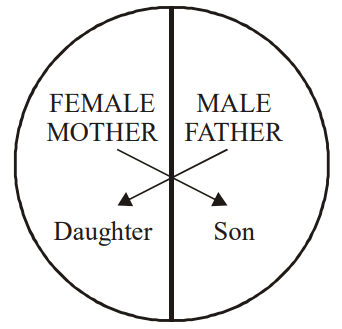 The diagram shows the trait passing from the mother to the son and from the father to the daughter, i.e., a criss-cross pattern of inheritance.
Such a pattern is characteristic of genes located on the X chromosome: a son receives his only X chromosome from his mother, while a father passes his X chromosome only to his daughters.
Haemophilia is a sex-linked (X-linked) recessive disorder and follows this pattern.
Thalassemia, phenylketonuria and sickle cell anaemia are autosomal recessive disorders; they are inherited equally by sons and daughters from both parents and do not show criss-cross inheritance.
Hence the condition that could be an example of this pattern is haemophilia. -
If a colourblind woman marries a normal visioned man, their sons will be -Colour blindness is a recessive X-linked character. Let $X^c$ be the X chromosome carrying the gene for colour blindness.
A colourblind woman must be homozygous: $X^cX^c$.
A normal visioned man is $XY$.
The mother produces only $X^c$ eggs; the father produces $X$ sperms and $Y$ sperms.
Sons receive the Y chromosome from the father and their only X chromosome from the mother, so all sons are $X^cY$, i.e. colourblind.
Daughters are $X^cX$: normal visioned but carriers.
This passing of the character from mother to sons is called criss-cross inheritance.
So all their sons will be colourblind. -
A woman with normal vision, but whose father was colour blind, marries a colour blind man. Suppose that the fourth child of this couple was a boy. This boy -Colour blindness is an X-linked recessive trait. Let $X^c$ carry the allele for colour blindness.
The woman has normal vision, but her father was colour blind, so she received $X^c$ from him. She is a carrier: $X^cX$.
The colour blind man is $X^cY$.
A son receives the Y chromosome from his father and one X chromosome from his mother.
The mother gives either $X^c$ or $X$ with equal probability, so each son has a 50 percent chance of being $X^cY$ (colour blind) and a 50 percent chance of being $XY$ (normal).
The birth order of the child has no effect on this probability.
A male has only one X chromosome, so he cannot be heterozygous for this trait.
So the boy may be colour blind or may have normal vision. -
Haemophilia is more commonly seen in human males than in human females because -Haemophilia is a sex-linked recessive disease: the gene is located on the X chromosome.
A male has only one X chromosome (XY), so a single recessive allele ($X^hY$) is enough to make him haemophilic; there is no second allele to mask it.
A female has two X chromosomes and becomes haemophilic only if both carry the recessive allele ($X^hX^h$); with one defective allele she is a normal carrier ($X^hX$).
A haemophilic female needs a haemophilic father and a carrier (or affected) mother, which is very rare.
So the disease is far more common in males because it is due to an X-linked recessive mutation. -
The recessive genes located on X-chromosomes in humans are always-Human males have one X and one Y chromosome (XY). Most genes on the X chromosome have no corresponding allele on the Y chromosome.
So a male has only one copy of each X-linked gene; he is hemizygous. A recessive allele on his X chromosome has no dominant allele to mask it, and it is always expressed.
Females (XX) express an X-linked recessive trait only if they are homozygous recessive; heterozygous females are carriers.
Examples: colour blindness and haemophilia are much more common in males.
Such genes are not necessarily lethal or sub-lethal.
So recessive genes on the X chromosome are always expressed in males. -
Which of the following is the example of sex linked disease : -Sex-linked diseases are caused by genes present on the sex chromosomes, usually the X chromosome.
Colour blindness (red-green) is caused by a recessive gene on the X chromosome, so it is a sex-linked (X-linked recessive) disorder, much more common in males.
AIDS (caused by HIV), syphilis (Treponema) and gonorrhoea (Neisseria) are sexually transmitted infections caused by microbes, not genetic diseases.
So colour blindness is an example of a sex-linked disease.
ABO blood groups – multiple alleles and co-dominance
-
Which of the following characteristics represent 'Inheritance of blood groups' in humans? a. Dominance b. Co-dominance c. Multiple allele d. Incomplete dominance e. Polygenic inheritance
ABO inheritance shows dominance, co-dominance and multiple alleles.
$I^AI^O$, $I^BI^O$ – dominant–recessive relationship $I^AI^B$ – co-dominance $I^A$, $I^B$ and $I^O$ – three different allelic forms of a gene (multiple allelism) So dominance, co-dominance and multiple alleles (a, b and c) are shown.
Mendel's experiments – seven characters
-
Among the following characters, which one was not considered by Mendel in his experiments on pea?
Trichome type was not among Mendel's seven traits.
During his experiments Mendel studied seven characters. The nature of trichomes, i.e. glandular or non-glandular, was not considered by Mendel.
Mendel's experiments – history
-
Which one from those given below is the period for Mendel's hybridization experiments?
Mendel worked on peas from 1856 to 1863.
Mendel conducted hybridisation experiments on pea plants for 7 years, between 1856 and 1863, and his data were published in 1865 (according to NCERT).
Mendelian disorders – thalassemia and sickle-cell anaemia
-
Thalassemia and sickle cell anemia are caused due to a problem in globin molecule synthesis. Select the correct statement.
Thalassemia = too little globin; sickle cell = faulty globin.
Thalassemia differs from sickle-cell anaemia in that the former is a quantitative problem of synthesising too few globin molecules, while the latter is a qualitative problem of synthesising an incorrectly functioning globin.
Monohybrid cross – genotypic ratio
-
A tall true breeding garden pea plant is crossed with a dwarf true breeding garden pea plant. When the $F_1$ plants were selfed, the resulting genotypes were in the ratio of
$F_2$ genotypes TT : Tt : tt = 1 : 2 : 1.
Parents: Tall (TT) × Dwarf (tt); gametes T and t; $F_1$: Tt (heterozygous tall)
$F_1$ selfed: TT (homozygous tall) 25%, Tt (heterozygous tall) 50%, tt (homozygous dwarf) 25%
Genotypic ratio 1 : 2 : 1 (tall homozygous : tall heterozygous : dwarf); phenotypic ratio 3 : 1.
Genetic disorders
-
Pick out the correct statements. I. Haemophilia is a sex-linked recessive disease. II. Down's syndrome is due to aneuploidy. III. Phenylketonuria is an autosomal recessive gene disorder. IV. Sickle cell anaemia is an X-linked recessive gene disorder.
Sickle-cell anaemia is autosomal, not X-linked.
Sickle-cell anaemia is an autosomal recessive disorder caused by a point mutation replacing glutamic acid with valine in the haemoglobin β-chain, forming abnormal haemoglobin. So statement IV is wrong; the remaining three statements are correct. -
Both sickle cell anemia and Huntington's chorea are -Congenital disorders are disorders present from birth; those caused by defective genes are inherited from the parents.
Sickle cell anaemia is an autosomal recessive genetic disorder, caused by a point mutation in the gene for the beta-globin chain of haemoglobin (glutamic acid is replaced by valine at the sixth position).
Huntington's chorea is an autosomal dominant genetic disorder that causes the progressive degeneration of nerve cells in the brain, with involuntary jerky movements; its symptoms usually appear in middle age.
Both are caused by defective genes that the person is born with, so both are congenital (genetic) disorders.
Neither is caused by bacteria, viruses or pollutants.
So both are congenital disorders. -
Which of the following is correct match -Down's syndrome is caused by trisomy of chromosome 21 (an extra copy of the 21st chromosome); correctly matched.
Sickle cell anaemia is an autosomal recessive disorder (gene on chromosome 11), not X-linked.
Haemophilia is X-linked recessive, not Y-linked.
Parkinson's disease is a neurodegenerative disorder, not caused by the X and Y chromosomes.
So the correct match is Down syndrome = 21st chromosome.
Dominance, co-dominance, pleiotropy and polygenic inheritance
-
Match the terms in Column I with their description in Column II and choose the correct option.
Pick the matching item from Column II for each row.
Column I
- A. Dominance
- B. Co-dominance
- C. Pleiotropy
- D. Polygenic
Column II
- 1. Many genes govern a single character
- 2. In a heterozygous organism, only one allele expresses itself
- 3. In a heterozygous organism, both alleles express themselves
- 4. A single gene inheritance influences many characters
Correct answer: A → 2, B → 3, C → 4, D → 1
Match each term to its definition.
Dominance: in a heterozygous organism only one allele expresses itself.
Co-dominance: in a heterozygous organism both alleles express themselves.
Pleiotropy: a single gene influences many characters.
Polygenic inheritance: a single character is governed by many genes.
Correct match: A-2, B-3, C-4, D-1.
Sex-linked disorders – haemophilia
-
Which of the following most appropriately describes haemophilia?
Haemophilia is X-linked recessive.
Haemophilia is an X-linked recessive disorder caused by mutations on the X chromosome. Males are affected because of their single X chromosome; daughters act as carriers. -
Christmas disease is another name for : -Haemophilia is an X-linked recessive disorder in which blood fails to clot normally.
Haemophilia A is due to deficiency of clotting factor VIII (antihaemophilic globulin).
Haemophilia B is due to deficiency of clotting factor IX (Christmas factor). It is called Christmas disease after Stephen Christmas, the first patient in whom it was described (1952).
So Christmas disease is another name for haemophilia B.
Chromosomal aberrations – translocation
-
The mechanism that causes a gene to move from one linkage group to another is called:
True-breeding lines
-
A true breeding plant is:
Genetic variation
-
Which is the most common mechanism of genetic variation in the population of a sexually reproducing organism?Recombination (crossing over during meiosis at gamete formation) is the most common source of genetic variation in sexually reproducing organisms.
Chromosomal aberrations
-
The movement of a gene from one linkage group to another is calledTranslocation: a chromosome segment separates and joins a non-homologous chromosome, so genes move to another linkage group.
Inversion reverses the gene order of a segment by $180^\circ$; duplication repeats a segment; crossing over exchanges segments between homologous chromosomes.
Multiple allelism
-
Multiple alleles are presentMultiple alleles are more than two alternative forms of a gene, all occupying the same locus on homologous chromosomes (e.g. ABO blood group alleles).
Mendelian terminology
-
Alleles areAlleles are different molecular forms of the same gene, controlling the same character and present at the same locus on homologous chromosomes.
Multiple alleles and codominance
-
A man with blood group 'A' marries a woman with blood group 'B'. What are all the possible blood groups of their offspring?
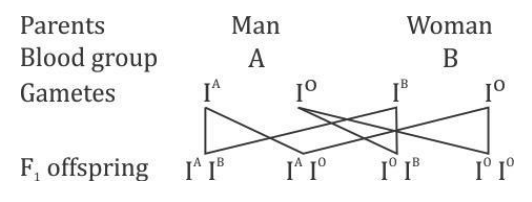
If the parents are heterozygous: man $I^Ai$, woman $I^Bi$.
Gametes: $I^A$, $i$ and $I^B$, $i$.
Offspring: $I^AI^B$ (AB), $I^Ai$ (A), $I^Bi$ (B), $ii$ (O).
So all four blood groups A, B, AB and O are possible.
Linkage
-
The term "linkage" was coined by:
-
When a cluster of genes show linkage behaviour they : -Linkage is the tendency of genes located close together on the same chromosome to be inherited together.
Since linked genes move together into the gametes, they do not follow Mendel's law of independent assortment; parental combinations appear more often than new combinations.
Recombination between linked genes is possible through crossing over, but its frequency is less than 50 percent; the stronger the linkage, the less recombination. Linked genes are used to make chromosome maps.
So when genes show linkage behaviour, they do not show independent assortment. -
Independent assortment of genes does not take place when : -Mendel's law of independent assortment holds for genes located on different (non-homologous) chromosomes, which separate independently during meiosis.
Genes located close together on the same chromosome are linked; they tend to be inherited together and do not assort independently.
So independent assortment does not take place when genes are linked and located on the same chromosome.
Codominance
-
A gene showing codominance has:
-
If two persons with 'AB' blood group marry and have sufficiently large number of children, these children could be classified as 'A' blood group : 'AB' blood group : 'B' blood group in 1 : 2 : 1 ratio. Modern technique of protein electrophoresis reveals presence of both 'A' and 'B' type proteins in 'AB' blood group individuals. This is an example of:In the AB blood group both alleles $I^A$ and $I^B$ express themselves fully, producing both A and B type proteins. This is codominance.
-
Which Mendelian idea is depicted by a cross in which the $F_1$ generation resembles both the parents?In co-dominance both alleles are expressed in the heterozygote, so the $F_1$ generation resembles both parents, as in the AB blood group.
Gene interaction
-
Fruit colour in squash is an example of:In summer squash a dominant allele (W) masks the effect of the colour gene, giving a 12 : 3 : 1 ratio. This is dominant epistasis.
Incomplete dominance
-
$F_2$ generation in a Mendelian cross showed that both genotypic and phenotypic ratios are same as 1 : 2 : 1. It represents a case ofIn incomplete dominance the heterozygote has an intermediate phenotype, so each genotype has its own phenotype.
In Mirabilis jalapa or snapdragon the $F_2$ shows 1 red (RR) : 2 pink (Rr) : 1 white (rr), so the phenotypic and genotypic ratios are both 1 : 2 : 1.
With complete dominance the phenotypic ratio would be 3 : 1. -
In $Antirrhinum$ two plants with pink flowers were hybridized. The $F_1$ plants produced red, pink and white flowers in the proportion of 1 red, 2 pink and 1 white. What could be the genotype of the two plants used for hybridization? Red flower colour is determined by RR, and white by rr genes.In $Antirrhinum$ (snapdragon) flower colour shows incomplete dominance: RR is red, rr is white and the heterozygote Rr is pink, because R is not completely dominant over r.
Both parent plants are pink, so each must be Rr.
Cross: $Rr \times Rr$; gametes from each parent: R and r.
Offspring: 1 RR : 2 Rr : 1 rr
Phenotypes: 1 red : 2 pink : 1 white, exactly as observed (phenotypic ratio = genotypic ratio).
Hence the genotype of both plants is Rr.
Mutation
-
Which one of the following is a wrong statement regarding mutations?A mutation is a change in the DNA sequence that alters the genotype and phenotype.
A change in even a single base pair of DNA is a mutation, called a point mutation. The classical example is sickle-cell anaemia, in which a single base substitution (GAG → GUG in the codon) replaces glutamic acid by valine in the $\beta$-globin chain.
So the statement that a single base pair change does not cause mutation is wrong.
Deletions and insertions of base pairs shift the reading frame and cause frame-shift mutations (true).
Chromosomal aberrations are commonly observed in cancer cells (true), and UV and gamma radiations are physical mutagens (true).
Hence the wrong statement is 'Change in a single base pair of DNA does not cause mutation'. -
Mutations can be induced withAgents that induce mutations are called mutagens; they change the base sequence or structure of DNA.
High-energy ionising radiations such as gamma rays and X-rays (and non-ionising UV rays) are physical mutagens that damage DNA and cause breaks in chromosomes.
Gamma radiations are used in mutation breeding of crops, e.g., to obtain disease-resistant mung bean.
Infra-red radiation has too little energy to alter DNA; it only produces heat.
IAA (an auxin) and ethylene are plant growth regulators, not mutagens.
Hence mutations can be induced with gamma radiations. -
Point mutation involvesA mutation that arises from a change in a single base pair of DNA is called a point mutation.
The classical example is sickle-cell anaemia, in which a single base substitution (GAG to GUG in the codon for the sixth amino acid of the β-globin chain) replaces glutamic acid by valine.
Deletions and insertions of base pairs cause frame-shift mutations, and duplication is a chromosomal change.
Hence a point mutation involves a change in a single base pair. -
Haploids are more suitable for mutation studies than the diploids. This is because:Most mutations are recessive.
A diploid organism has two alleles for every gene, so a recessive mutation is masked by the dominant normal allele in the heterozygous condition and is not seen in the phenotype.
A haploid organism has only one set of chromosomes and therefore only one allele of each gene.
There is no second allele to mask the mutant one, so every mutation, whether dominant or recessive, is expressed immediately in the phenotype.
This makes the detection of mutations easy, which is why haploids (for example Neurospora, and haploid plants raised by anther culture) are preferred for mutation studies.
Haploids are not more abundant, not reproductively more stable, and mutagens do not penetrate them more effectively.
So the reason is that all mutations, whether dominant or recessive, are expressed in haploids.
Sex determination in humans
-
Which one of the following conditions of the zygotic cell would lead to the birth of a normal human female child?Humans have 23 pairs of chromosomes: 22 pairs of autosomes and one pair of sex chromosomes (2n = 46).
A normal female has the constitution 44 + XX and a normal male has 44 + XY.
The ovum always carries an X; if it is fertilised by an X-bearing sperm the zygote is XX and develops into a female child.
A zygote with one X and one Y develops into a male; only one X (XO) gives Turner's syndrome, a sterile abnormal female; a zygote with only a Y is not viable.
Hence a zygote with two X chromosomes leads to the birth of a normal female child. -
Male XX and female XY sometimes occur due toMaleness in humans is determined by the SRY gene (sex-determining region of Y), located near the tip of the Y chromosome's short arm.
During meiosis in the father, an abnormal crossing over between the X and Y chromosomes can transfer the SRY region from Y to X.
An XX zygote that receives an X carrying SRY develops as a male (XX male), while an XY zygote whose Y has lost SRY develops as a female (XY female).
So these conditions occur due to transfer of segments between the X and Y chromosomes.
Multiple alleles and co-dominance
-
ABO blood grouping is controlled by gene I which has three alleles and shows co-dominance. There are six genotypes. How many phenotypes in all are possible?The gene I has three alleles: $I^A$, $I^B$ and i. $I^A$ and $I^B$ are dominant over i and co-dominant with each other.
Genotypes $I^AI^A$ and $I^Ai$ give blood group A.
Genotypes $I^BI^B$ and $I^Bi$ give blood group B.
Genotype $I^AI^B$ gives blood group AB, and genotype ii gives blood group O.
So the six genotypes give four phenotypes: A, B, AB and O. -
ABO blood groups in humans are controlled by the gene I. It has three alleles – $I^A$, $I^B$ and i. Since there are three different alleles, six different genotypes are possible. How many phenotypes can occur?$I^A$ and $I^B$ are completely dominant over i, and they are co-dominant with each other.
The six genotypes are $I^AI^A$, $I^Ai$, $I^BI^B$, $I^Bi$, $I^AI^B$ and ii.
$I^AI^A$ and $I^Ai$ both give blood group A.
$I^BI^B$ and $I^Bi$ both give blood group B.
$I^AI^B$ gives blood group AB (both antigens expressed) and ii gives blood group O.
So four phenotypes are possible: A, B, AB and O.
Mendel's laws
-
Which one of the following cannot be explained on the basis of Mendel's Law of Dominance?The Law of Dominance states: (i) characters are controlled by discrete units called factors; (ii) factors occur in pairs; (iii) in a dissimilar pair of factors one member dominates (dominant) the other (recessive).
So the first three statements are all parts of the Law of Dominance.
The fact that alleles do not blend, and that both the parental characters are recovered as such in the $F_2$ generation, is explained by the Law of Segregation: the two factors of a pair separate during gamete formation so that each gamete receives only one.
Hence the statement about non-blending of alleles and recovery of both characters in $F_2$ cannot be explained by the Law of Dominance.
Sex-influenced and sex-limited traits
-
Select the incorrect statement from the following.Baldness is a sex-influenced trait, not a sex-limited one: the gene is autosomal and is present in both sexes, but it behaves as dominant in males and recessive in females because of the influence of male sex hormones.
Sex-limited traits are expressed in only one sex, e.g., milk production in females or beard in males.
Linkage: genes on the same chromosome tend to be inherited together and do not assort independently, so it is an exception to independent assortment (true).
Galactosemia is caused by the lack of an enzyme of galactose metabolism; it is an inborn error of metabolism (true).
Genetic drift, the random change in allele frequency, is significant in small populations (true).
Hence the incorrect statement is that baldness is a sex limited trait.
Biostatistics and Variation
-
If the mean and the median pertaining to a certain character of a population are of the same value, which of the following is most likely to occurThe mean is the arithmetic average of all the values, and the median is the middle value when the values are arranged in order.
In a normal distribution the values are distributed symmetrically on both sides of the central value, giving a bell-shaped curve.
Because of this symmetry, the mean, the median and the mode coincide in a normal distribution.
In a skewed curve the distribution is not symmetrical, and the mean is pulled towards the longer tail, so the mean and the median differ.
A bi-modal distribution has two peaks, and a T-shaped curve is not a frequency distribution of this kind.
Many characters of a population, such as height, show this kind of continuous variation.
So when the mean and the median have the same value, a normal distribution is most likely.
Monohybrid Cross and Test Cross
-
In pea plants, yellow seeds are dominant to green. If a heterozygous yellow seeded plant is crossed with a green seeded plant, what ratio of yellow and green seeded plants would you expect in F1 generation?Let G be the allele for yellow seeds (dominant) and g the allele for green seeds (recessive).
Heterozygous yellow seeded plant: Gg. Green seeded plant: gg (homozygous recessive).
The cross is Gg x gg, which is a test cross.
Gametes of the heterozygous parent: G and g in equal numbers. Gametes of the green parent: all g.
Offspring: Gg (yellow) and gg (green) in equal numbers.
So the ratio of yellow to green seeded plants is 1 : 1, i.e. 50 : 50.
Law of Independent Assortment
-
A human male produces sperms with the genotypes AB, Ab, aB, and ab pertaining to two diallelic characters in equal proportions. What is the corresponding genotype of this person?The four kinds of sperms contain both A and a, and both B and b, so the person must be heterozygous for both genes.
A person of genotype AaBb forms gametes by the independent assortment of the two pairs of alleles.
A can go with B or b, and a can go with B or b, giving four types of gametes: AB, Ab, aB and ab, in equal proportions (25 percent each).
AaBB would produce only two types of gametes, AB and aB.
AABb would produce only two types, AB and Ab.
AABB would produce only one type, AB.
So the genotype of the person is AaBb.
Drosophila as Experimental Material
-
Which one of the following is the most suitable medium for culture of Drosophila melanogaster ?Drosophila melanogaster is the fruit fly, used by T.H. Morgan for his experiments in genetics.
In nature it lives and breeds on ripe and fermenting fruits, feeding on the yeast that grows on them.
It can therefore be cultured very easily in the laboratory on a simple medium such as ripe banana.
The flies lay their eggs on the fruit, and the larvae feed on it and complete their life cycle in about two weeks.
This ease of culture, along with the short life cycle, the large number of offspring and the clear distinction between the sexes, made Drosophila ideal for genetic studies.
Moist bread, plain agar-agar and cow dung are not its natural food.
So the most suitable medium is ripe banana.
Genotype and Phenotype
-
Phenotype of an organism is the result of -The genotype is the genetic constitution of an organism, i.e. the set of alleles it carries.
The phenotype is the observable expression of its characters: appearance, structure, physiology and behaviour.
The genes set the potential for a character, but how far that potential is expressed depends on the environment (nutrition, temperature, light and so on).
For example, a plant with genes for tallness will not grow tall if it is starved of nutrients, and genetically identical plants can look different in different environments.
So the phenotype = genotype + environment.
Mutations, linkage, cytoplasmic effects and sexual dimorphism each affect only particular characters.
So the phenotype of an organism is the result of genotype and environment interactions.
Extranuclear Inheritance
-
In which mode of inheritance do you expect more maternal influence among the offspring ?Besides the nucleus, genes are also present in the cytoplasm, in the DNA of mitochondria and chloroplasts (plasmagenes).
At fertilisation the egg contributes almost all the cytoplasm of the zygote, while the male gamete contributes practically only its nucleus.
So the cytoplasmic genes of the offspring come almost entirely from the mother.
Characters controlled by them are transmitted only through the female parent; this is called cytoplasmic or maternal inheritance, and reciprocal crosses give different results.
Examples are leaf variegation in Mirabilis jalapa and cytoplasmic male sterility in maize.
In autosomal and X-linked inheritance both parents contribute genes, and Y-linked genes pass only from father to son.
So more maternal influence is expected in cytoplasmic inheritance. -
Genes for cytoplasmic male sterility in plants are generally located in -Cytoplasmic male sterility (CMS) is a condition in which the plant fails to produce functional pollen, while the female parts remain normal.
It is inherited only through the female parent (maternal inheritance), which shows that the responsible genes are outside the nucleus.
The genes responsible are located in the mitochondrial genome; rearrangements in mitochondrial DNA produce abnormal proteins that disturb pollen development.
CMS is very useful in hybrid seed production (for example in maize, sorghum and rice), because it avoids the laborious emasculation of flowers.
Nuclear 'restorer of fertility' genes can restore pollen production in the hybrid.
So the genes for cytoplasmic male sterility are generally located in the mitochondrial genome.
Gamete Formation
-
How many different kinds of gametes will be produced by a plant having the genotype AABbCC ?The number of different kinds of gametes produced $= 2^n$, where $n$ is the number of heterozygous gene pairs.
In the genotype AABbCC, the gene pairs AA and CC are homozygous, and only Bb is heterozygous.
So n = 1.
Number of kinds of gametes $= 2^1 = 2$
The two kinds of gametes are ABC and AbC.
So the plant will produce two different kinds of gametes.
Special Chromosomes: Polytene Chromosomes
-
The salivary gland chromosomes in the dipteran larvae are useful in gene mapping because -The salivary gland cells of dipteran larvae (such as Drosophila and Chironomus) contain giant chromosomes called polytene chromosomes.
They are formed by endoreduplication: the chromosomes replicate repeatedly without any separation or cell division, so each chromosome comes to have about 1000 or more chromatids lying side by side.
Because the chromatids are aligned exactly, they show a characteristic pattern of dark bands and light interbands, and the bands correspond to particular genes.
Changes such as deletions, duplications and inversions can be seen directly in the band pattern, so the genes can be located (mapped) cytologically.
The great length and ease of staining are consequences of this polyteny; the basic reason is endoreduplication.
So they are useful in gene mapping because they have endoreduplicated chromosomes.
Cytoplasmic (Extranuclear) Inheritance
-
Extranuclear inheritance is a consequence of presence of genes in -Extranuclear (cytoplasmic) inheritance is inheritance through genes located outside the nucleus.
Mitochondria and chloroplasts are semi-autonomous organelles. They contain their own circular double-stranded DNA, ribosomes and machinery for protein synthesis.
These organelles pass to the next generation mainly through the cytoplasm of the egg, so such traits show maternal inheritance (e.g. leaf variegation in Mirabilis jalapa, studied by Correns).
Endoplasmic reticulum, lysosomes and ribosomes do not contain genes (DNA).
So extranuclear inheritance is due to genes present in mitochondria and chloroplasts.
Gamete Formation and Independent Assortment
-
A male human is heterozygous for autosomal genes A and B and is also hemizygous for hemophilic gene h. What proportion of his sperms will be abh :-Genotype of the man: Aa Bb $X^hY$ (heterozygous for A and B, and hemizygous for h, i.e. one $X^h$ and a Y).
Assuming independent assortment, each gene pair separates independently into the sperms.
Probability of a sperm getting a $= \dfrac{1}{2}$ (A or a)
Probability of getting b $= \dfrac{1}{2}$ (B or b)
Probability of getting the X with h $= \dfrac{1}{2}$ (the other half of the sperms carry Y)
Probability of an abh sperm $= \dfrac{1}{2} \times \dfrac{1}{2} \times \dfrac{1}{2} = \dfrac{1}{8}$
The man forms $2^3 = 8$ types of sperms in equal proportions (ABh, ABY, Abh, AbY, aBh, aBY, abh and abY), and abh is one of them.
So $\dfrac{1}{8}$ of his sperms will be abh.
Inheritance of Three Genes
-
A self-fertilizing trihybrid plant forms :-A trihybrid plant is heterozygous for three genes, e.g. AaBbCc.
Number of types of gametes $= 2^n$, where n is the number of heterozygous gene pairs: $2^3 = 8$ (ABC, ABc, AbC, Abc, aBC, aBc, abC, abc).
On self-fertilisation, each of the 8 types of male gametes can fuse with each of the 8 types of female gametes.
Number of zygote combinations $= 8 \times 8 = 64$ (the squares of the Punnett square).
(These give 27 different genotypes and 8 phenotypes in the ratio 27 : 9 : 9 : 9 : 3 : 3 : 3 : 1.)
So the plant forms 8 different gametes and 64 different zygotes.
Dihybrid Cross and Test Cross
-
In a plant red fruit (R) is dominant over yellow fruit (r) and tallness (T) is dominant over shortness (t). If a plant with RRTt genotype is crossed with a plant that is rrttGametes of RRTt: RT and Rt (in equal proportion, 1/2 each).
Gametes of rrtt: rt only.
Offspring: RT $\times$ rt = RrTt (red, tall); Rt $\times$ rt = Rrtt (red, short).
So all offspring have red fruit (Rr), because the RRTt parent is homozygous for red.
For height, Tt $\times$ tt gives 1/2 Tt (tall) and 1/2 tt (short).
Ratio: 1 red tall : 1 red short.
So 50% of the offspring will be tall with red fruit. -
Due to the cross between TTRr × ttrr the resultant progenies showed how many percent plants tall, red flowered :Gametes of TTRr: TR and Tr (each 1/2). Gametes of ttrr: tr only.
Offspring: TtRr (tall, red) and Ttrr (tall, white) in equal numbers.
All are tall (Tt), and half are red (Rr).
So 50% of the plants are tall and red flowered.
Cytoplasmic (Maternal) Inheritance
-
One of the parents of a cross has a mutation in its mitochondria. In that cross, that parent is taken as a male. During segregation of $F_2$ progenies that mutation is found in -Mitochondrial DNA is inherited through the cytoplasm.
During fertilisation, the egg contributes almost all of the cytoplasm (and mitochondria) to the zygote. The sperm contributes mainly its nucleus; its few mitochondria are lost or destroyed.
So mitochondrial traits show maternal (uniparental) inheritance: they are passed only through the female parent.
Here the parent with the mitochondrial mutation is the male, so its mitochondria are not transmitted to the $F_1$, and therefore not to the $F_2$ either.
So the mutation is found in none of the progenies.
Mutation: Induced Mutations
-
Which of the following discoveries resulted in a Nobel Prize : -H. J. Muller showed in 1927, working with Drosophila, that X-rays induce mutations, including sex-linked recessive lethal mutations, which he detected with his ClB method.
For this discovery of the production of mutations by X-ray irradiation, Muller received the Nobel Prize in Physiology or Medicine in 1946.
Cytoplasmic inheritance (Correns) and recombination of linked genes as such were not awarded Nobel Prizes; genetic engineering is a technology rather than a single discovery.
So the discovery that X-rays induce sex-linked recessive lethal mutations resulted in a Nobel Prize.
Cytoplasmic Inheritance
-
Genes for cytoplasmic male sterility in plants are generally located in : -Cytoplasmic male sterility (CMS) is the inability of a plant to produce functional pollen, inherited through the female parent (maternally).
It is caused by changes (rearrangements forming new open reading frames) in the mitochondrial genome, which affect the energy supply needed for pollen development.
Nuclear restorer (Rf) genes can restore fertility.
CMS is widely used in producing hybrid seeds (e.g. maize, rice, sorghum), as it removes the need for manual emasculation.
So genes for cytoplasmic male sterility are generally located in the mitochondrial genome. -
Extranuclear inheritance occurs in : -In killer strains of Paramecium aurelia, the killer trait is due to kappa particles, which are present in the cytoplasm (they are symbiotic bacteria).
Kappa particles produce a toxin (paramecin) that kills sensitive strains. They are inherited through the cytoplasm, not through nuclear genes, though a nuclear gene K is needed to maintain them (studied by Sonneborn).
So extranuclear (cytoplasmic) inheritance occurs in killer Paramecium.
Mendel's Experiments: Types of Crosses
-
Two crosses between the same pair of genotypes or phenotypes in which the sources of the gametes are reversed in one cross, is known as : -In a reciprocal cross, the same two parents are crossed twice, with their sexes exchanged. Example: tall (female) × dwarf (male), and dwarf (female) × tall (male).
Mendel used reciprocal crosses and found the same results, showing that the traits he studied were not affected by which parent was male or female (i.e. they were not sex-linked or cytoplasmic).
A test cross is a cross of an individual with a homozygous recessive parent; a dihybrid cross involves two characters.
So such crosses are called reciprocal crosses.
Mendel's Laws: Independent Assortment
-
The genes controlling the seven pea characters studied by Mendel are now known to be located on how many different chromosomes : -The garden pea has 7 pairs of chromosomes (2n = 14).
Later studies showed that the genes for the seven characters studied by Mendel lie on only four different chromosomes (chromosomes 1, 4, 5 and 7).
Some of them are on the same chromosome but far apart, so crossing over is frequent and they still assort nearly independently. Mendel also did not test every pair of characters together, so he did not detect linkage.
So the genes are located on four different chromosomes.
Mendel's Seven Characters
-
Which one of the following traits of garden pea studied by Mendel was a recessive feature : -Mendel's seven pairs of contrasting characters (dominant / recessive):
Seed shape: round / wrinkled. Seed colour: yellow / green. Flower colour: violet / white. Pod shape: inflated / constricted. Pod colour: green / yellow. Flower position: axial / terminal. Stem height: tall / dwarf.
Axial flower position, green pod colour and round seed shape are dominant traits.
Green seed colour is recessive (yellow seed colour is dominant). Note that green is dominant for pod colour but recessive for seed colour.
So the recessive feature is green seed colour. -
According to Mendelism which character is showing dominance :In Mendel's garden pea, the dominant traits include: axial flower position, round seed, yellow seed, green pod, inflated pod, violet flower and tall stem.
Terminal flower position, wrinkled seed and green seed (cotyledon) colour are recessive.
So green pod colour shows dominance.
Sex-limited and Sex-influenced Traits
-
Pattern baldness, moustaches and beard in human males are examples of : -Sex-limited traits are controlled by autosomal genes, but they are expressed in only one sex, because their expression depends on the sex hormones.
The genes for beard and moustache growth are present in both men and women, but they are expressed only in males under the influence of testosterone.
Pattern baldness is also autosomal and expressed mainly in males because of the male hormones (strictly it is described as sex-influenced, since it is dominant in males and recessive in females).
Sex-linked traits, such as haemophilia and colour blindness, are due to genes on the X chromosome.
So these are examples of sex limited traits.
Sex Determination: Genic Balance
-
In Drosophila, the sex is determined by : -In Drosophila, sex is determined by the genic balance mechanism proposed by C. B. Bridges.
Sex depends on the ratio of the number of X chromosomes (X) to the number of sets of autosomes (A), i.e. the X/A ratio. The Y chromosome does not decide sex (it is needed only for male fertility).
X/A = 1 (e.g. XX + 2A): female. X/A = 0.5 (e.g. XY + 2A): male. X/A between 0.5 and 1: intersex. X/A greater than 1: metafemale; less than 0.5: metamale.
Determination by fertilised or unfertilised egg (haplodiploidy) occurs in honeybees.
So in Drosophila, sex is determined by the ratio of the number of X chromosomes to the sets of autosomes.
Linkage Maps
-
Genetic Map is one that : -A genetic (linkage) map shows the relative positions (sites) of genes on a chromosome and the distances between them.
It is prepared from the recombination frequencies between linked genes: 1 percent recombination = 1 map unit (centimorgan). Alfred Sturtevant made the first genetic map in Drosophila.
So a genetic map is one that establishes the sites of the genes on a chromosome. -
There are three genes a, b and c. The percentage of crossing over between a and b is 20%, b and c is 28% and a and c is 8%. What is the sequence of genes on chromosomeMap distance is proportional to the frequency of crossing over: a–b = 20 units, b–c = 28 units, a–c = 8 units.
The largest distance (b–c = 28) is between the two genes at the ends.
The third gene, a, lies between them: b–a + a–c = 20 + 8 = 28 = b–c.
[add image: linkage map b ---20--- a --8-- c]
So the sequence of genes on the chromosome is b, a, c.
Monohybrid Cross
-
A plant of $F_1$-generation with genotype \"AABbCC\"". On selfing of this plant what is the phenotypic ratio in $F_2$-generation : -"In the genotype AABbCC, only the gene pair B/b is heterozygous; AA and CC are homozygous.
On selfing, AA $\times$ AA gives all AA and CC $\times$ CC gives all CC, so these genes do not produce any variation in phenotype.
Bb $\times$ Bb gives BB : Bb : bb = 1 : 2 : 1, i.e. 3 dominant : 1 recessive in phenotype.
So the cross behaves like a monohybrid cross, and the phenotypic ratio in $F_2$ is 3 : 1.
X-linked Dominant Inheritance
-
A diseased man marries a normal woman. They get three daughters and five sons. All the daughters were diseased and sons were normal. The gene of this disease is : -A father gives his X chromosome to all his daughters and his Y chromosome to all his sons.
If the disease gene is on the X chromosome and is dominant, the affected father ($X^AY$) passes $X^A$ to every daughter, so all daughters are affected, even with a normal mother ($X^aX^a$).
Sons receive the father's Y and the mother's normal X, so all sons are normal.
Cross: $X^AY \times X^aX^a \rightarrow X^AX^a$ (all daughters affected) and $X^aY$ (all sons normal).
This exactly matches the family. An autosomal or X-linked recessive gene would not give this pattern with a normal mother.
So the gene of this disease is sex linked dominant.
Molecular Basis of Mendel's Traits
-
Mendel obtained wrinkled seeds in pea due to deposition of sugars instead of starch. It was due to which enzyme : -The R gene of pea codes for starch branching enzyme (SBE1), which converts amylose into amylopectin.
In rr plants, a mutation (a transposon insertion) makes this enzyme non-functional. Less starch is made and more sugar accumulates in the seed.
The extra sugar draws in water by osmosis while the seed develops; when the seed matures and dries, it loses this water and shrinks, so it becomes wrinkled.
So wrinkled seeds were due to the absence of the starch branching enzyme.
Gene Interaction: Complementary Genes
-
Ratio of complementary genes is : -Complementary genes are two non-allelic dominant genes that produce a character only when both are present together (e.g. purple flower colour in sweet pea, studied by Bateson and Punnett).
In the $F_2$ of a dihybrid cross: 9 $A\_B\_$ show the character, while 3 $A\_bb$ + 3 $aaB\_$ + 1 aabb (= 7) do not.
So the ratio is 9 : 7.
(9 : 3 : 4 is recessive epistasis and 12 : 3 : 1 is dominant epistasis.) -
Two nonallelic genes produce a new phenotype when present together but fail to do so independently then it is called : -Complementary genes are two non-allelic dominant genes that interact to produce a new phenotype only when both are present together; neither alone produces it.
Example: in sweet pea, purple flowers appear only when both C and P are present; CCpp and ccPP are both white.
Epistasis is when one gene masks the effect of another gene, and polygenes add up their effects (quantitative inheritance).
So such genes are called complementary genes.
Co-dominance
-
When dominant and recessive alleles express themselves together it is called : -In co-dominance, both alleles of a gene express themselves fully in the heterozygote; neither masks the other.
Example: in the ABO blood group, $I^A$ and $I^B$ are both expressed in $I^AI^B$ (blood group AB); in cattle, red and white give roan.
In dominance only the dominant allele is expressed, and in incomplete dominance the heterozygote is intermediate.
So when both alleles express themselves together, it is called co-dominance.
Linkage: Test Cross
-
A and B genes are linked. What shall be genotype of progeny in a cross between AB/ab and ab/ab : -With complete linkage, the heterozygote AB/ab forms only parental gametes: AB and ab.
The homozygous recessive parent ab/ab forms only ab gametes.
Progeny: AB $\times$ ab = AB/ab (AaBb) and ab $\times$ ab = ab/ab (aabb), in a 1 : 1 ratio.
(If crossing over occurred, a few recombinants Aabb and aaBb would also appear.)
So the progeny genotypes are AaBb and aabb.
Sex Determination: Probability
-
Probability of four sons to a couple is : -In humans, the probability of each child being a son is $\dfrac{1}{2}$, because the father's sperm carries X or Y in equal numbers.
Each birth is independent, so the probability of four sons in four births is $\left(\dfrac{1}{2}\right)^4$.
$= \dfrac{1}{16}$
Dosage Compensation: Barr Body
-
Number of Barr bodies in XXXX female : -In mammals, only one X chromosome remains active in each cell; all extra X chromosomes are condensed and inactivated as Barr bodies (Lyon hypothesis).
Number of Barr bodies = number of X chromosomes $- 1$.
For XXXX: $4 - 1 = 3$ Barr bodies.
(A normal XX female has 1 Barr body, and a normal male has none.)
Rh Factor and Erythroblastosis Foetalis
-
Erythroblastosis foetalis is caused when :If an $Rh^-$ mother carries an $Rh^+$ foetus (the foetus gets the Rh antigen from an $Rh^+$ father), some foetal RBCs can enter the mother's blood at delivery.
The mother then forms anti-Rh antibodies. In a later pregnancy with an $Rh^+$ foetus, these antibodies cross the placenta and destroy the foetal RBCs, causing severe anaemia and jaundice (haemolytic disease of the newborn).
It can be prevented by giving anti-Rh antibodies (anti-D) to the mother after the first delivery.
So erythroblastosis foetalis occurs when the female is $Rh^-$ and the male is $Rh^+$.
That is every question in Principles of Inheritance and Variation.
Want a score?
Answers here are not saved. Practise as a test to be marked and see your progress.
Practise as a testQuestions per paper
Asked in 16 of the last 16 papers (2017–2026).
- 2026: 7 questions
- 2026 Re-NEET: 3 questions
- 2025: 3 questions
- 2024: 6 questions
- 2024 Re-NEET: 6 questions
- 2023: 5 questions
- 2023 Manipur: 7 questions
- 2022: 6 questions
- 2022 Phase 2: 6 questions
- 2021: 2 questions
- 2020: 4 questions
- 2020 Phase-2: 3 questions
- 2019: 5 questions
- 2019 Odisha: 4 questions
- 2018: 4 questions
- 2017: 5 questions
Concepts tested
- Test cross 4
- ABO blood groups 3
- ABO blood group inheritance 2
- Autosomal recessive inheritance 2
- Chromosomal disorders 2
- Chromosomal theory of inheritance 2
- Codominance 2
- Colour blindness cross 2
- Gene order from recombination frequencies 2
- Linkage 2
- Linkage prevents independent assortment 2
- Multiple alleles - ABO blood groups 2
- Pleiotropy 2
- Point mutation 2
- Punnett square 2
- Quantitative traits 2
- Sturtevant and gene mapping 2
- Trisomy 21 2